QIDI Q2 3D Printer Review – CoreXY Enclosed High-Speed Printer
QIDI Q2 3D Printer
If you have been watching the 3D printing market lately, you have probably noticed a wave of new machines promising professional-grade performance at beginner-friendly prices. The QIDI Q2 3D printer is one of the most talked-about newcomers in this space, and for good reason. Launched in 2025 by QIDI Tech — a company with over a decade of experience building desktop 3D printers — the Q2 is positioned as a redefinition of what an entry-level machine can actually do.
What makes the QIDI Q2 review conversation so interesting is that this printer does not feel like a compromise. It packs features that, until recently, were exclusive to machines costing twice as much or more: a fully enclosed heated chamber, a CoreXY motion system, a next-generation auto-leveling mechanism, high-speed printing, broad filament compatibility, and even optional multicolor capability. All of this comes in at a retail price of $499 — a figure that turns heads in any serious conversation about desktop FDM printing.
QIDI describes the Q2 as a printer designed “for DIYers, families, designers, and you,” which captures its broad appeal nicely. Whether you are a complete beginner setting up your first machine, a hobbyist who wants to print engineering-grade materials at home, or a small business owner who needs reliable output without enterprise-level costs, the Q2 is built to serve. It also comes with MET certification — making it the first entry-level 3D printer to earn this US safety credential — which signals that QIDI takes home use seriously on every level, not just performance.
In this detailed QIDI Q2 review, we will walk through every major aspect of the printer: its design philosophy, mechanical architecture, build volume, heating systems, supported materials, printing speed, software ecosystem, connectivity, and ultimately, whether it earns its place on your workbench.
QIDI Q2
High-Speed 3D Printer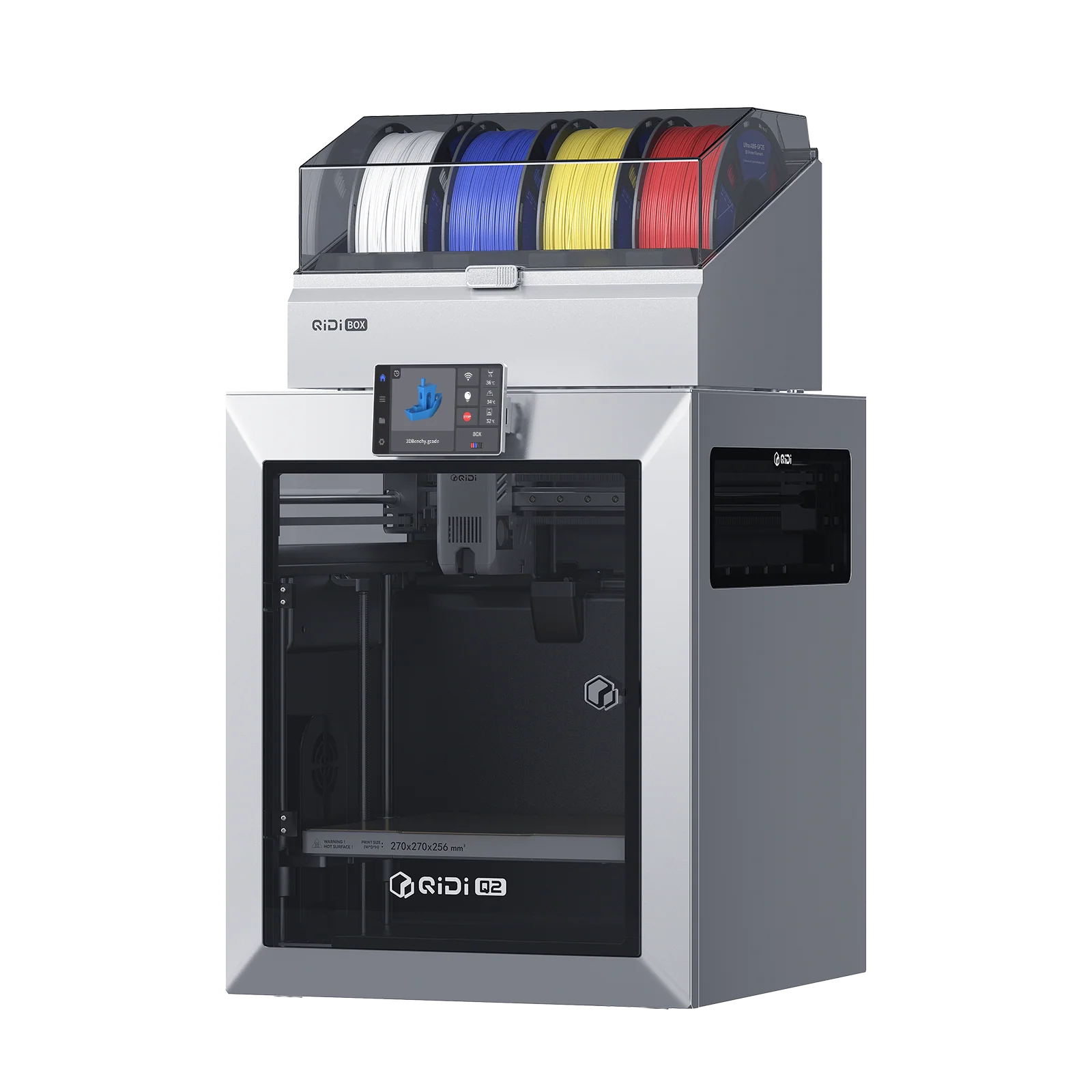
Professional FDM Printer
Next-generation high-speed 3D printer from QIDI Tech. Advanced CoreXY mechanics, intelligent features, and reliable performance for professionals and enthusiasts.
2. QIDI Q2 Design and Build Quality
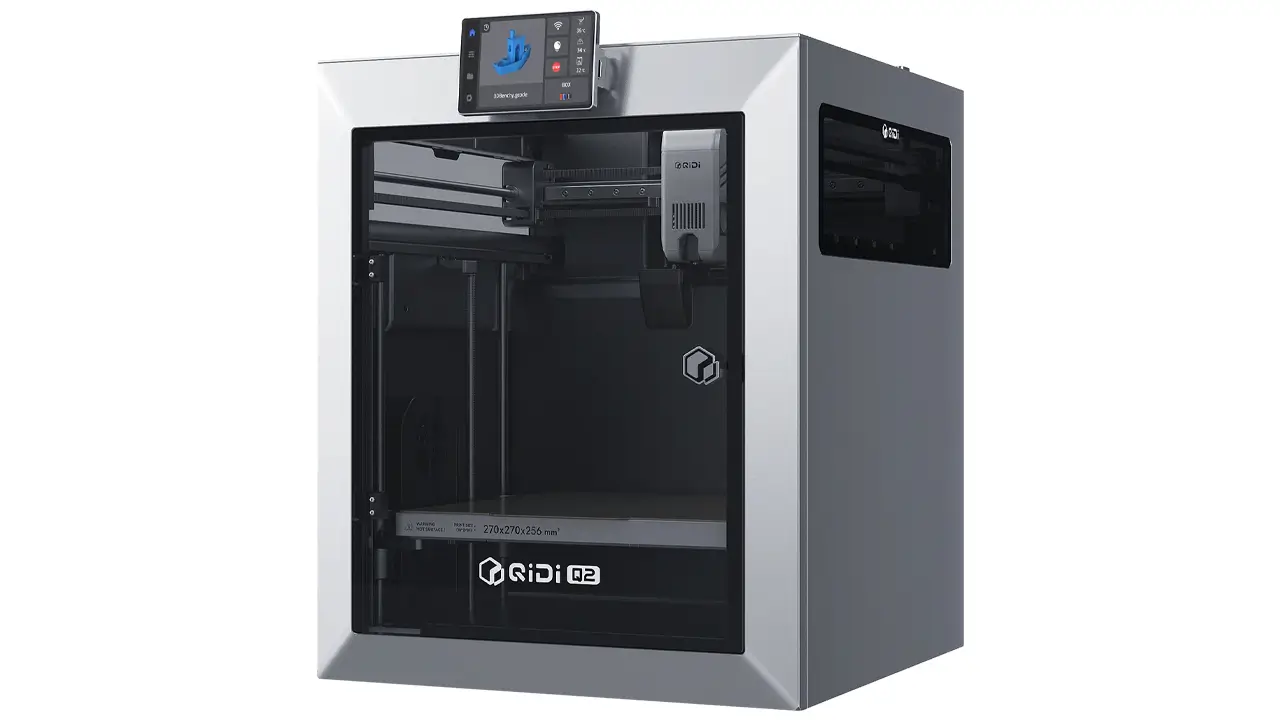
The first thing you notice about the Q2 is how solid it feels. This is a QIDI Q2 enclosed 3D printer, meaning the entire print area is surrounded by walls, a top cover, and a front door — an approach that has become increasingly popular among machines aimed at serious users. But the Q2 does not just use enclosure as a marketing checkbox. The design is deliberately engineered around it.
The outer dimensions of the printer are 402 × 438 × 494 mm, which makes it a mid-sized machine that fits comfortably on a desk or workshop shelf. The full metal frame and precision bearings inside the enclosure give it a rigidity that you would expect from a much more expensive machine. QIDI uses flame-retardant materials throughout the construction, which is an important safety detail for a machine that runs at high temperatures inside a sealed chamber.
The front panel features a 4.3-inch color touchscreen with a resolution of 480 × 272 pixels — not the largest display in the category, but responsive and well-organized. The interface provides real-time feedback on print progress, temperatures, and system status, keeping you informed without requiring you to open a companion app every few minutes.
The lid of the Q2 is a sliding design rather than a hinged door on top. This is a thoughtful ergonomic choice: when you are printing PLA or PETG, which prefer cooler ambient conditions, you can leave the lid partially open to let some heat escape. For high-temperature materials like ABS or PC, you slide it fully closed to preserve the chamber warmth. It is a small detail that makes a real difference in practice.
The 3-in-1 air filtration system is another standout design feature. It combines a G3 pre-filter for large particles, an H12 HEPA filter for fine dust and particulates, and an activated carbon layer to capture VOCs (volatile organic compounds) released during printing. This trifecta of filtration makes the Q2 genuinely suitable for use in living rooms, offices, or classrooms — not just garages or workshops.
3. CoreXY Motion System
At the mechanical heart of the Q2 is a QIDI Q2 CoreXY printer architecture, and this choice has a major impact on everything from print quality to maximum speed.
In a CoreXY system, the printhead moves in both the X and Y directions simultaneously using two motors and a crossed belt arrangement. Unlike bed-slinger designs — where the print bed moves back and forth during printing — CoreXY keeps the bed stationary on the vertical axis during lateral movement, reducing the inertia that the system has to manage. The result is faster acceleration, better dimensional accuracy at speed, and significantly reduced vibration artifacts at the print surface.
QIDI has pushed this architecture further with several proprietary enhancements. The Q2 uses a custom 1.5GT belt, which features a higher tooth density than standard GT2 belts. This increased density results in smoother motion, lower vibration frequency artifacts (VFA), and a cleaner surface finish on printed parts — particularly visible on curved or diagonal surfaces where belt resonance typically shows up as repeating patterns in the filament.
The X-axis uses a high-hardness linear guide rail, which provides a much more stable and precise sliding surface compared to the rod-and-bearing setups found on many lower-cost printers. The Z-axis relies on dual independent lead screw motors, ensuring that both sides of the gantry stay level during vertical movement.
Resonance compensation — sometimes called input shaping — is also built into the system. This feature analyzes and counteracts the natural resonant frequencies of the printer’s structure, allowing it to print at high speeds without introducing ringing or ghosting artifacts in the final output. Combined with the 1.5GT belt and linear rail, the result is a motion system that punches well above its price class.
4. QIDI Q2 Build Volume and Dimensions
One of the most practical considerations for any printer purchase is how big your parts can actually be. The QIDI Q2 build volume stands at 270 × 270 × 256 mm (width × depth × height), which gives you a generous working envelope for a machine of this size and price point.
To put that in perspective, QIDI claims this represents approximately 30% more printing space than comparable entry-level printers — and compared to the Q2’s predecessor, the Q1 Pro, the build volume has increased by 30% while the printer’s overall footprint has actually decreased by 20%. That is a meaningful engineering achievement: more usable space inside a smaller external package.
In practical terms, a 270 × 270 mm footprint means you can print full-scale functional prototypes, large decorative objects, multi-part assemblies laid out flat, or simply batch-print many smaller parts in a single job to save time. The 256 mm of Z-height adds flexibility for tall vases, figurines, architectural models, or vertical mechanical components.
The dual-sided textured PEI build plate provides good adhesion for most common filaments and allows easy part removal once the plate cools — prints typically pop off without needing tools. The plate is compatible with a wide range of materials and surface finishes.
| Parameter | Value |
|---|---|
| Build Volume (W×D×H) | 270 × 270 × 256 mm |
| Printer Dimensions | 402 × 438 × 494 mm |
| Package Dimensions | 480 × 520 × 585 mm |
| Net Weight | 18.1 kg |
| Gross Weight | 23.5 kg |
| Display | 4.3-inch color touchscreen, 480 × 272 px |
5. High-Temperature Hotend and Heated Chamber
This is where the QIDI Q2 truly separates itself from most machines in its price bracket. The QIDI Q2 heated chamber system is a second-generation actively heated design that can reach up to 65°C, and the hotend can achieve temperatures of up to 370°C.
Let’s unpack why these numbers matter. Most entry-level 3D printers have an ambient chamber — meaning the air inside is not actively heated, just passively warmer from the heat of the bed and hotend. This works fine for PLA and PETG, but causes serious problems with engineering materials like ABS, ASA, PC, and nylon. These filaments want to shrink as they cool, and when one layer cools faster than the next, you get warping, delamination, and cracked parts. An actively heated chamber eliminates this problem by keeping the entire print environment at a consistent temperature, layer by layer.
At 65°C, the Q2’s chamber is hot enough to handle ABS, ASA, PC, glass-filled composites, and even advanced materials like PPS-CF. Combined with the 370°C hotend — which uses a ceramic throat and a hardened steel bimetal nozzle — the Q2 is genuinely ready for engineering-grade applications out of the box.
The ceramic throat is a particularly important detail. Standard hotends use PTFE-lined components, which can degrade at temperatures above 240–260°C and release potentially harmful compounds. By using a ceramic throat, QIDI eliminates that risk and enables sustained high-temperature printing without material degradation in the hot zone. The hardened steel nozzle, meanwhile, handles abrasive filaments like carbon fiber composites without wearing out the way a standard brass nozzle would.
The heated bed surface can reach up to 120°C, which provides additional adhesion support for high-temperature materials and allows printing on a warm surface that matches the chamber conditions.
Auto-leveling on the Q2 is handled by an integrated load-cell sensor that uses the nozzle itself as the probe — a “nozzle-as-sensor” approach. Since there is no physical offset between the sensor and the nozzle tip, the system achieves true zero-offset first layer accuracy. This means your first layer is not just good — it is precisely calibrated every single time, regardless of bed surface texture or environmental vibrations.
6. Supported Materials and Filament Compatibility
QIDI Q2 filament compatibility is one of the broadest in the entry-level segment. According to official QIDI documentation, the Q2 supports the following materials:
- PLA — the most common and beginner-friendly filament, easy to print and available in hundreds of colors
- PETG — tougher and more flexible than PLA, excellent for functional parts
- ABS — strong, heat-resistant, widely used in industry
- ASA — UV-resistant variant of ABS, ideal for outdoor applications
- TPU / TPE — flexible and rubber-like; the Q2 supports TPU with a recommended hardness of 95A
- PA (Nylon) — strong, slightly flexible, excellent for mechanical parts
- PC (Polycarbonate) — extremely strong and heat-resistant engineering material
- PLA-CF, PETG-CF, ABS-GF, PAHT-CF, PPS-CF — carbon fiber and glass fiber composites for maximum strength-to-weight performance
Qidi Tech
Shenzhen, China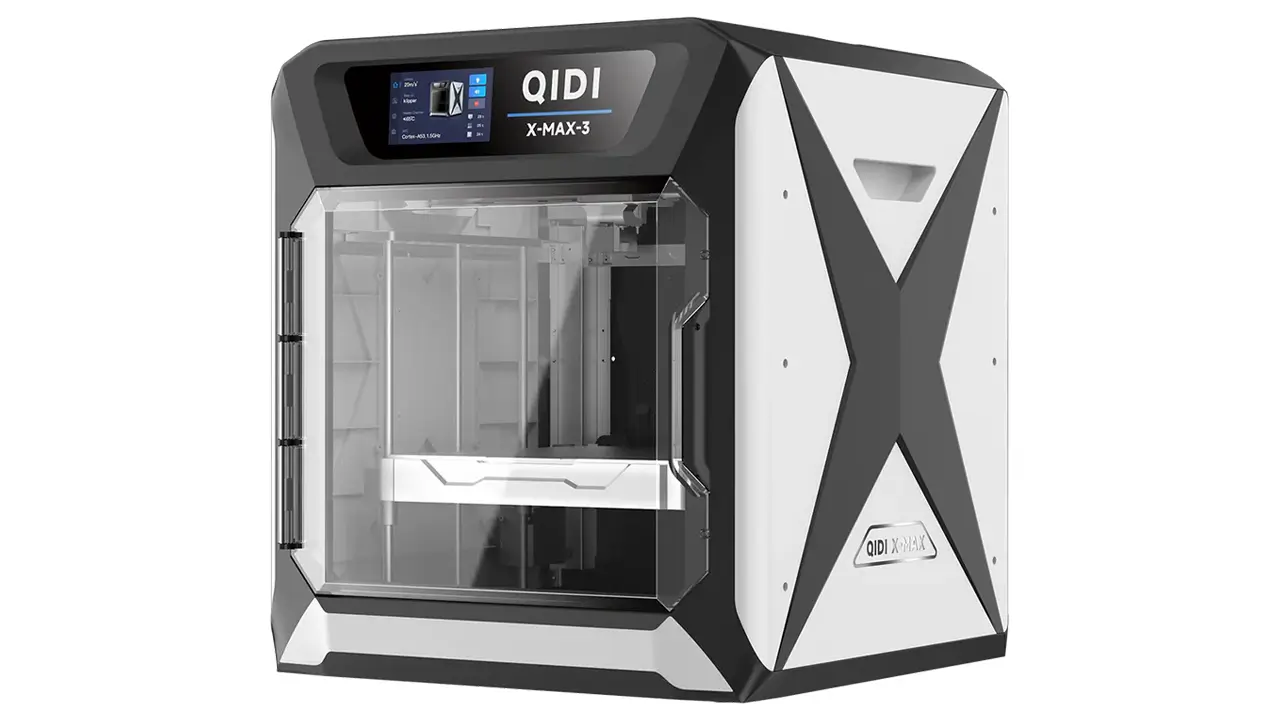
Engineering Printers
Professional-grade printers for engineering materials. Enclosed chambers, high-temperature hotends, and industrial reliability for demanding applications.
| Filament Type | Difficulty Level | Heated Chamber Required |
|---|---|---|
| PLA | Beginner | No |
| PETG | Beginner–Intermediate | No |
| ABS / ASA | Intermediate | Recommended |
| TPU (95A) | Intermediate | No |
| PA (Nylon) | Advanced | Yes |
| PC | Advanced | Yes |
| Carbon Fiber Composites | Advanced | Yes |
| PPS-CF | Expert | Yes |
The dual-gear stepper-motor extruder provides consistent filament drive force, which is especially important for abrasive composites and flexible materials. The hardened steel nozzle ensures that even PLA-CF or PAHT-CF, which quickly wear out brass nozzles, will not degrade print quality over time.
7. Printing Speed and Performance
Speed has become one of the defining battlegrounds in the modern consumer 3D printer market, and the QIDI Q2 printing speed specifications are impressive. The maximum toolhead speed is rated at 600 mm/s, with a maximum acceleration of 20,000 mm/s².
To appreciate what these numbers mean in practice, consider that the average FDM printer from just a few years ago had a practical top speed of around 60–100 mm/s. Today’s high-speed machines have raised that ceiling dramatically, and the Q2 sits firmly in the top tier for its price range.
Of course, maximum speed and real-world printing speed are not the same thing. In everyday use, you will typically print at speeds well below 600 mm/s — the actual speed depends on the material, layer height, print quality setting, and part geometry. However, having a machine capable of 600 mm/s means that even at “medium quality” settings, you are moving faster than many competitors at their maximum. That translates to shorter print times across the board.
The resonance compensation system and the 1.5GT belt work together here to make high-speed printing actually look good. Without resonance compensation, pushing a CoreXY system to 600 mm/s would result in severe ringing artifacts — those ghostly echo patterns that appear on walls and surfaces after sharp direction changes. With it properly tuned, the Q2 can maintain clean surface quality even at aggressive speeds.
The heated bed also contributes to performance. At up to 120°C, it ensures first-layer adhesion stays strong even during long, fast prints where vibration and airflow would otherwise cause adhesion failures.
| Spec | Value |
|---|---|
| Max Toolhead Speed | 600 mm/s |
| Max Acceleration | 20,000 mm/s² |
| Max Hotend Temperature | 370°C |
| Max Bed Temperature | 120°C |
| Max Chamber Temperature | 65°C |
| Motion System | CoreXY with 1.5GT belt + linear rail |
| Leveling | Auto, nozzle-as-sensor load cell |
8. Multicolor Printing with QIDI Box
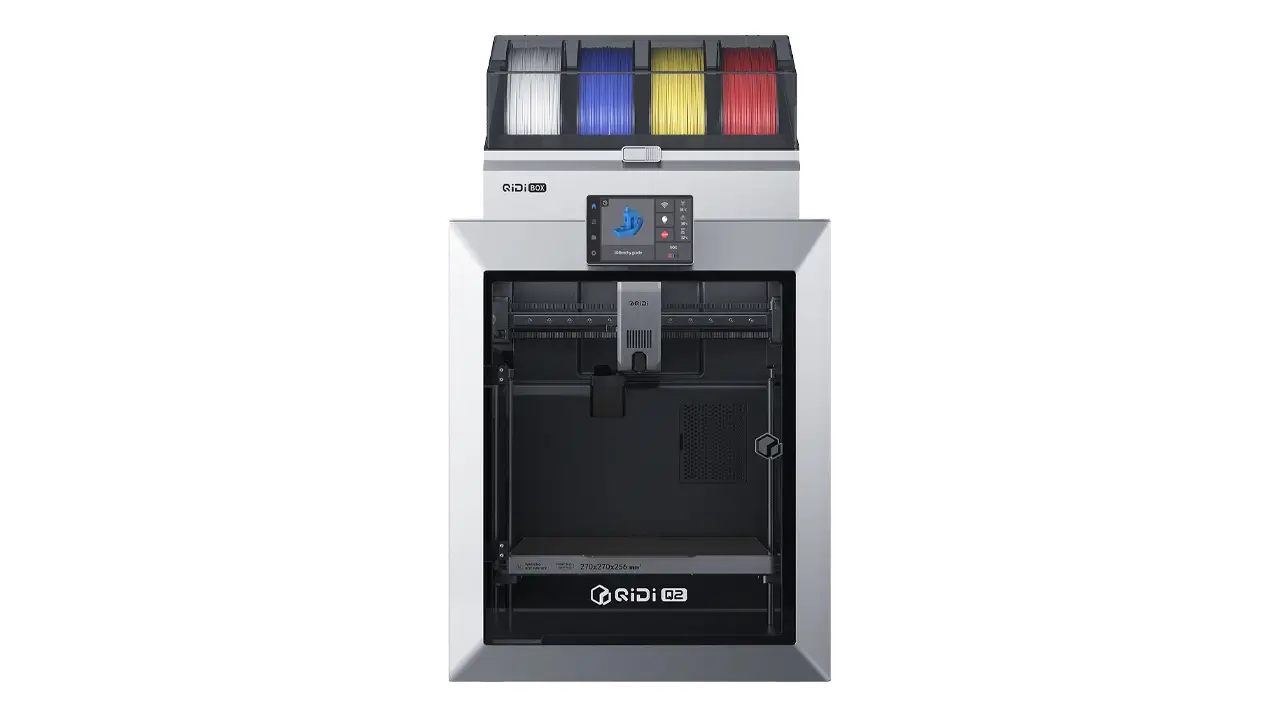
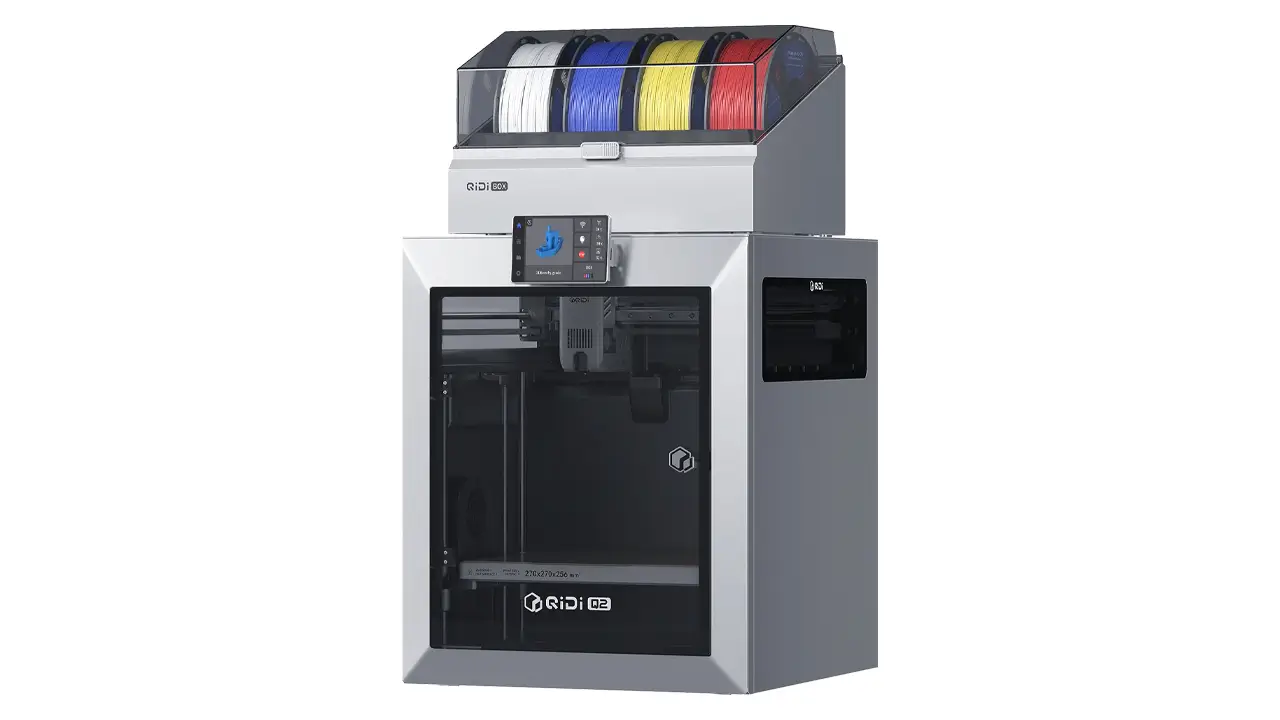
One of the most exciting optional expansions for the Q2 is QIDI Q2 multicolor printing via the QIDI Box accessory. This is a separate automatic filament switching unit that connects to the printer and holds up to four spools at once. Here is where things get really interesting: you can chain up to four QIDI Boxes together, giving the printer access to up to 16 different filaments or colors in a single print job.
The QIDI Box is not just a passive spool holder. It features its own internal heating chamber that reaches up to 65°C, which keeps filaments warm and dry — critical for hygroscopic materials like nylon and PC that absorb moisture from the air and print poorly if not kept conditioned. The box uses a hardened steel extruder for reliable feeding of abrasive and composite filaments, and it includes smart NFC-based filament recognition that automatically applies the correct print settings when QIDI-branded spools are loaded.
For color switching, the QIDI Box uses a filament cutting mechanism — when one material finishes, it cuts the old strand and feeds the next one through. This approach avoids the “purge tower” waste that some multi-material systems generate, though some amount of purging is still involved during transitions.
It is worth noting that as an optional accessory, the QIDI Box adds cost to the overall setup. The base Q2 retails at $499 as a standalone printer; a combo package that includes the QIDI Box is priced at $649. For users primarily interested in single-material high-temperature printing, the standalone version is already an excellent machine. The multicolor capability is a genuine bonus for those who want it, with the flexibility to add it later.
One important note from independent testing: some reviewers have found that the QIDI Box can have friction issues in the filament path that complicate reliable multi-material switching in early production units. QIDI has acknowledged this and the situation may improve with firmware and hardware updates. As always with new accessory launches, it is worth checking the latest community feedback before purchasing the combo version specifically for multicolor use.
9. QIDI Q2 Software and Connectivity
QIDI Q2 specs for software and connectivity are well-rounded for a machine in this category. The printer runs on Klipper firmware — an open-source firmware platform widely used in advanced 3D printers that enables fast processing of print instructions and is highly customizable. Klipper is well-regarded in the community for its flexibility and the quality of its motion planning algorithms.
For slicing, QIDI provides QIDI Studio as the recommended software. QIDI Studio is based on Bambu Studio (itself a fork of the popular open-source slicer PrusaSlicer), so users familiar with either of those applications will find the interface intuitive. It includes pre-configured profiles for all QIDI materials, supports automatic supports, and integrates directly with the printer for one-click job submission.
Because the Q2 runs Klipper, it is also fully compatible with popular third-party slicers, including OrcaSlicer and PrusaSlicer. This is a significant advantage for users who have already invested time in learning those tools and have custom profiles they want to reuse. Supported file formats include STL, OBJ, 3MF, and STEP/STP — covering everything from standard hobbyist exports to full engineering CAD formats.
Connectivity options are comprehensive:
- Wi-Fi — supports both 2.4 GHz and 5 GHz networks
- Ethernet (LAN) — wired connection for stable local network printing
- USB Drive — fully offline printing without any network required
- QIDI Cloud — remote monitoring and print control via QIDI’s cloud infrastructure
The integrated HD camera (up to 1080P) serves multiple roles. It provides live visual monitoring of the print, records time-lapse videos of the process, and uses AI detection to identify printing failures — particularly the dreaded “spaghetti failure” where a print detaches from the bed and the nozzle begins extruding into open air. When detected, the printer can automatically pause to prevent further material waste and potential damage.
| Feature | Details |
|---|---|
| Firmware | Klipper (open-source) |
| Recommended Slicer | QIDI Studio |
| Compatible Slicers | OrcaSlicer, PrusaSlicer |
| File Formats | STL, OBJ, 3MF, STEP/STP |
| Connectivity | Wi-Fi 2.4G/5G, Ethernet, USB, Cloud |
| Camera | Up to 1080P HD with AI failure detection |
| Certifications | MET (US OSHA accredited), IECEE CB |
10. QIDI Q2 Price and Final Verdict
Let us talk about QIDI Q2 price and whether this machine represents good value for the investment.
The standalone QIDI Q2 retails at $499. The combo version, which includes one QIDI Box for multi-material printing, is priced at $649. These figures place the Q2 in a competitive sweet spot — above the very cheapest entry-level machines, but well below the premium enclosed printers from brands like Bambu Lab, which can run $700–$1,000 or more for comparable feature sets.
For $499, you are getting a machine with a 270 × 270 × 256 mm build volume (genuinely large for the price), a 370°C hotend capable of engineering-grade filaments, an actively heated 65°C chamber, CoreXY motion with linear rails and 1.5GT belts, load-cell auto-leveling, 600 mm/s maximum print speed, 3-in-1 HEPA + carbon filtration, a 1080P AI camera, Klipper firmware, and MET safety certification. That is an extraordinary feature list at this price point.
Who is the QIDI Q2 for?
It is an excellent choice for beginners who want a machine that will grow with them as they develop their skills — rather than an entry-level printer they will outgrow in six months. The auto-leveling, enclosed design, and pre-configured slicer profiles mean setup is manageable even for first-timers. At the same time, the engineering material support, open Klipper firmware, and high-speed capability ensure that experienced users will not feel limited.
It is a strong match for hobbyists and makers who want to experiment with ABS, ASA, nylon, or carbon fiber composites but do not want to spend over $1,000 to do it. It is also a solid fit for small businesses, educators, and design studios that need reliable desktop output without an enterprise-level investment.
The QIDI Q2 is perhaps less ideal for users who prioritize multicolor printing above all else — the QIDI Box is an exciting add-on, but early reports suggest it still has room to mature before it becomes a fully seamless experience. For single-material printing, especially with engineering filaments, the Q2 stands on its own very confidently.
Final take: The QIDI Q2 is a thoughtfully engineered, feature-rich 3D printer that delivers genuine professional-grade capabilities at a price that makes them accessible to a wide audience. It is one of the strongest values in the enclosed FDM market today, and a machine worth serious consideration if you are shopping in the $400–$600 range.
Polimerukr.com
Ukraine
3D Printing Materials & Supplies
Your trusted source for high-quality 3D printing materials in Ukraine. Wide selection of filaments, resins, and accessories for all printer types with fast local shipping.
Related
Discover more from bestchina3dprinters.com
Subscribe to get the latest posts sent to your email.