Flashforge Guider 3 Ultra Overview
The world of professional 3D printing is evolving fast, and the Flashforge Guider 3 Ultra 3D printer stands right at the cutting edge of that evolution. Designed from the ground up for industrial and commercial use, this machine is not your typical desktop hobbyist printer. It is a serious piece of engineering equipment built to handle demanding production environments, day in and day out.
Flashforge, a company trusted by over one million users worldwide, developed the Guider 3 Ultra specifically for professionals who need more than just good prints. They need reliability, repeatability, and the ability to work with advanced engineering-grade materials. Whether you are running a small manufacturing workshop, a product design studio, or an R&D lab, this printer was built with you in mind.
What makes the Guider 3 Ultra stand apart from the crowded FDM printer market is its combination of industrial-scale build volume, high-speed CoreXY motion, dual extrusion capabilities, and a sealed enclosure with advanced air filtration. It is, in essence, a mini production machine packed into a well-engineered chassis that can sit on a workbench or factory floor.
In this review, we will walk through everything you need to know about the Flashforge Guider 3 Ultra — from its physical design and motion system to its material compatibility, real-world performance, and overall value for money. If you are considering investing in a large-format professional 3D printer, this article will give you all the information you need to make an informed decision.
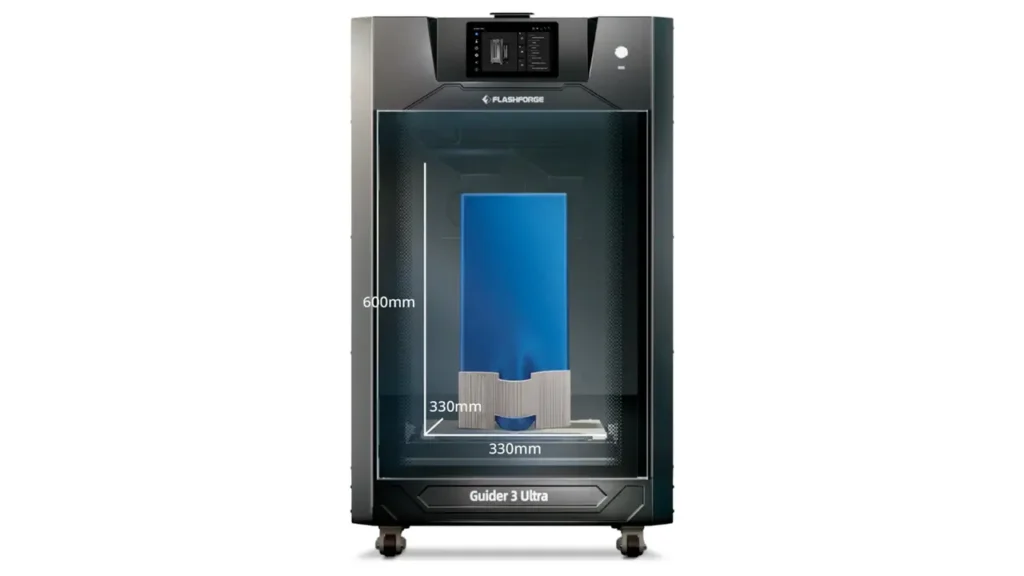
2. Flashforge Guider 3 Ultra Review: First Look
When the Guider 3 Ultra arrives, the first thing you notice is how seriously Flashforge has taken the packaging. The machine weighs over 45 kilograms and arrives on a pallet, surrounded by thick cardboard and dense foam inserts. This is not a printer you casually unbox — it demands respect from the moment it arrives.
Once unpacked, the physical presence of the printer is immediately impressive. The overall machine dimensions are 635 × 550 × 1070 mm, making it a tall, tower-like unit that occupies a meaningful footprint. The frame is built from metal components, giving it a rigidity that you can feel when you grip any part of the structure. There is no flex, no wobble — just solid industrial construction.
The enclosure is fully sealed, which is a major point in its favor. A fully enclosed chamber is essential for printing materials like ABS, ASA, and engineering-grade nylon composites, as it prevents drafts from causing warping and helps maintain a stable thermal environment throughout long print jobs.
The front panel features a large 7-inch capacitive touchscreen that is highly responsive. The interface offers over 65 controls, covering essential print functions including file management, temperature control, movement, calibration, and system configurations, including real-time temperature monitoring and remote camera controls. The touchscreen experience is polished and intuitive, which is refreshing for a machine at this price and capability level.
On the top of the machine, you will find the dual sealed filament chambers — a clever and practical feature that keeps your spools dry and ready for printing. These dual sealed filament chambers effectively ensure that filaments remain in a sealed and dry environment both during the printing process and in the idle state, and the humidity level can be visually checked via an equipped hygrometer.
Overall, the first impression is one of quality and seriousness. This is a machine that looks and feels like it belongs in a professional environment.
3. CoreXY Motion System
At the heart of the Guider 3 Ultra’s performance is its CoreXY motion architecture, and this is where things get genuinely exciting for anyone familiar with motion system design in FDM printers.
The Core-XY structure, with its metal components, provides high rigidity to reduce errors from vibrations or mechanical shifts. Its independently controlled X and Y axes minimize the looseness and inaccuracies common in traditional belt-driven systems, ensuring greater precision and stability in printing.\
In practical terms, this means the print head can move with extraordinary speed and accuracy without introducing the ringing or ghosting artifacts that plague many other fast-printing systems. CoreXY designs keep the print bed moving only along the Z-axis, while the toolhead handles all X and Y movement. This separation of motion responsibilities is key to achieving both speed and quality simultaneously.
The CoreXY mechanism employs two motors working in unison to control movement in both the X- and Y-axes. This coordinated motor control is what enables the machine to achieve its remarkable acceleration figures without sacrificing dimensional accuracy.
For the Z-axis, Flashforge has implemented a dual ball screw design. The Z-axis is composed of two ball screws and four linear shafts. The ball screws are connected to Z-axis stepper motors via belts and control vertical movement, while the linear shafts provide vertical guidance. This dual ball screw arrangement is far more precise and durable than single-screw or threaded-rod designs commonly found in lower-cost printers.
The CoreXY design results in smoother movement, reduced resonance frequency, quiet operation, and reduced misaligned layers. The vibration suppression system, combined with pressure compensation algorithms, ensures that even at maximum speed the output quality remains consistent.
For users running the printer in an office adjacent to workspaces, the quiet operation is a genuine bonus. The machine uses silent stepper drivers, and the overall acoustic profile is notably subdued for a printer of this class.
Flashforge
Jinhua, China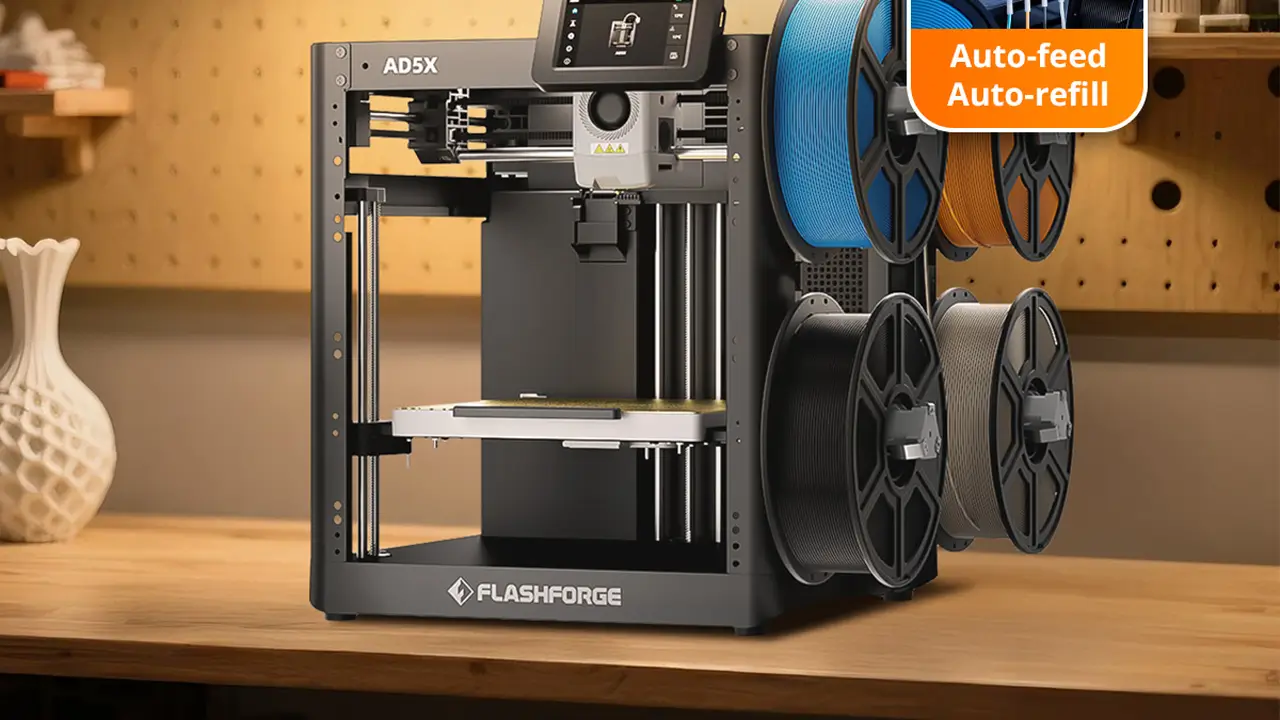
Industrial Stability
Industrial stability with intuitive controls. Reliable mechanics, enclosed enclosures for stable ABS and nylon printing, high-quality assembly for education and professional use.
4. Build Volume and Large Format Printing
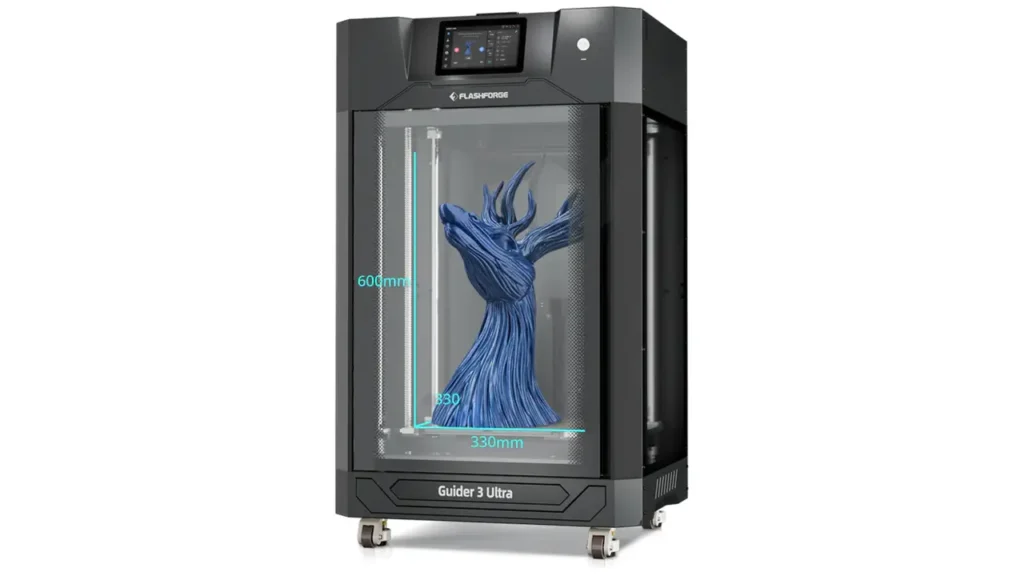
One of the most talked-about features of the Guider 3 Ultra is its build volume, and for good reason. The Flashforge Guider 3 Ultra boasts a substantial 330 × 330 × 600 mm build volume when operating with a single nozzle, but this volume shrinks to 300 × 330 × 600 mm when utilizing both nozzles due to the additional space required for the second extruder.
That 600 mm Z-height is truly exceptional. Very few printers in this price bracket can match that vertical capacity, and it opens up a remarkable range of possibilities. You can print tall architectural models, full-length industrial prototypes, large decorative sculptures, and oversized engineering components all in a single run — no splitting and gluing required.
The breadth of 330 mm and depth of 330 mm (single extruder mode) is equally generous, giving you a footprint that comfortably accommodates large flat parts such as panels, trays, brackets, and enclosures.
To put this into perspective with a real-world example: a gas manifold measuring 84 × 84 × 350 mm with 15% infill printed on the Guider 3 Ultra in 10 hours and 32 minutes, compared to 22 hours and 49 minutes on a competing machine. That kind of time saving is enormously valuable in professional production environments.
The heated bed can reach up to 120°C, which is important for ensuring good first-layer adhesion with demanding materials. The heated bed has pressure sensors at its bottom, enabling fully automatic Z-axis height calibration and leveling for a flawless first layer. This auto-leveling system means you do not need leveling tools or manual Z-axis calibration, which is a significant time saver when working with back-to-back production runs.
The printer comes factory-installed with a flexible PEI steel sheet, ideal for materials like PLA, PETG, PLA-CF, PETG-CF, PETG-GF, PA-CF, and PA-GF. An additional flexible PC steel sheet is also included, recommended for ASA, ABS, PA, and similar materials.
5. Dual Extruder System
The dual extruder system is one of the most technically sophisticated elements of the Guider 3 Ultra, and it is what elevates this printer from a very good single-material machine into a genuinely versatile industrial tool.
The Guider 3 Ultra features a stable dual-extruder and CoreXY structure for exceptional industrial-grade performance, with precise nozzle switching that ensures consistent output.
The dual extruder configuration unlocks two major categories of capability. First, it enables multi-material printing, where you can combine different filament types in a single object — for example, a rigid structural material for the body and a flexible or soluble material for support structures. Second, it allows for different support strategies that dramatically reduce print time and improve surface quality.
The printer supports removable and soluble materials for complex models with overhangs, bridges, and hollow structures. By combining self-supporting and breakaway supports, it reduces support printing time by approximately 50% and ensures easy removal.
The raft support mode is another innovation worth highlighting. When the support uses the same material as the model, it reduces extruder switches and waiting time, cutting model print time by about 70%. This is a substantial productivity gain for anyone printing complex geometry regularly.
Nozzle diameter options include 0.4 mm as the default, with 0.6 mm and 0.8 mm available as optional configurations. The all-metal hotend construction means you can push high-performance composite materials through the system without worrying about degradation of PTFE liners, which is a common failure point on cheaper hotend designs.
The dual-fan cooling system rapidly cools extruded filament, ensuring higher accuracy in high-speed printing. Additionally, the printer features two model cooling fans on each side with comprehensive air ducts, plus two auxiliary fans specifically for rapid cooling during high-speed operations.
6. Printing Speed and Performance
Speed is one of the headline features of the Guider 3 Ultra, and Flashforge has not been shy about the numbers. The printing speed range runs from 10 to 500 mm/s, with a maximum acceleration of 20,000 mm/s² and a maximum travel speed of 500 mm/s.
To put those figures in context, most conventional FDM printers operate comfortably at 50–100 mm/s. Reaching 500 mm/s with 20,000 mm/s² acceleration places the Guider 3 Ultra in the top tier of high-speed FDM machines currently available.
Of course, real-world print speeds vary depending on the material, layer height, and model complexity. With ABS, maximum print speed of 350 mm/s while maintaining decent layer adhesion is achievable without visually affecting the printed parts. For PLA and PETG, higher speeds are typically achievable. For engineering composites like PA-CF and PETG-CF, lower speeds are recommended to ensure proper bonding and dimensional accuracy.
The Guider 3 Ultra’s CoreXY structure and vibration control deliver ±0.15 mm printing precision, with X/Y accuracy of 0.011 mm and Z-axis accuracy of 0.0025 mm. Layer heights range from 0.05 to 0.4 mm, enabling both fine detail and high-speed output.
The vibration suppression system — which uses active vibration compensation or input shaping — is critical to maintaining print quality at these speeds. Without it, high-speed printing typically results in ringing artifacts visible on vertical surfaces. With it enabled, surfaces come out smooth and clean even when running at aggressive speeds.
The printer enhances surface quality with extruder pressure compensation for precise extrusion and smooth first layers, plus vibration suppression that eliminates ringing and ghosting during high-speed additive manufacturing.
7. Technical Specifications
Here is a comprehensive look at the official technical specifications of the Flashforge Guider 3 Ultra:
| Parameter | Value |
|---|---|
| Machine Name | Guider 3 Ultra |
| Extruder Quantity | 2 (Dual) |
| Build Volume (Single) | 330 × 330 × 600 mm |
| Build Volume (Dual) | 300 × 330 × 600 mm |
| Printing Precision | ±0.15 mm |
| X/Y Position Precision | 0.011 mm |
| Z Position Precision | 0.0025 mm |
| Layer Thickness | 0.05 – 0.4 mm |
| Printing Speed | 10 – 500 mm/s |
| Max Acceleration | 20,000 mm/s² |
| Max Nozzle Temperature | 350°C |
| Max Bed Temperature | 120°C |
| Nozzle Diameter | 0.4 mm (default); 0.6 / 0.8 mm (optional) |
| Display | 7-inch capacitive touchscreen |
| Connectivity | USB, Ethernet, Wi-Fi (5G & 2.4G) |
| Air Filtration | HEPA 13 + activated carbon |
| Power Supply | AC 100–240V, 50/60Hz, 850W max |
| Machine Dimensions | 635 × 550 × 1070 mm |
| Software | Orca-Flashforge / FlashPrint 5 / Cura / Slic3r |
| File Formats | STL / 3MF / OBJ / FPP / BMP / PNG / JPEG |
| Warranty | 12 months (machine); 3 months (extruder) |
The motherboard is built around a quad-core Cortex-A53 64-bit MCU with 8 GB of built-in storage, silent drivers, dual-band Wi-Fi, and an AC rapid heating platform. This is a powerful computing core that enables real-time vibration compensation, automatic leveling, pressure compensation, and cloud connectivity simultaneously.
The supported material list is extensive: PLA, ABS, HIPS, ASA, PETG, CoPA, PLA-CF, PETG-CF, PAHT-CF, PAHT-GF, PET-CF, PET-GF, PA12-CF, PA-CF, PA-GF, and NexPA-CF25 are all officially supported, giving professionals access to a truly broad range of engineering-grade composites.
8. Professional Applications
The Flashforge Guider 3 Ultra professional 3D printer is not positioned as a general-purpose consumer device. It is a targeted tool for specific high-value professional workflows, and understanding those workflows helps explain why the design choices make sense.
In engineering and product development, the machine excels at rapid prototyping of functional components. Its applications include end-use parts, rapid development and validation, manufacturing jigs and fixtures, and architectural and art models.
For example, a battery box assembly printed in ABS can be used for dimensional verification and functional testing across multiple kit configurations during the design and R&D phase — a task that would previously have required expensive CNC machining or slow overnight prints on conventional systems.
In manufacturing support applications, the ability to print tooling and jigs in materials like PAHT-CF means factories can produce custom fixtures on demand rather than waiting for machined parts. A tooling component printed in PAHT-CF demonstrated this capability, providing manufacturing auxiliary tools with high stiffness and thermal resistance.
Architectural and design studios benefit from the tall Z-axis particularly. An artistic sculpture printed in PLA-CF showed clean surfaces and fine detail, demonstrating that the machine is equally capable of producing visually polished display pieces as it is functional engineering parts.
Medical model printing is another area of application, where accurate anatomical geometry requires both the large build volume and the precision the Guider 3 Ultra delivers.
The machine is designed for continuous, 24/7 production use, with auto-switching spools ensuring uninterrupted printing and eliminating manual filament change downtime. For small-batch manufacturing operations that need to keep machines running around the clock, this continuous operation capability is a major operational advantage.
9. Price and Market Position
The Flashforge Guider 3 Ultra is priced at $3,999 USD through official Flashforge retail channels, placing it firmly in the mid-range industrial FDM printer segment. Free shipping is available within the continental United States, and the printer includes a 30-day return window and a 12-month warranty on the machine body.
To understand whether this price is justified, it is useful to compare it with what else is available at this level of the market.
| Feature | Flashforge Guider 3 Ultra | Raise3D Pro3 Plus | Modix Big-120Z |
|---|---|---|---|
| Price (approx.) | $3,999 | ~$4,999+ | ~$4,500+ |
| Build Volume | 330×330×600 mm | 305×305×605 mm | 610×610×1200 mm |
| Max Print Speed | 500 mm/s | ~150 mm/s | ~200 mm/s |
| Dual Extruder | Yes | Yes | Single (optional dual) |
| Enclosed Chamber | Yes | Yes | Optional |
| HEPA Filtration | Yes (HEPA 13) | Yes | Optional |
| Chamber Heater | No | Yes | Optional |
The Guider 3 Ultra’s strongest competitive advantage is clearly its print speed combined with its price point. Getting 500 mm/s with dual extrusion and a fully enclosed chamber for under $4,000 is genuinely competitive. The Raise3D Pro3 Plus, for instance, costs more and prints significantly slower, though it does offer an active heated chamber — which the Guider 3 Ultra lacks.
For users who specifically need to print large volumes of high-temperature materials like polycarbonate or high-performance nylon in full-scale format, the absence of a heated chamber is a real limitation worth considering before purchase. For PLA, PETG, ABS, ASA, and carbon fiber composites in moderate sizes, however, the Guider 3 Ultra delivers exceptional throughput for its price.
10. Final Verdict
After covering every major aspect of this machine, it is time to bring it all together with an honest assessment.
The Flashforge Guider 3 Ultra large format 3D printer is a genuinely impressive piece of equipment that delivers on most of its promises. The combination of a 330 × 330 × 600 mm build envelope, 500 mm/s speed capability, dual extrusion, all-metal hotends rated to 350°C, and a HEPA 13 filtered fully enclosed chamber is a compelling package — especially at a price of $3,999.
For professionals in product design, engineering prototyping, tooling production, and architectural modeling, this printer offers a meaningful productivity upgrade over conventional machines. The time savings on large or complex prints are real and significant, as the production time comparisons demonstrated clearly.
The build quality is excellent. The CoreXY frame is rigid and well-engineered. The touchscreen UI is genuinely pleasant to use. The software ecosystem, now centered around Orca-Flashforge with compatibility for Cura and Slic3r, is functional and improving. The printer can accept Klipper-flavored G-code, which means compatibility with various slicers capable of generating this format.
Where does the Guider 3 Ultra fall short? There are a few honest observations worth making. The lack of a heated chamber is a genuine limitation for users who need to print large parts in PC, high-temp nylon, or other warp-prone engineering materials. For smaller parts in those materials — say, 250 × 250 × 250 mm or less — the enclosed chamber provides enough passive warmth to work. But full-build-volume parts in ultra-high-temp composites may require creative workarounds or may simply not be achievable without a chamber heater.
The dual extrusion system, while capable and well-designed, requires thoughtful calibration and proper profile setup to get the best results, particularly with multi-material prints. Getting this right rewards patience and experimentation.
The built-in camera, while useful for remote monitoring, produces time-lapses of limited quality — a minor annoyance rather than a dealbreaker.
On balance, the Flashforge Guider 3 Ultra is an excellent choice for a wide range of professional and semi-industrial 3D printing applications. It is fast, accurate, material-versatile, and competitively priced. For anyone who regularly needs to produce large, complex, or high-performance prints at scale, it represents outstanding value and a meaningful production capability upgrade.
If your workflow demands maximum output, large format parts, and engineering-grade material compatibility — and you can live without an active heated chamber — the Flashforge Guider 3 Ultra deserves a serious look.
Polimerukr.com
Ukraine
3D Printing Materials & Supplies
Your trusted source for high-quality 3D printing materials in Ukraine. Wide selection of filaments, resins, and accessories for all printer types with fast local shipping.
Discover more from bestchina3dprinters.com
Subscribe to get the latest posts sent to your email.