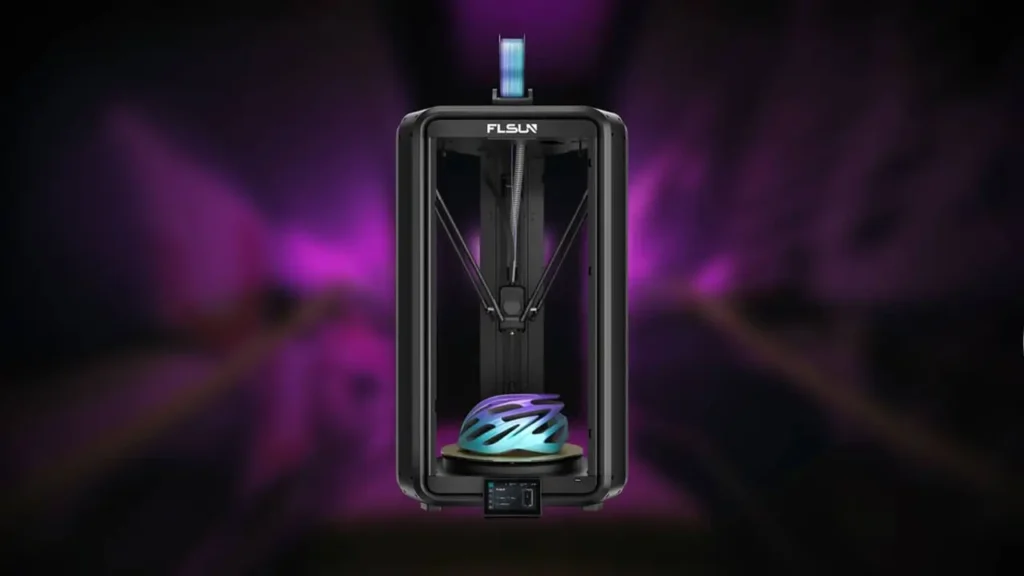
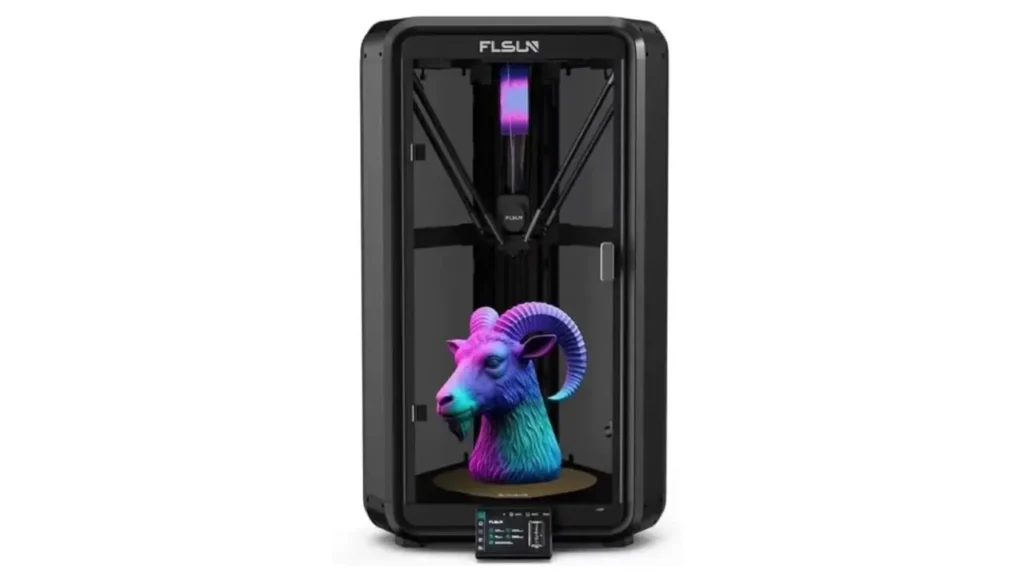
FLSUN T1 MAX 3D Printer
If you’ve been keeping an eye on the world of desktop manufacturing, you’ve probably noticed that speed has become the central conversation. Makers, engineers, and print farm operators all want the same thing: faster output, fewer failures, and a machine that keeps up with real production demands. That’s exactly the gap the FLSUN T1 MAX 3D printer was built to fill.
Officially launched on June 25, 2025, the FLSUN T1 MAX represents the company’s most ambitious delta printer to date. FLSUN describes itself as a global leader in delta 3D printing solutions, and the T1 MAX is their clearest statement of intent yet — a machine engineered from the ground up for print farms, prosumers, and anyone who refuses to compromise between speed and quality.
What makes this ultra fast delta 3D printer genuinely exciting isn’t just one headline number. It’s the combination of extreme speed, a significantly expanded build volume, intelligent automation features, open-source firmware, and a farm-ready open frame design. Whether you’re running a small-batch production line, printing cosplay armor, prototyping mechanical parts, or managing a cluster of machines for commercial output, the T1 MAX positions itself as a serious tool for serious users.
This review walks through every aspect of the machine — specs, performance, strengths, weaknesses, and how it stacks up against the competition in 2026. Let’s dig in.
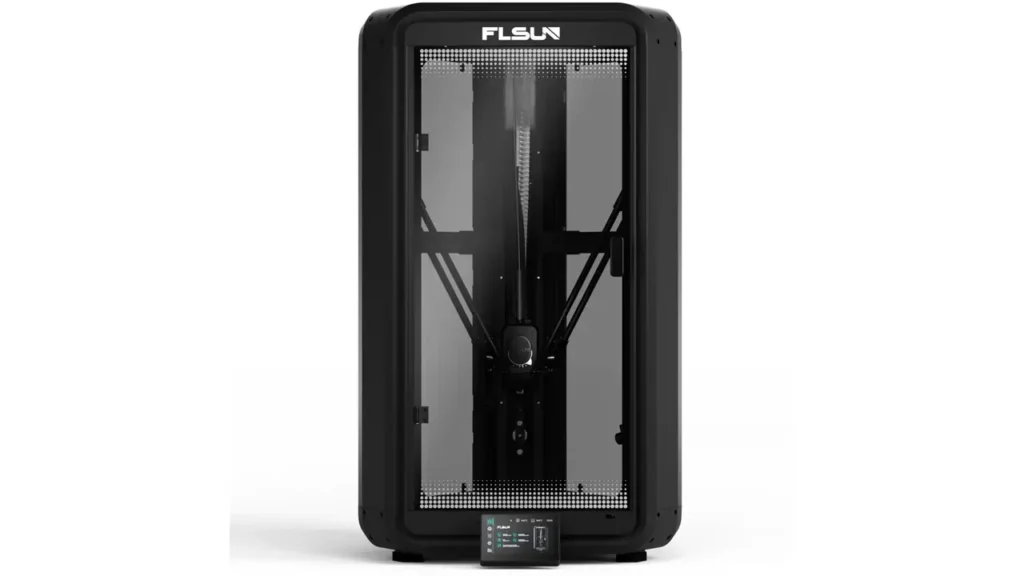
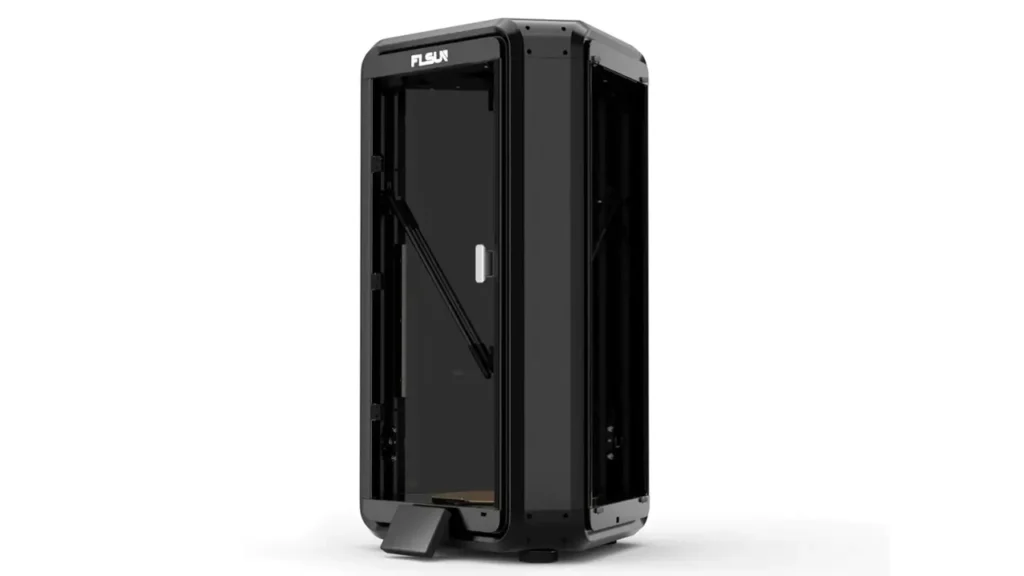
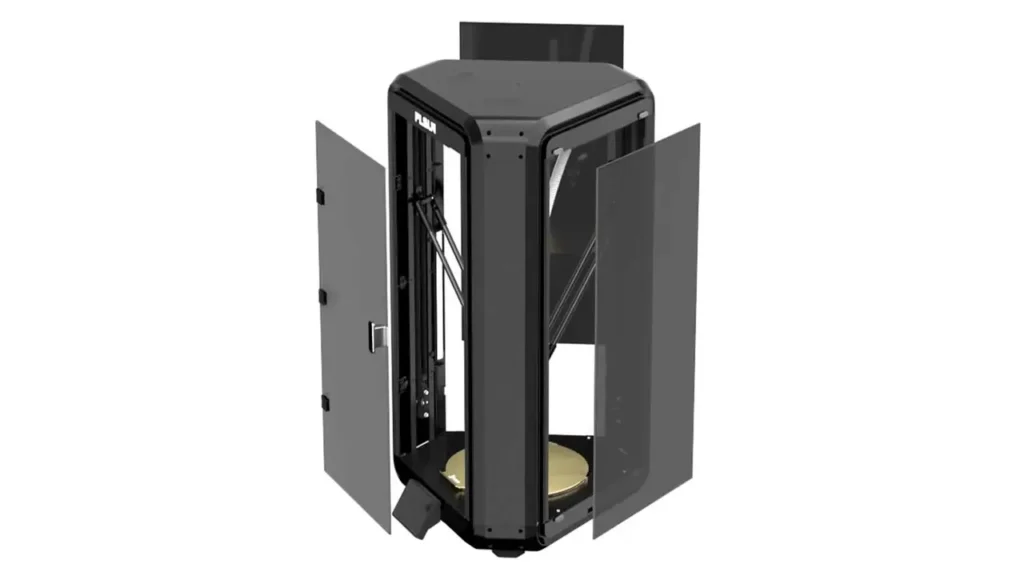
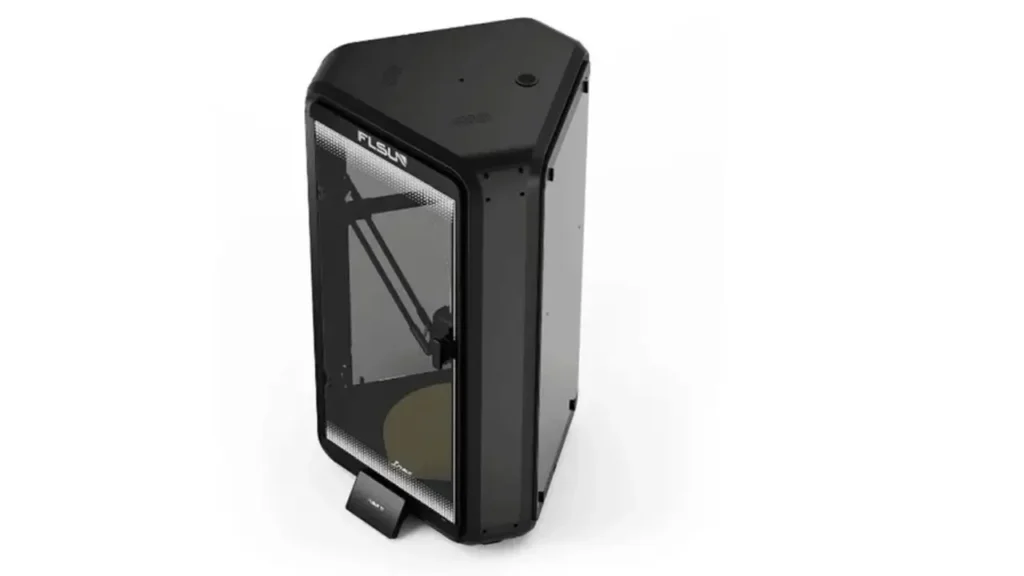
2. Ultra-Fast 1000 mm/s Printing Performance
The number that gets attention first is 1,000 mm/s. That is the maximum print speed FLSUN claims for the T1 MAX, paired with an acceleration of 30,000 mm/s². To put that in perspective, most mainstream FDM printers operate comfortably between 100 and 300 mm/s, with high-speed CoreXY machines pushing up to 500 mm/s under optimal conditions. The T1 MAX doubles that ceiling.
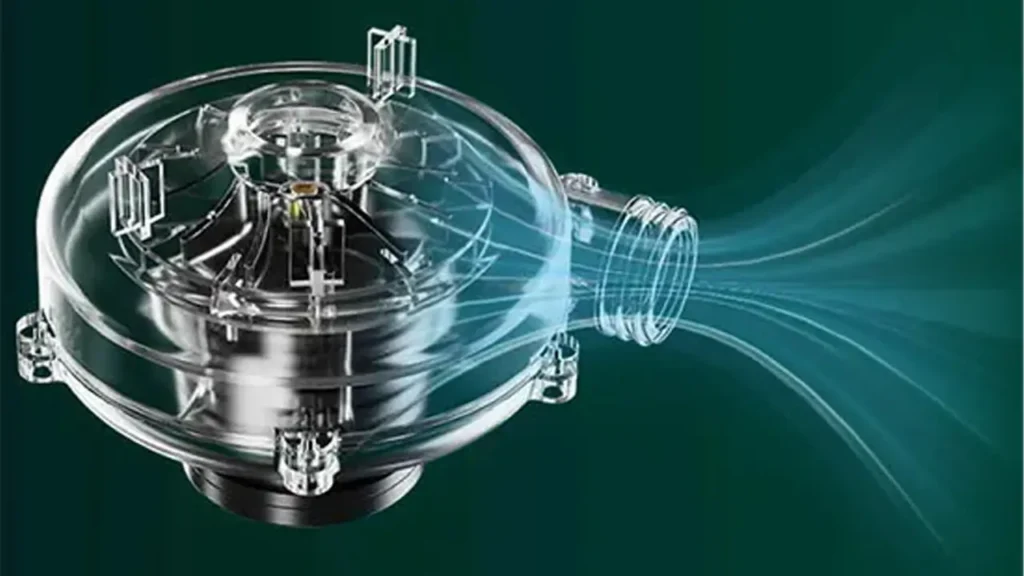
This level of high speed 3D printing is made possible by a combination of hardware upgrades working together. The machine uses a high-temperature hotend capable of reaching 300°C, a dual-gear direct drive extruder designed specifically for high-flow operation, a high-torque stepper motor, and a CPAP turbo blower fan running at 30,000 RPM for layer cooling. Together, these components allow a maximum volumetric flow rate of 90 mm³/s — a figure that is roughly three times higher than comparable machines in a similar price bracket.
In real-world terms, what does 1,000 mm/s actually mean for your workflow? It means that prints which would take four to six hours on a standard printer can be completed in under two hours. For a 1000 mm/s 3D printer operating in a production environment, this translates directly into more parts per day, lower cost per unit, and faster turnaround for clients. A print farm running eight T1 MAX units simultaneously — exactly the configuration used by toy manufacturer Jin Qi Toy Factory in a documented real-world deployment — can achieve output volumes that would previously have required far more machines and floor space.
It’s worth being transparent here: 1,000 mm/s is the maximum rated speed, not the default printing speed for every model. Complex geometries, fine layer heights, and certain materials will run at lower speeds to maintain dimensional accuracy. However, the T1 MAX’s speed ceiling means that even at 60–70% of maximum, you’re still operating significantly faster than most competing machines at their peak.
Innovative vibration compensation technology is built into the firmware to counteract the resonance that naturally occurs at extreme speeds. This is critical — without it, fast printing would produce ringing artifacts in the output. With it, the T1 MAX maintains clean surface quality even when pushing the upper limits of its speed range.
3. Why Delta Architecture Matters
Delta printers occupy a unique position in the FDM landscape. While the market has largely moved toward CoreXY and bed-slinger designs, FLSUN has continued refining delta kinematics — and with the T1 MAX, it’s easy to understand why.
In a delta printer, the print head is suspended by three arms connected to vertical carriages on three towers. All three carriages move simultaneously to position the hotend in three-dimensional space. This parallel arm system has a fundamental mechanical advantage: the moving mass is extremely low. Only the hotend and effector plate move during printing, compared to CoreXY systems where a heavier gantry assembly travels across the frame, or bed-slinger designs where the bed itself moves.
Lower moving mass means lower inertia, which directly enables higher acceleration without the mechanical stress or resonance that would plague heavier systems. This is the core reason why a delta 3D printer for farm applications makes so much physical sense — the architecture is inherently suited to rapid, repetitive motion cycles.
For an industrial delta 3D printer deployed in a farm environment, the structural advantages go further. Delta printers are tall by design, which means they deliver exceptional build height without requiring a larger footprint. They also have fewer horizontal mechanical components that experience wear from repeated linear motion. The T1 MAX’s three-tower open frame is straightforward to inspect, service, and repair — a meaningful consideration when you’re running machines 24 hours a day.
The delta motion system also offers a geometric advantage for circular and organic shapes. Because the print head moves through arcs rather than strict X/Y linear paths, curved surfaces and cylindrical objects are often rendered with slightly smoother geometry than on Cartesian machines. For print farms producing consumer products, decorative items, or functional parts with curved profiles, this translates to less post-processing.
FLSUN’s optimized parallel-arm and effector system on the T1 MAX specifically improves fault detection and simplifies repairs, so that when maintenance is needed, downtime is minimized and the production line returns to operation quickly.
Polimerukr.com
Ukraine
3D Printing Materials & Supplies
Your trusted source for high-quality 3D printing materials in Ukraine. Wide selection of filaments, resins, and accessories for all printer types with fast local shipping.
4. Build Volume and Practical Capacity
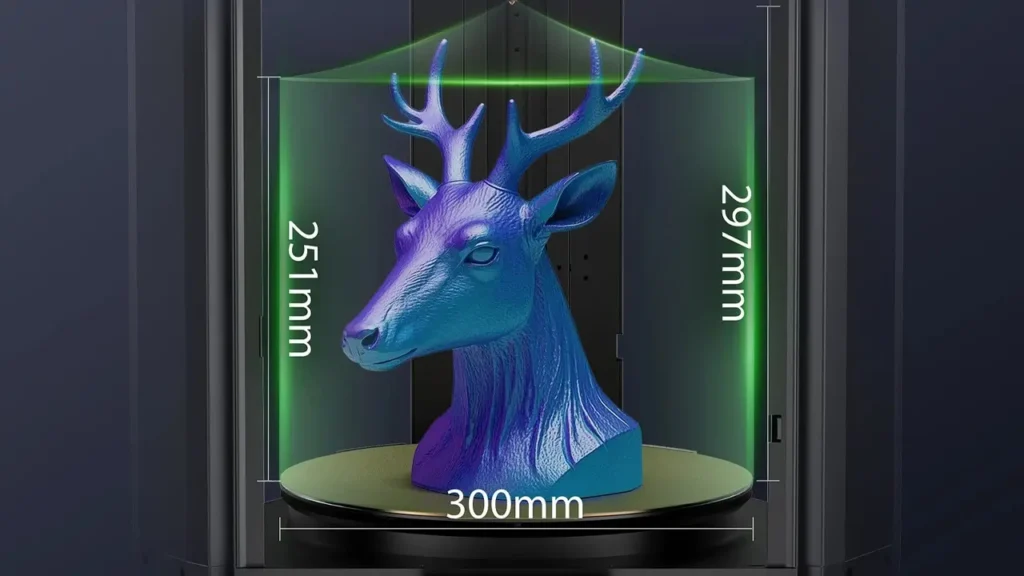
The FLSUN T1 MAX features a build volume of Φ300×297 mm³. This is a cylindrical build area — the Φ300 indicates a 300 mm diameter circular base, with 297 mm of usable vertical height. Compared to the standard FLSUN T1 and T1 Pro, which feature a 260 mm diameter base, the T1 MAX represents a meaningful increase in capacity.
For those more familiar with rectangular build volumes, a 300 mm diameter cylinder accommodates a square object of approximately 200×200 mm — a useful reference point. However, the circular shape is especially advantageous for tall, cylindrical, or radially symmetric objects: vases, helmets, columns, pipes, wheels, and similar forms can be printed in their entirety without splitting into multiple pieces.
For a large build volume delta printer serving a production environment, this matters enormously. Every print that can be completed in a single job rather than split across multiple prints saves assembly time, eliminates visible seams, and reduces the risk of part failure at joint lines. The T1 MAX’s Φ300×297 mm³ volume makes it one of the most spacious consumer-accessible delta printers currently available.
In a print farm context, the larger build area also supports batch printing of smaller parts. Multiple components can be arranged across the full diameter of the build plate in a single job, increasing throughput per print cycle without requiring any additional hardware investment.
The textured PEI-coated build plate provides strong first-layer adhesion for PLA, PETG, and similar materials, while releasing prints cleanly after cooling. Enhanced auto-leveling and improved first-layer detection are built into the firmware, reducing the manual calibration overhead that has historically been a friction point with delta printers.
5. FLSUN T1 MAX Specs Breakdown
Here is a comprehensive overview of the FLSUN T1 MAX specs, compiled from official FLSUN product documentation:
| Parameter | Specification |
|---|---|
| Printing Technology | FDM (Fused Deposition Modeling) |
| Build Volume | Φ300×297 mm³ (cylindrical) |
| Max Print Speed | 1000 mm/s |
| Max Acceleration | 30,000 mm/s² |
| Max Volumetric Flow Rate | 90 mm³/s |
| Hotend Max Temperature | 300°C |
| Heated Bed Max Temperature | 100°C |
| Nozzle | Hardened steel, 0.4 mm |
| Extruder Type | Dual-gear direct drive (HT) |
| Cooling System | CPAP turbo fan, 30,000 RPM, noise-dampened |
| Build Plate | Textured PEI-coated magnetic flex plate |
| Frame Design | Open frame (all-metal, farm-optimized) |
| Firmware | Klipper-based, fully open source |
| Noise Level | ~56 dB |
| Key Smart Features | Auto-leveling, filament runout sensor, model skip detection, power resume |
| Farm Features | Cluster Control, batch printing support |
| Launch Price (Early Bird) | $479 (standard price $549–$699) |
| Supported Materials | PLA, PETG, ABS, ASA, TPU and more |
The Klipper-based firmware is a significant detail. It means the T1 MAX is fully open to community customization — users can tune pressure advance, input shaping, resonance compensation, and virtually every print parameter directly through the Klipper interface. For experienced operators who want maximum control over their machines, this is a substantial advantage over proprietary closed firmware systems.
6. Performance in Print Farms
The FLSUN T1 MAX was designed from the beginning with the print farm operator in mind. This is not a machine that happens to work in a farm context — it was architected specifically for clustered, high-volume, continuous production environments.
The open frame design is a deliberate choice for farm deployment. Unlike enclosed printers that require opening doors and navigating internal layouts for maintenance, the T1 MAX’s open three-tower structure gives immediate access to every component: the hotend, the extruder, the build plate, the electronics. In a farm environment where dozens of machines may need attention across a single shift, this accessibility directly reduces downtime.
Cluster Control is the farm-specific software feature that allows multiple T1 MAX units to be monitored and managed from a central interface. Rather than walking to each printer individually to check status, start jobs, or address errors, an operator can oversee the entire farm from one screen. This is the kind of operational efficiency that makes the difference between a profitable farm and a chaotic one.
FLSUN documented a real-world farm deployment with Jin Qi Toy Factory, where eight T1 MAX units were used together to produce large articulated print-on-plate dragons — each approximately 3.2 feet long. During the deployment, a power interruption occurred unintentionally, providing a live test of the printer’s power resume functionality. Seven of the eight units resumed successfully without any print loss. That is the kind of reliability data that matters far more than spec sheet numbers when you’re running production.
For return on investment, the math is compelling. A single T1 MAX producing parts at 1,000 mm/s with 90 mm³/s flow rate can replace two or three slower printers in a comparable production window. At a purchase price in the $499–$699 range, the per-unit cost for a farm build is accessible, and the throughput scaling is genuinely linear as you add machines.
The intelligent model skip detection feature is specifically valuable in farm operations. If one part on a multi-part print plate fails mid-job, the printer can detect the issue and skip that specific part, continuing to complete the rest of the plate rather than halting the entire job. This minimizes material waste and keeps production moving even when individual part failures occur.
7. Real-World Speed vs Quality Balance
Honesty is important here. The 1,000 mm/s figure is a maximum rated speed, and like all maximum specifications in 3D printing, it represents an upper ceiling rather than a universal operating mode. The practical question is: at what speeds does the T1 MAX deliver acceptable quality for professional use?
The answer, based on available documentation and testing reports, is encouraging. The T1 MAX maintains strong dimensional accuracy and surface quality at speeds well above what most competitors can manage. At typical high-speed operating ranges — roughly 400 to 700 mm/s — the machine produces results that are clean enough for functional prototypes, consumer products, and display-quality prints.
The fast FDM 3D printer landscape in 2026 has made it clear that speed and quality are no longer mutually exclusive when the underlying hardware is engineered correctly. The T1 MAX’s vibration compensation system, built into the Klipper firmware, actively cancels the resonance frequencies that cause ringing and ghosting artifacts at high speeds. Input shaping calibration can be run and adjusted by the operator to fine-tune this compensation for specific print profiles.
Layer adhesion at speed is supported by the 90 mm³/s flow rate from the hotend. This is critical — a printer can move fast, but if the hotend can’t melt and deposit material quickly enough to keep up, you get under-extrusion, weak layers, and structural failures. The T1 MAX’s hotend is rated to keep up with the motion system, which is what makes high-speed printing viable rather than merely theoretical.
The one area where users need to manage expectations is with highly detailed, small-scale prints. Miniature figures, intricate mechanical assemblies with fine tolerances, and very small text or surface detail will benefit from slower speeds and finer layer heights. The T1 MAX is capable of 0.1 mm layer heights, but at those settings you are trading speed for precision — which is the correct trade-off for the application. For large, fast production runs, it is the fastest consumer delta on the market. For jewelry-scale miniatures, it is still capable, but not its strongest use case.
8. FLSUN T1 MAX Review: Strengths and Weaknesses
After reviewing all available official specifications, documented real-world deployments, and technical teardowns, here is an honest evaluation of where the T1 MAX excels and where it has limitations.
Strengths:
The most obvious strength is raw speed. At 1,000 mm/s maximum and 30,000 mm/s² acceleration, the T1 MAX is among the fastest FDM printers available to consumers in 2026. Combined with the 90 mm³/s flow rate, this is not just marketing — the hardware is genuinely built to sustain high-velocity printing.
The expanded Φ300×297 mm³ build volume is a meaningful upgrade over previous FLSUN models and gives the T1 MAX a genuine edge for tall prints and large-format production batches.
The open-source Klipper firmware is a significant plus for advanced users. Full access to configuration files, input shaping, pressure advance, and macro scripting means the machine can be optimized far beyond its factory defaults.
The open frame design is genuinely practical for farm environments. Maintenance is fast, airflow is unrestricted, and the visual status of all three towers is immediately obvious.
Smart features — auto-leveling, filament runout detection, intelligent model skip, power resume — reduce operator intervention and keep production running with minimal supervision.
At $479–$699, the price-to-performance ratio is competitive for a machine with these specifications.
Weaknesses:
The open frame design, while excellent for farms and accessibility, means the T1 MAX is not ideal for materials that require a controlled thermal environment. ABS, ASA, and high-temperature engineering filaments benefit from an enclosed print chamber to prevent warping. Users who primarily print these materials should consider the enclosed T1 Pro variant instead.
Delta printers in general — and the T1 MAX specifically — are tall machines that require overhead clearance. In a crowded workspace or under low ceilings, the vertical footprint can be a practical challenge.
The cylindrical build area, while generous, is not directly equivalent to a rectangular build volume of the same nominal dimensions. Users accustomed to Cartesian printers need to adjust their mental model of usable space, particularly for square or rectangular parts with corners that extend toward the edges of the plate.
The T1 MAX is not recommended for complete beginners. It assumes familiarity with slicer software, first-layer calibration concepts, and basic printer maintenance. First-time users would be better served starting with a simpler Cartesian machine before stepping up to a high-speed delta platform.
9. Comparison with Other High-Speed Printers
The high-speed FDM market in 2026 is more competitive than ever. The T1 MAX’s primary competitors are CoreXY-based machines from Bambu Lab, Creality, and Anycubic, as well as FLSUN’s own earlier models.
| Feature | FLSUN T1 MAX | Typical CoreXY Competitor | FLSUN T1 (standard) |
|---|---|---|---|
| Motion System | Delta | CoreXY | Delta |
| Max Print Speed | 1000 mm/s | 300–600 mm/s | 1000 mm/s |
| Build Volume Base | Φ300 mm (cylindrical) | 220–256 mm rectangular | Φ260 mm (cylindrical) |
| Build Height | 297 mm | 250–300 mm | 330 mm |
| Frame Type | Open frame | Enclosed or semi-enclosed | Enclosed (acrylic) |
| Firmware | Klipper (open source) | Proprietary or Marlin | Klipper |
| Farm-Specific Features | Cluster Control, skip detection | Limited or none | Basic |
| Price Range | $499–$699 | $299–$800+ | ~$299–$399 |
Where CoreXY machines have the advantage is in enclosed designs suited to engineering materials, and in rectangular build volumes that are more familiar and often easier to slice efficiently. Many CoreXY printers in this price range also benefit from large, established user communities and extensive third-party modification ecosystems.
Where the T1 MAX wins is in vertical build capacity, low-mass motion dynamics, farm-specific software infrastructure, and the delta architecture’s natural suitability for tall, cylindrical, or radially complex parts. For an industrial delta 3D printer at this price point, there is currently no direct competitor matching the T1 MAX’s combination of build volume, speed, and farm-ready feature set.
The T1 MAX also benefits from FLSUN’s commitment to open source. Unlike some competitors who lock firmware to prevent user modification, FLSUN’s Klipper-based system gives operators full access to tune the machine beyond factory settings — a meaningful advantage for sophisticated users who want to extract maximum performance.
10. Final Verdict: Is the FLSUN T1 MAX Worth It in 2026?
The FLSUN T1 MAX 3D printer is a well-conceived, purpose-built machine that delivers on its core promises. For the right user, it is an outstanding investment. For the wrong user, it is more machine than necessary.
Let’s be clear about who this printer is for. Print farm operators who need reliable, high-throughput production on a budget will find the T1 MAX compelling — the combination of 1,000 mm/s speed, Φ300×297 mm³ build volume, Cluster Control software, intelligent skip detection, and the accessible open frame makes it one of the most capable farm-oriented machines under $700 currently available. The documented real-world deployment at Jin Qi Toy Factory, where eight units ran in parallel with power-resume reliability, is the kind of evidence that matters for anyone making a capital investment decision.
For individual makers and prosumers, the T1 MAX is equally appealing if your work involves tall models, large single-piece prints, or high-volume personal production. Cosplay armor, architectural models, functional enclosures, large display pieces — these are use cases where the T1 MAX’s unique combination of build volume and speed creates genuine value that smaller, faster CoreXY machines cannot match.
For engineers and prototypers who need speed above all else, the T1 MAX’s 1,000 mm/s ceiling and fully open Klipper firmware allow a level of performance tuning that proprietary machines simply cannot offer. You can run standard profiles for reliable daily output, and push to maximum settings for rapid iteration when a deadline demands it.
The ultra fast delta 3D printer category has been niche for years, dominated by FLSUN’s own earlier machines and a handful of smaller manufacturers. With the T1 MAX, FLSUN has made a clear argument that delta architecture is not a relic of early desktop 3D printing — it is a mature, scalable, genuinely fast platform for production-oriented users who understand its strengths.
At $499 to $699, depending on configuration and timing, the T1 MAX represents strong value for anyone in its target market. It is not a beginner machine, and it is not a replacement for an enclosed printer if you primarily work with engineering-grade materials. But for print farms, experienced makers, and anyone who needs large, fast, reliable output — the FLSUN T1 MAX is one of the most capable machines you can buy in 2026.
Discover more from bestchina3dprinters.com
Subscribe to get the latest posts sent to your email.