 Skip to content
 If you’ve been keeping an eye on the budget 3D printer market lately, you’ve probably noticed something interesting happening: machines that used to cost $800–$1,000 are now showing up for under $500 — and they’re bringing genuinely serious technology along with them.
The Longer LK10 Plus review for 2026 is a perfect example of this trend. Released officially on April 7, 2026, this machine packs a Klipper-compatible high-speed control board, 500 mm/s print speed, a generous 320×320×400 mm build volume, and eddy-current auto bed leveling — all starting at just $419.99. That combination used to belong to a completely different price tier. Let’s take a deep, friendly dive into what makes this longer 3D printer 2026 one of the most talked-about releases of the year.


H2: Design and Build Quality – Longer LK10 Specs at a Glance
First impressions matter, and the LK10 Plus does a good job of communicating “serious machine” right out of the box. The LK10 series is designed for makers, educators, and product designers who need a more efficient desktop 3D printing solution. The frame follows the classic open Cartesian architecture that Longer has refined across its LK lineup, with sturdy aluminum extrusions forming the main structure. This isn’t a wobbly toy — it’s a machine built to handle extended, high-speed print sessions without rattling itself apart.
The Klipper high-speed control board comes with 8GB of onboard storage, supporting large print files, and motion sensors on the X and Y axes that automatically calibrate parameters for consistent performance during high-speed printing. That last bit is particularly important: running a printer at 500 mm/s without input shaping compensation is a recipe for ringing artifacts and ghosting on your prints. The onboard sensors take care of that automatically.
Here is a full breakdown of the key longer lk10 specs:
| Specification | Longer LK10 Plus |
|---|---|
| Build Volume | 320 × 320 × 400 mm |
| Max Print Speed | 500 mm/s |
| Firmware | Klipper-compatible |
| Auto Leveling | Eddy-current (non-contact) |
| Extruder Type | High-flow direct-drive |
| Heatbreak | Copper-Titanium Bi-Metal |
| Onboard Storage | 8 GB |
| Filament Detection | Automatic run-out sensor |
| Belt Tensioning | Semi-automatic |
| Release Date | April 7, 2026 |
| Price (LK10 Plus) | $419.99 (early bird) |
Looking at those numbers, it’s easy to understand why this machine generated so much excitement in the community almost immediately after launch. The combination of specifications here would have been considered upper-midrange territory just two years ago.

Longer LK10 Plus
Large-format 3D printer from Longer with reliable performance. Spacious build volume, silent operation, and user-friendly features perfect for prototyping and large-scale projects.
- • 300×300×400 mm Build
- • Silent TMC Drivers
- • Glass Print Bed
- • Resume Print Function
Build Volume – Big Prints Matter
One of the most compelling reasons to consider the LK10 Plus is its sheer print real estate. The 320×320×400 mm build volume puts it firmly in the budget large 3D printer category — and not just barely. That’s a meaningful amount of space. To put it in perspective, you can print a full-sized motorcycle helmet shell, large cosplay armor pieces, or functional engineering prototypes without ever needing to slice them into separate parts and glue them together afterward.
The LK10 Plus offers a 320×320×400 mm build volume, allowing for large models to be produced without splitting or assembling parts. For users searching for a large desktop 3D printer, this significantly reduces post-processing and assembly time while improving workflow efficiency. That matters enormously in practical terms. Every time you glue two halves of a print together, you’re introducing a potential weak point, spending extra time on sanding and finishing, and dealing with visible seam lines. Eliminating that step entirely is a genuine quality-of-life upgrade.
The 400 mm of Z-height deserves special mention. Tall prints — architectural models, figurines with elaborate bases, vase-mode containers — benefit enormously from that extra vertical clearance. Most budget printers in this price bracket top out at 250–300 mm of height, making the LK10 Plus a genuinely unusual find in the under-$500 space.
Performance and Print Speed – The 500 mm/s Reality Check
Let’s talk about the number everyone notices first: 500 mm/s. That’s the longer lk10 print speed headline figure, and it’s a legitimate specification — but it’s worth understanding what it means in real-world use.
Marketing speed figures represent the mechanical ceiling of what the printer’s motion system can achieve. In everyday printing, you’ll typically run PLA somewhere between 150–300 mm/s for a good balance of speed and quality. However, what matters is that the machine is engineered to handle those speeds without falling apart — and that’s where Klipper firmware becomes the hero of this story.
The LK10 Plus features a high-speed control board compatible with Klipper firmware, delivering advanced motion algorithms and smooth high-speed printing. With Klipper, printing large and complex models is faster while maintaining stability. This is the critical difference between a printer that claims 500 mm/s and one that can actually use it sensibly. Klipper’s input shaping and pressure advance features actively compensate for the resonance and oozing that would otherwise destroy print quality at high speeds. The motion sensors on both X and Y axes feed real-time data into those algorithms, meaning the printer is continuously adapting to its own behavior.
The result is a machine where printing at 250–350 mm/s in everyday use feels completely normal, with quality that holds up well. Occasional bursts toward 500 mm/s on infill passes are perfectly achievable. For anyone coming from a standard Marlin-based printer running at 60–80 mm/s, the throughput improvement is genuinely dramatic — you can finish prints in a fraction of the time.
Klipper Integration and Setup – Longer LK10 Klipper Setup Made Easy
Klipper firmware has developed a passionate following in the 3D printing community because of what it can do for print quality and speed. Traditionally, getting Klipper running required technical knowledge: setting up a Raspberry Pi, editing configuration files manually, and working through a sometimes-lengthy troubleshooting process. The longer lk10 klipper setup experience aims to change that.
The LK10 series ships with a dedicated Klipper-compatible high-speed control board already installed and pre-configured. You don’t need to source a Raspberry Pi separately, flash any firmware, or write your own configuration files from scratch. The machine comes ready to use out of the box with Klipper already doing its job.
For users who want to go deeper — adjusting input shaper values, tuning pressure advance for specific filaments, or pushing the printer toward its performance ceiling — the open nature of Klipper means all of that is possible. Klipper’s web interface (typically accessed via a browser on your local network) gives you live telemetry, a macro system, and the ability to modify printer.cfg parameters without ever touching the machine physically. For educators and product designers who just want reliable fast prints, the out-of-box experience handles everything. For enthusiasts who want to optimize every parameter, the platform supports that too.
This dual accessibility is one of Klipper’s greatest strengths and one of the LK10 Plus’s smartest design decisions.
Auto Leveling Technology Explained – Longer LK10 Auto Leveling
Bed leveling has historically been one of the most frustrating aspects of FDM 3D printing, especially on larger-format machines where the bed surface has more opportunity to warp, bow, or drift out of flat. The longer lk10 auto leveling system takes a modern approach to solving this problem.
The LK10 series features eddy-current auto bed leveling, a non-contact system that precisely scans the bed surface for height variations. Unlike traditional point-based leveling, it performs linear scans for higher accuracy and faster setup. During printing, real-time Z-axis compensation ensures even layers, reducing warping and clogs.
Let’s break down why this matters compared to older approaches. Traditional systems like BLTouch use a physical probe that touches the bed surface at a set number of points — typically 9, 16, or 25. The printer then creates a mesh from those data points and compensates accordingly. This works reasonably well, but it has limitations: the measurement resolution is fixed, physical probes can wear out or give inconsistent readings, and the process of touching the bed can introduce errors if the surface has debris on it.
Eddy-current sensing works differently. It uses electromagnetic induction to detect the bed surface without making contact at all. The sensor sweeps across the bed in linear paths, gathering far more data points than a touch-based probe. The result is a much higher-resolution bed mesh, which is especially valuable on a 320×320 mm bed where subtle warping across the surface is common. The non-contact nature also means the system is less sensitive to bed cleanliness and temperature variation during the scan.
Real-time Z-axis compensation during the print — not just at the start — is the final piece that ties this together. Even if the bed moves slightly during printing due to thermal expansion, the printer continuously adapts. This is particularly valuable when printing at high speeds, where any bed irregularity has less time to be compensated for by the layer adhesion process.
Longer Orange 4K
4K Mono MSLA Resin Printer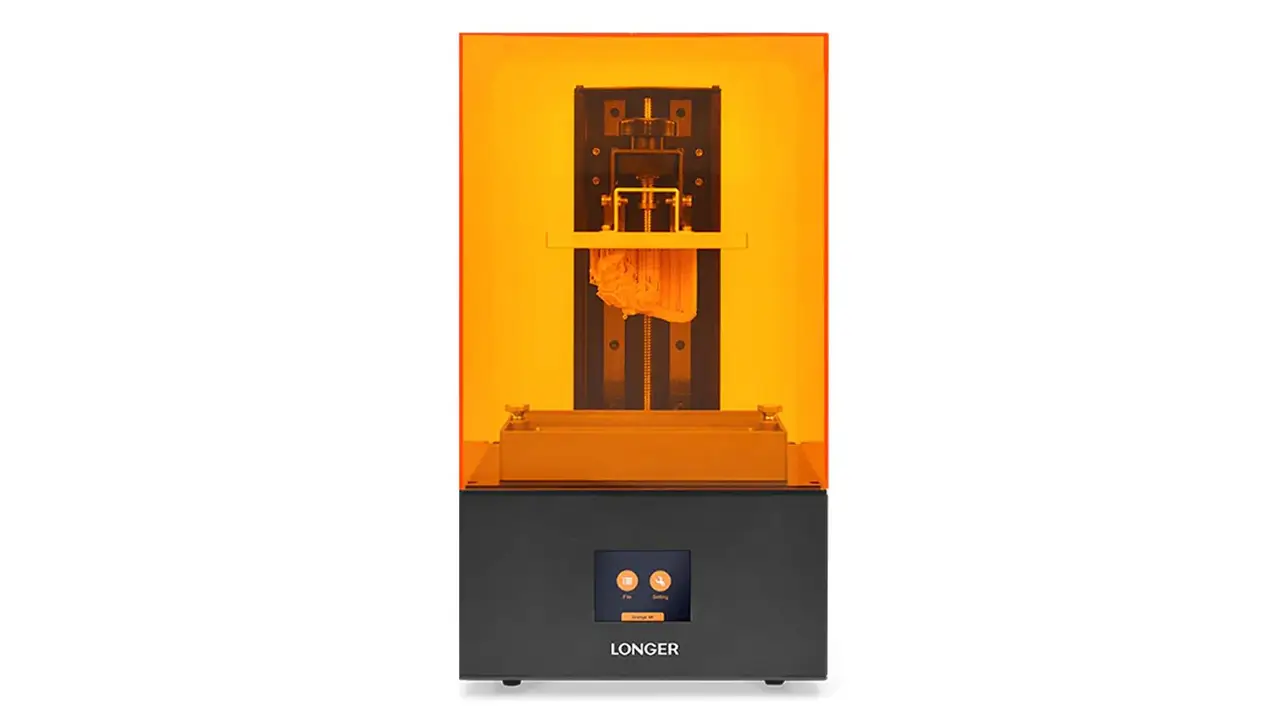
Budget 4K Resin Printer
High-resolution 4K mono MSLA 3D printer from Longer. Exceptional detail for miniatures and jewelry, fast curing, and reliable performance at an affordable price point.
Features Breakdown – Longer LK10 Plus Features in Detail
Beyond the headline specs, the longer lk10 plus features include a thoughtful set of quality-of-life improvements that make daily use genuinely pleasant.
The high-flow direct-drive extruder is worth highlighting. Direct-drive setups place the motor directly above the hotend, dramatically reducing the distance that filament has to travel. This makes the printer far more capable with flexible materials like TPU, and it improves retraction performance across the board — fewer stringing issues, more reliable extrusion consistency at high speeds. The high-flow designation indicates that the extruder and hotend combination is designed for volumetric output rates that match the 500 mm/s motion capability. There’s no point having a fast gantry if the hotend can’t keep up with filament delivery.
The copper-titanium bi-metal heatbreak is an engineering detail that deserves attention. Traditional heatbreaks use a single material — often stainless steel — to create the thermal transition zone between the hot and cold sections of the hotend. A bi-metal design combines the thermal conductivity properties of copper (excellent heat transfer in the hot zone) with the thermal resistance of titanium (excellent heat isolation in the cold zone). The result is a sharper, more stable thermal boundary, which reduces the risk of heat creep — a common failure mode where softened filament creeps into the cold zone and causes clogs.
Smart automation features round out the package. Filament run-out detection pauses prints automatically when filament runs out, and semi-automatic belt tensioning maintains optimal belt tension without manual adjustments. These features enhance reliability and ease of use, letting you focus on creating rather than troubleshooting. For anyone who has lost a multi-hour print to an empty spool, automatic filament detection is a feature that earns its keep quickly.
Comparison – Longer LK10 Plus vs LK5 Pro
For existing Longer users, the natural question is how the LK10 Plus stacks up against the previous generation flagship, the LK5 Pro. This is a meaningful comparison because many makers currently own or are considering the LK5 Pro.
| Feature | LK10 Plus (2026) | LK5 Pro |
|---|---|---|
| Build Volume | 320 × 320 × 400 mm | 300 × 300 × 400 mm |
| Max Print Speed | 500 mm/s | ~100–150 mm/s |
| Firmware | Klipper (built-in) | Marlin (stock) |
| Auto Leveling | Eddy-current (automatic) | Manual (BLTouch optional) |
| Extruder | High-flow direct-drive | Bowden extruder |
| Heatbreak | Copper-Titanium bi-metal | Standard PTFE |
| Motion Sensors | X and Y axis (built-in) | None |
| Belt Tensioning | Semi-automatic | Manual |
| Onboard Storage | 8 GB | MicroSD only |
| Starting Price | $419.99 | ~$299–$349 |
The longer lk10 vs lk5 pro comparison is frankly not very close in terms of raw capability. The LK10 Plus represents a generational leap rather than an incremental upgrade. The switch from Marlin to Klipper alone is transformative — it changes not just the print speed ceiling, but the entire way you interact with and tune the machine. Adding built-in eddy-current leveling, a direct-drive high-flow extruder, and the bi-metal heatbreak on top of that means virtually every subsystem of the printer has been rethought.
For LK5 Pro owners, the question isn’t whether the LK10 Plus is better — it clearly is across almost every metric. The real question is whether the improvement justifies the upgrade cost for your specific workflow. If you print large, complex parts frequently and time matters to you, the answer is probably yes. If you’re an occasional hobbyist running small prints with no time pressure, your LK5 Pro continues to be a capable machine.
H2: Pros and Cons
No longer lk10 plus review would be complete without an honest assessment of where this printer shines and where it has room to grow.
Starting with the positives: the value proposition here is exceptional. Klipper firmware, eddy-current auto leveling, and high-flow direct-drive extrusion at this price point would have been unthinkable even 18 months ago. The build volume is genuinely large for a desktop machine, and the 8GB onboard storage means you’re not juggling SD cards for every large print. The smart automation features — filament detection, semi-automatic belt tensioning — reduce the friction of daily use meaningfully. For makers who want to run the printer as a workhorse rather than a constant tinkering project, these details add up.
The copper-titanium bi-metal heatbreak is a detail that signals thoughtful engineering. It’s the kind of component choice that suggests Longer’s engineering team understood the thermal demands of sustained high-speed printing and designed accordingly rather than cutting corners.
On the other side of the ledger, it’s worth noting that high-speed printing in a budget machine still requires appropriate expectations. The 500 mm/s figure is a ceiling, and real-world quality printing typically happens at 150–300 mm/s. Users who expect to immediately print at maximum speed and get perfect results will need to invest some time in calibration — though Klipper makes that calibration process significantly more guided and accessible than older firmware approaches.
As with any newly released printer, the longer-term reliability picture will become clearer as the community accumulates real-world hours on these machines over the coming months. The feature set is impressive on paper, and the early reception has been positive, but seasoned 3D printer users know that longevity data takes time to gather. Spare parts availability and community support for the LK10 series are factors to monitor.
Polimerukr.com
Ukraine
3D Printing Materials & Supplies
Your trusted source for high-quality 3D printing materials in Ukraine. Wide selection of filaments, resins, and accessories for all printer types with fast local shipping.
Final Verdict – Is the Longer LK10 Plus Worth It?
After working through everything this machine brings to the table, the conclusion for this longer lk10 plus review is fairly clear: yes, it’s worth it — with some context.
The LK10 Plus and the broader LK10 series balance speed, stability, and usability in a way that makes it highly efficient for desktop 3D printing applications. The machine is specifically targeted at makers, educators, product designers, and prototyping teams who need meaningful output without the cost of professional equipment. Within that audience, it delivers exactly what it promises.
The combination of Klipper firmware and eddy-current auto leveling at this price point is rare — essentially bringing semi-professional performance features into entry-level territory. A 320×320×400 mm build volume means you’re not fighting against size constraints on most real-world projects. The high-flow direct-drive extruder opens the door to flexible filaments without the stringing headaches of Bowden setups. And 8GB of onboard storage means the machine functions more like a modern networked device than a traditional SD-card printer.
If you’re a hobbyist stepping up from a smaller, slower machine, the LK10 Plus will feel like a significant upgrade in almost every respect. If you’re an educator looking for a classroom-capable machine that prints quickly and handles large educational models, the combination of automation features and build volume makes it genuinely practical. If you’re a product designer who needs rapid iteration on physical prototypes, the throughput advantage of Klipper-enabled high-speed printing translates directly into faster development cycles.
The early bird pricing of $419.99 makes the decision even easier for anyone already considering a printer in this class. That price point, for this feature set, is where the real story of the Longer LK10 Plus in 2026 lies: it represents what the budget high speed 3D printer klipper market is becoming — smarter, faster, and more capable than most people expected it to be this soon.
🇬🇧 English
Great breakdown of the Longer LK10 Plus! The article is clear, detailed, and actually useful — especially the Klipper insights. The site feels professional and easy to navigate. Definitely bookmarking bestchina3dprinters.com for future reviews.
🇪🇸 Español
Excelente análisis del Longer LK10 Plus. La información es clara, bien estructurada y muy útil, especialmente sobre la velocidad y Klipper. El sitio es moderno y fácil de usar. Sin duda volveré a bestchina3dprinters.com.
🇸🇦 العربية
مراجعة رائعة لطابعة Longer LK10 Plus. المقال منظم وواضح ويقدم معلومات دقيقة خاصة حول Klipper والسرعة. الموقع سهل التصفح واحترافي. سأتابع bestchina3dprinters.com للمزيد من المراجعات.
🇨🇳 中文
这篇关于 Longer LK10 Plus 的评测非常专业!内容清晰、结构合理,特别是对 Klipper 和打印速度的分析很有帮助。网站设计简洁,阅读体验很好。我会继续关注 bestchina3dprinters.com。
🇫🇷 Français
Très bon article sur la Longer LK10 Plus. Les explications sont claires et pertinentes, surtout concernant Klipper et les performances. Le site est agréable et bien organisé. Je recommande bestchina3dprinters.com.
🇩🇪 Deutsch
Sehr guter Bericht über den Longer LK10 Plus. Die Infos sind klar, strukturiert und wirklich hilfreich, besonders zu Klipper und Geschwindigkeit. Die Website wirkt professionell und übersichtlich. Ich werde bestchina3dprinters.com weiter nutzen.
AndreevWebStudio.com
Professional web development and design services. Custom WordPress sites, landing pages, e-commerce solutions, and 3D printing content creation for businesses and creators.
- • WordPress Development
- • Custom Web Design
- • E-Commerce Solutions
- • 3D Printing Content
Discover more from bestchina3dprinters.com
Subscribe to get the latest posts sent to your email.
