Introduction to Qidi Tech X-Max 3
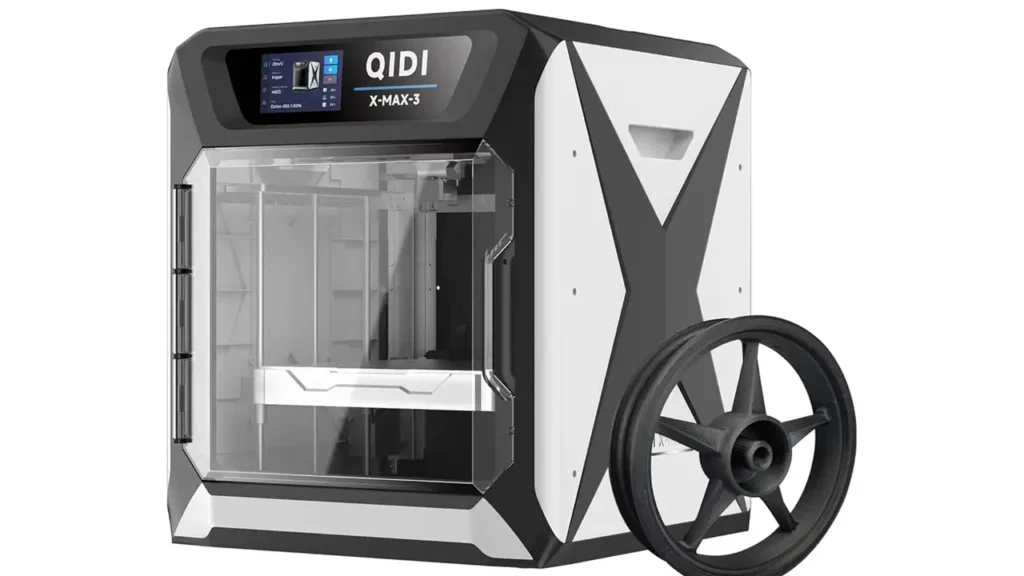
If you’ve been searching for a large-format, high-speed 3D printer that doesn’t force you to choose between power and precision, the Qidi Tech X-Max 3 deserves a very close look. This machine represents QIDI Tech’s most ambitious leap yet in the consumer-to-professional segment — a printer that confidently blurs the line between desktop maker tool and genuine industrial workhorse.
The Qidi Tech X-Max 3 review community has been buzzing since its release, and for good reason. This isn’t just a spec-sheet upgrade over its predecessor — it’s a ground-up rethink of what a large enclosed FDM printer should feel like to own, operate, and push to its limits. From its massive 325 × 325 × 315 mm build volume to its 600 mm/s maximum print speed, the X-Max 3 makes a compelling case for anyone who needs to print big, fast, and reliably.
Whether you’re a small business owner producing functional prototypes, a hobbyist tired of size limitations, or an engineer who regularly works with engineering-grade materials, this printer was designed with you in mind. In this review, we’ll walk through everything — specs, speed, enclosure, firmware, print quality, material compatibility, pricing, and the honest verdict on whether this machine is worth your money.
2. Qidi Tech X Max 3 Specs Overview
Before diving into real-world performance, let’s ground ourselves in the numbers. The Qidi Tech X Max 3 specs are genuinely impressive for the price category, especially when you consider what comparable machines from other brands offer at similar or higher price points.
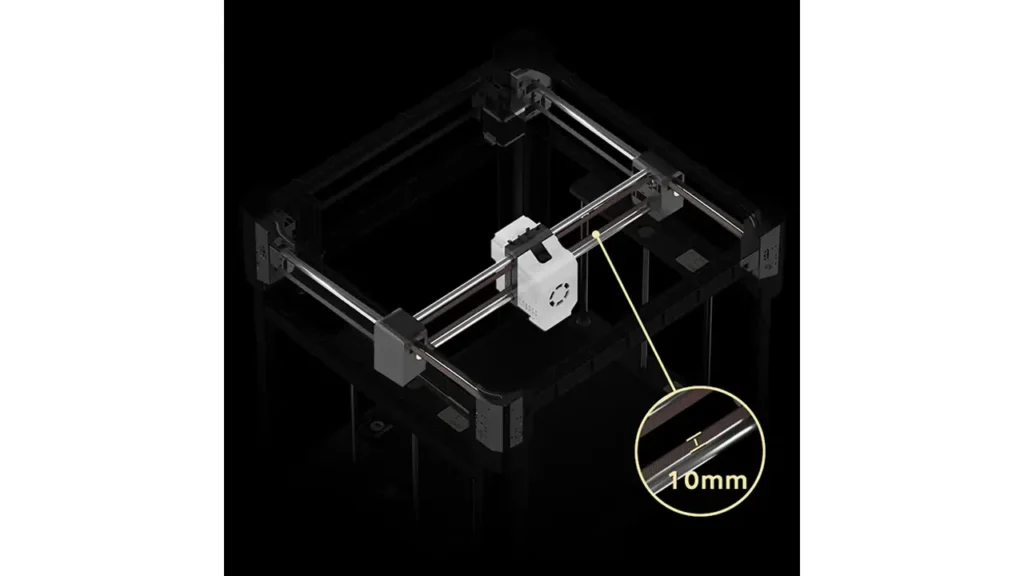
At its core, the X-Max 3 is a CoreXY 3D printer from Qidi built around an all-metal frame reinforced with metal crossbeams at the base. This structure is engineered for rigidity — resistant to deformation even during high-speed, high-acceleration printing sessions. The motion system rides on high-grade hardness steel linear hollow optical axes, which QIDI claims deliver 60% lower deflection compared to standard options. The result is a stable, precise platform that can maintain quality even at elevated speeds.
The printer is driven by a 64-bit Cortex-A53 processor running at 1.5 GHz with 8GB eMMC storage — the brain behind the Klipper firmware stack. TMC2209 silent stepper drivers keep noise levels manageable during operation.
| Specification | Detail |
|---|---|
| Build Volume | 325 × 325 × 315 mm |
| Motion System | CoreXY |
| Max Print Speed | 600 mm/s |
| Max Acceleration | 20,000 mm/s² |
| Max Flow Rate | 35 mm³/s |
| Layer Resolution | 0.05 – 0.4 mm |
| Printing Accuracy | ±0.1 mm |
| Nozzle Diameter | 0.4 mm (×2 included) |
| Max Nozzle Temp | 350°C |
| Max Bed Temp | 120°C |
| Chamber Heating | Up to 65°C (active) |
| Processor | 64-bit Cortex-A53, 1.5 GHz, 8G eMMC |
| Stepper Drivers | TMC2209 (silent) |
| Display | 5-inch color touchscreen |
| Firmware | Klipper (with Fluidd console) |
| Leveling | Fully automatic |
| Transmission Belt | 10 mm |
| Extruder Gear Ratio | 9.5:1 hardened steel |
3. Large Build Volume Explained
One of the X-Max 3’s defining characteristics is its large build volume — and when QIDI says large, they mean it. At 325 × 325 × 315 mm (approximately 12.8 × 12.8 × 12.4 inches), this Qidi Tech 3D printer’s large build volume puts it firmly in the upper tier of desktop FDM machines currently available.
To put that in perspective: you could print a full-sized helmet visor shell, large engineering brackets, full-scale architectural models, or functional enclosures without needing to split your design into multiple parts. For anyone who has felt constrained by the 220 × 220 mm or 256 × 256 mm build plates of more common printers, stepping up to the X-Max 3’s platform feels genuinely liberating.
The build plate itself is a 6 mm thick aluminum plate — significantly more robust than the thinner plates found on budget alternatives. It features a dual-sided PEI surface with embedded magnets for easy print removal. It heats up to 120°C, which is essential when working with engineering-grade filaments that require a warm, stable first layer to adhere properly and resist warping during the print.
The combination of the large platform and the heated bed means you’re not just getting more space — you’re getting more usable space, with the kind of first-layer reliability that allows you to actually trust long print jobs you walk away from.
4. High-Speed Printing Performance
Speed is where the X-Max 3 makes headlines, and rightfully so. This is a true Qidi X-Max 3 high speed 3D printer — not in the marketing-hyperbole sense, but in measurable, functional reality.
QIDI officially rates the X-Max 3 at a maximum print speed of 600 mm/s, paired with an acceleration ceiling of 20,000 mm/s². Achieving these numbers requires every element of the system to pull together, and the X-Max 3 was engineered with that in mind.
The CoreXY motion architecture is the starting point. By keeping the print head’s mass low and moving only the toolhead (rather than the entire print bed), CoreXY allows dramatically faster movements without introducing the inertia-related artifacts that ruin prints on Cartesian-style printers. QIDI enhanced this further by switching to high-grade steel linear hollow optical axes, which reduce weight while maintaining rigidity — a 60% reduction in deflection error compared to conventional options.
The extruder system plays an equally important role. The X-Max 3’s high-velocity extruder uses a 9.5:1 hardened steel gear ratio and achieves a volumetric flow rate of 35 mm³/s. For context, a standard extruder on a budget machine might flow 10–15 mm³/s. This generous flow capacity ensures that even at high linear speeds, the hotend can supply enough molten filament to maintain a continuous, well-formed bead.
The cooling system was redesigned to match: an improved part-cooling fan reduces clogging risk and ensures rapid solidification of the filament after deposition, which is critical to maintaining sharp details at speed.
It’s worth noting that while 600 mm/s is the rated maximum, real-world high-quality printing typically happens at 250–400 mm/s on most profiles — still substantially faster than the 50–150 mm/s that many competitive printers operate at.
5. Klipper Firmware & Smart Features
Modern high-performance 3D printing and Klipper firmware have become nearly synonymous, and the Qidi Tech X-Max 3’s Klipper firmware integration is one of its strongest selling points for technically inclined users.
Klipper offloads motion planning from the printer’s mainboard to a more powerful external processor (in this case, the onboard 64-bit Cortex-A53), enabling more complex real-time calculations and smoother motion control. On the X-Max 3, this translates directly into the machine’s ability to sustain high accelerations without introducing ringing or ghosting artifacts into prints.
Several Klipper-powered smart features come pre-configured on the X-Max 3:
Input Shaping / Resonance Compensation — Klipper’s resonance compensation algorithms measure and counteract the vibration frequencies of the printer’s frame, allowing high-speed movement without the wavy “ringing” artifacts that plague machines running stock firmware at similar speeds.
Pressure Advance — This feature compensates for the elasticity of the filament path, ensuring consistent extrusion width when the printer accelerates, decelerates, or changes direction. The result is cleaner corners and sharper detail.
Klipper Adaptive Meshing and Purging (KAMP) — QIDI has implemented KAMP, which means the printer automatically generates a bed mesh calibrated to just the area your print actually occupies — not the entire 325 × 325 mm surface. This saves time and ensures a perfectly calibrated first layer every single time.
Beyond Klipper, the X-Max 3 ships with a 5-inch color touchscreen for direct on-machine control, along with access to the Fluidd console — a browser-based interface that lets you monitor, control, and modify print settings remotely from any device on your local network.
The machine also features fully automatic leveling, eliminating the most frustrating step of the printing process for newcomers and experienced users alike.
6. Fully Enclosed Heated Chamber
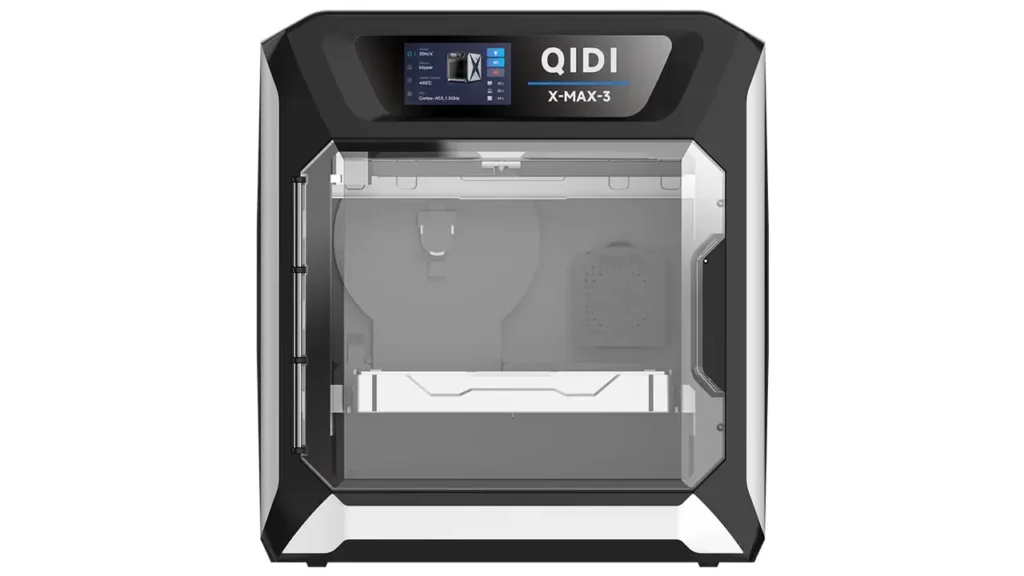
The Qidi Tech X-Max 3 enclosure is not a passive shell — it’s an active thermal management system, and this distinction matters enormously for material compatibility and print consistency.
The chamber is independently heated by a dedicated 300W heating element and can maintain temperatures up to 65°C throughout the print session. This is a temperature range that makes a meaningful difference when printing with ABS, ASA, polycarbonate, and especially advanced composites like carbon-fiber-filled nylons and PAHT-CF. Without a heated enclosure, these materials are prone to warping, layer delamination, and cracking as the outer surfaces cool faster than the interior during a long print. With the chamber held at 60–65°C, the entire print stays warm and pliable, equalizing thermal stress and delivering far more reliable results.
What sets the X-Max 3 apart from many competitors even in this regard is its chamber circulation fan with an activated carbon air filter. The fan ensures even temperature distribution across the full build volume — crucial for tall prints where the top layers might otherwise be significantly cooler than the bottom. The carbon filter simultaneously captures and neutralizes VOCs and fine particulates emitted during printing, which is especially important if the printer operates in a home office or shared workspace.
This combination of active heating, forced air circulation, and active filtration is the sort of feature set you typically see on machines costing significantly more. It’s a genuine differentiator for the X-Max 3 in its price bracket.
7. Print Quality & Material Compatibility
Real-world Qidi Tech X-Max 3 print quality holds up impressively across a wide range of materials and use cases. Let’s break this down by what the machine can actually handle.
The X-Max 3 ships with two interchangeable 0.4 mm nozzles: a copper alloy nozzle optimized for thermal conductivity and smooth extrusion with standard filaments, and a hardened steel nozzle designed to withstand the abrasive nature of composite materials over thousands of hours of use. Both nozzles support temperatures up to 350°C — high enough for demanding engineering filaments.
| Material | Nozzle | Chamber Needed | Notes |
|---|---|---|---|
| PLA | Copper alloy | No | Excellent surface quality |
| ABS | Copper alloy | Recommended | Warp-free with heated chamber |
| ASA | Copper alloy | Recommended | UV-resistant outdoor parts |
| TPU | Copper alloy | No | Precise at ~40 mm/s |
| PC (Polycarbonate) | Either | Required | High strength, heat resistant |
| Nylon (PA) | Hardened steel | Required | High toughness applications |
| PA-CF / PAHT-CF | Hardened steel | Required | Industrial composite grade |
| PET-CF | Hardened steel | Required | Stiff, low-warp carbon composite |
With 0.05 mm minimum layer height, the X-Max 3 delivers prints with genuinely smooth surface finish — fine enough to reveal screw thread details and mechanical mating surfaces clearly. Dimensional accuracy of ±0.1 mm is sufficient for functional prototyping in most engineering contexts. Users report clean bridges, well-formed overhangs, and consistent wall thicknesses across the full build volume.
The QIDI Slicer software (based on PrusaSlicer) comes pre-loaded with material profiles for all supported filament types, with both a simplified “Normal Mode” for beginners and an “Expert Mode” for those who want granular control. The slicer also supports Ultimaker Cura, Simplify3D, and other third-party tools.
8. Industrial Capabilities
The X-Max 3 doesn’t just claim the label of a Qidi Tech industrial 3D printer — it earns it through a coherent set of design decisions that translate directly to professional and production-oriented use cases.
Consider what “industrial grade” actually means in this context: it’s the ability to print reliably with engineering materials, maintain dimensional accuracy across large parts, run long print jobs without failure, and handle the kind of continuous duty cycle that professional environments demand. The X-Max 3 addresses each of these requirements directly.
The all-metal frame with reinforced crossbeams eliminates the flex and drift that compromise precision over time on plastic-framed machines. The steel linear optical axes are rated as lifetime components — QIDI explicitly states they typically don’t need replacement with normal use. The 6 mm aluminum build plate is thick enough to maintain flatness under thermal cycling, avoiding the warping that plagues thinner beds on repeated heat-cool cycles.
For small businesses and engineering teams, this machine sits in an interesting position: it’s sophisticated enough to handle PA-CF and PET-CF composites for functional end-use parts, yet accessible enough that it doesn’t require a dedicated operator or lengthy calibration rituals before each print session. The automatic leveling and KAMP together ensure that a technician can load filament, select a profile, and walk away confident in the outcome.
Industries particularly well-served by the X-Max 3 include product design and prototyping, tooling and jig fabrication, architectural modeling, custom robotics components, and small-run functional part production.
9. Price & Market Position
The Qidi Tech X-Max 3 price positions it as one of the most competitive offerings in the large-format enclosed FDM segment. As of the time of writing, the X-Max 3 retails at approximately $849–$999 USD depending on the retailer and any active promotions. Bundle options — including filament packages — are also available on Amazon in the $909–$969 range.
| Configuration | Approx. Price (USD) |
|---|---|
| Base Unit (Amazon) | ~$779 – $849 |
| Bundle with PLA Filament | ~$909 |
| Bundle with 3kg PLA Matte Rapido | ~$959 |
| Bundle with PAHT-CF Filament | ~$969 |
At these price points, the X-Max 3 competes directly with machines like the Creality K1 Max and the Bambu Lab X1 Carbon — both strong contenders in the high-speed enclosed space. However, the X-Max 3 differentiates itself through its significantly larger build volume and active chamber heating up to 65°C, which neither competitor fully matches at equivalent price tiers.
For buyers who specifically need the combination of large build volume, active heated enclosure, and industrial material capability, the X-Max 3 offers a value proposition that is difficult to match at this price range. The inclusion of two hotends (copper and hardened steel) out of the box, a 5-inch touchscreen, and full Klipper access sweeten the package further.
10. Final Verdict – Is the Qidi Tech X-Max 3 Worth It?
After examining every facet of this machine, the answer is a clear yes — with the appropriate context about who it’s built for.
The Qidi Tech X-Max 3 excels when you need volume, speed, material versatility, and thermal control in a single package that won’t bankrupt a small studio budget. Its 325 × 325 × 315 mm build volume is genuinely large. Its CoreXY motion system is genuinely fast. Its Klipper firmware is genuinely powerful. And its 65°C actively heated, carbon-filtered enclosure is genuinely industrial.
This is not the machine for someone who prints small decorative figurines in PLA once a week. But if you regularly need large functional parts, work with engineering filaments like PAHT-CF or PC, run a small batch production workflow, or simply value the ability to print large things fast and reliably — the X-Max 3 is one of the most capable machines you can currently buy at this price point.
The build quality is solid, the ecosystem (QIDI Slicer + Klipper + Fluidd) is thoughtful, and the community and support around QIDI Tech has matured considerably. It’s a machine you can grow into, configure deeply if you want to, or run on sensible defaults if you don’t.
Bottom line: The Qidi Tech X-Max 3 is a high-performance, large-format CoreXY printer that punches well above its price class. For serious makers, small studios, and engineering teams who need reliable results with demanding materials at scale — it’s a very smart buy.
If you’re exploring powerful and affordable alternatives in the Chinese 3D printing space, the Qidi lineup deserves attention. We’ve already covered the X-Max 3, but there’s another serious contender shaking the market. Discover how it compares to Bambu Lab in our full breakdown here:
👉 https://bestchinagadget.com/qidi-q2-combo-killer-bambu-lab-review/
Discover more from bestchina3dprinters.com
Subscribe to get the latest posts sent to your email.