Introduction to Elegoo Orange Storm Giga
If you’ve been keeping up with the world of 3D printing, chances are you’ve already heard the buzz surrounding the Elegoo Orange Storm Giga. This machine arrived on the scene not with a whisper but with a thunderclap — literally turning heads at international trade shows, dominating crowdfunding platforms, and walking away with the prestigious Future Technology Innovation Award 2024. For a brand that started out making affordable hobbyist printers, this is quite a leap.
The OrangeStorm Giga received the Technology Innovation Award 2024, presented by Future, sharing recognition alongside major tech giants such as Samsung, HP, and LG. That tells you something important right away: this isn’t just another large format resin 3D printer — it’s a product that made the broader technology industry take notice.
So what exactly is the Elegoo Orange Storm Giga? At its core, it’s a professional-grade, large format 3D printer designed for people who refuse to think small. Whether you’re a studio designer, an automotive engineer, a prop builder, or simply someone who wants to print massive objects in one go, the Giga was built with you in mind. It bridges the gap between hobbyist machines and true industrial resin 3D printer systems — offering features that, until recently, were reserved exclusively for machines costing tens of thousands of dollars.
The campaign launched on Kickstarter with an initial goal of $100,000 and ended up raising over $3.38 million from 2,005 backers , which tells you everything about the hunger the market had for a machine like this. People were ready, they were waiting, and Elegoo delivered something spectacular.
In this review, we’re going to walk through everything — from build volume and print quality, to performance, software, real-world use cases, and an honest assessment of where the Giga shines and where it still has room to grow. Let’s dive in.

2. Massive Build Volume Explained
Let’s start with the headline feature, because when people say “large format,” the Giga takes that phrase to an entirely different level.
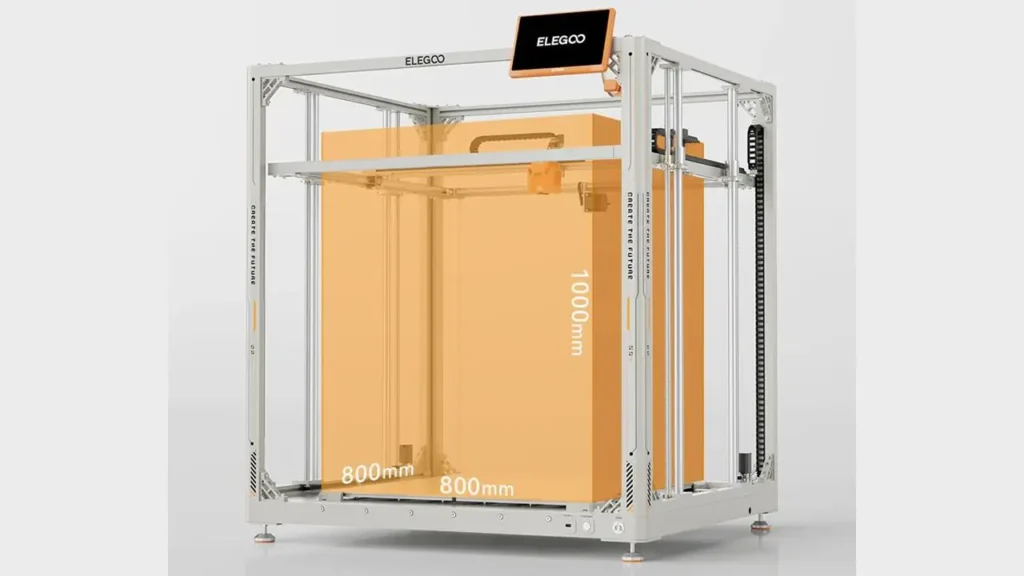
The OrangeStorm Giga impresses with a build volume of 800 × 800 × 1000 mm — an enormous space that allows users to print massive projects without needing to split models into smaller sections. To put that into perspective: 800 mm is roughly the width of a standard dining chair. 1000 mm is a full meter tall. You could print a life-size human torso, a full-scale architectural model, or a complete set of furniture components without ever slicing your design into separate parts.
This kind of large build volume resin printer architecture opens up genuinely new workflows. Instead of printing 6 components and gluing them together with visible seams, you print the whole thing at once. The structural integrity improves, finishing time decreases, and the final result looks far more professional.
With a build volume of 800 × 800 × 1000 mm, this industrial-grade printer not only meets printing needs for oversized models, but also reduces the need to cut models into smaller sections for more efficient printing.
What makes the Giga’s bed particularly interesting is how it handles such a large surface area. Rather than using a single massive heated plate (which would be extremely difficult to heat evenly and maintain), Elegoo engineered an elegant modular solution.
The heated bed consists of four independent magnetic PEI build plates, each measuring 410 × 410 mm, with a maximum temperature of 90 °C. These can be heated simultaneously and reach operating temperature within approximately 17 minutes at 25 °C ambient temperature. Smart sensors detect which zone a model occupies and heat only that zone, saving energy.
This zone-based heating is more than just clever — it’s a genuinely practical solution for large scale 3D printing. If you’re printing a smaller object that only occupies one quadrant of the bed, the system heats only that quadrant, reducing power consumption and warm-up time significantly. Each of those magnetic PEI plates is removable, making part removal and bed maintenance much easier than traditional fixed beds.
The maximum activity footprint of the machine measures 1224 × 1620 × 1570 mm , so you’ll want to make sure your workspace can accommodate both the machine itself and enough room to work around it comfortably.
3. Print Speed and Processing Power
One of the most important aspects of any large format printer is how efficiently it can push filament. A large volume is meaningless if every print takes a week to complete. Here, the OrangeStorm Giga really distinguishes itself.
Thanks to a 64-bit quad-core processor (SOC RK3328) with a 1.5 GHz clock speed, the Giga achieves a maximum printing speed of 300 mm/s, with a recommended printing speed of 150 mm/s — approximately six times faster than other printers of comparable size.
That’s a remarkable claim, and it’s backed by the processing hardware under the hood. A dedicated quad-core processor means the machine doesn’t just move fast — it thinks fast. Slicing previews, motion planning, and real-time adjustments all benefit from this computational headroom.
The OrangeStorm Giga integrates a 10.1-inch capacitive touchscreen with 1280 × 800 resolution running Elegoo’s Linux-based operating system (kernel 5.15 LTS), supporting eight languages: English, French, German, Russian, Italian, Spanish, Japanese, and Chinese.
The touchscreen is detachable, allowing you to carry it around during setup and leveling operations — a surprisingly thoughtful ergonomic touch on a machine of this scale.
The CoreXY motion system also contributes meaningfully to print speed and quality. Unlike traditional Cartesian motion systems where the bed moves along one axis, CoreXY keeps the bed stationary during printing and moves the toolhead in both X and Y. Linear X/Y axis guides maintain positional deviation of ≤0.05 mm during 20-hour prints, meeting industrial throughput demands.
For a high resolution 3D printer operating at this scale, that level of positional accuracy is genuinely impressive and critical for producing clean results across such a large area.
4. Industrial-Level Performance
The word “industrial” gets thrown around a lot in the consumer 3D printing world, but with the OrangeStorm Giga, it actually means something. This is a machine that was designed with professional environments in mind, and every structural decision reflects that.
The 104 kg steel frame reduces harmonic resonance by 75% at 200 mm/s printing speeds, enabling continuous operation in demanding environments such as automotive prototyping and aerospace tooling.
That 104 kg frame is not incidental — it’s foundational. Heavier frames vibrate less, and less vibration translates directly to crisper layer lines and more consistent part quality, especially during long print sessions. This is the same principle that governs why professional CNC machines are built from cast iron rather than aluminum.
TR8x4 trapezoidal leadscrews and dual 48V stepper motors eliminate layer shifts in 900 mm tall prints, achieving a 99% reduction in shift versus standard NEMA 17 systems. For anyone who’s ever watched a tall print fail catastrophically at hour 18 due to a Z-axis layer shift, this kind of robustness is genuinely welcome.
The machine also includes a suite of reliability features that are standard in industrial resin 3D printer environments but often missing from consumer machines. Automatic filament detection will pause and alert you when a spool runs out. Power-loss recovery means an unexpected power cut won’t waste 20 hours of print time. Caterpillar cable tracks protect wiring from dust, wear, and breakage during continuous operation.
Chris Hong, CEO of Elegoo, stated: “The Giga represents one of our boldest innovations yet, and we’re committed to further advancing our technology to empower creativity and precision on every scale.” That philosophy is visible throughout the machine’s engineering.
5. Print Head, Nozzle System and Print Quality
Let’s talk about what actually touches the filament — the print head and nozzle system — because this is where the Giga’s print quality story gets interesting.
The OrangeStorm Giga features a brass nozzle capable of reaching 300 °C, suitable for high-temperature materials. The dual-gear direct extruder and titanium heat break ensure consistent filament flow, while the 60 W ceramic heater provides rapid and stable heating.
The included nozzle diameter is 0.6 mm, with optional sizes of 0.4 mm, 0.8 mm, and 1.0 mm available. The 0.6 mm default is a smart choice for a machine of this scale — it balances reasonable detail with faster print times, which matters when your build volume is 800 liters.
One of the standout features of the Giga’s toolhead system is its expandability. The X-axis can accommodate up to four print heads simultaneously, enabling multi-color or multi-material printing workflows. The optional multi-nozzle configuration supports up to three additional print heads for multi-color printing.
Cooling is equally well-considered. Dual 5015 blower fans running at 15,000 RPM and a 4010 axial fan generate 42 CFM of airflow, enabling 75° PLA overhangs without supports at 0.4 mm layer heights. The 360° duct design maintains ±2 °C part temperature uniformity during 150 mm/s PETG printing, preventing warping in 800 mm long components.
Preventing warping on an 800 mm long PETG component is no small engineering challenge. The thermal consistency provided by this cooling architecture is what makes printing large engineering-grade parts genuinely viable.
Auto-leveling is handled by a 100-point inductive sensor grid. The 10 × 10 grid auto-leveling system reduces first-layer variance to ≤0.02 mm across its 820 × 820 mm² build surface. For context, a human hair is roughly 70 microns (0.07 mm) thick — a first-layer variance of 0.02 mm is less than one-third of a hair’s width across a surface area the size of a large dining table. That’s precision.
The PID auto-calibration system for nozzle temperature, combined with a built-in acceleration sensor for resonance compensation, ensures that print quality remains consistent whether you’re printing at 80 mm/s or pushing to the 300 mm/s maximum.
6. Who Is the Elegoo Orange Storm Giga For?
This is an important question because the Giga isn’t for everyone — and that’s actually a strength, not a weakness. Knowing your target user clearly means designing more purposefully, and Elegoo has done exactly that.
The Giga is a professional 3D printing machine designed for:
Studios and creative agencies that produce large-scale props, displays, set pieces, or installation art. Being able to print a 1-meter tall sculpture as a single piece rather than assembling dozens of smaller segments is a genuine competitive advantage.
Engineers and prototyping labs that need full-scale functional prototypes. An automotive engineer designing a bumper, a product designer validating an ergonomic grip, or a robotics team testing a large housing — all of these professionals benefit enormously from access to a large build volume that doesn’t require segmentation.
Cosplay and costume makers who want life-size armor, helmets, and props without seam lines or scale compromises. The cosplay community has already embraced large format printing enthusiastically, and the Giga’s dimensions make it perfectly suited for wearable-scale builds.
Architectural and interior design firms that produce physical presentation models. A 1:20 scale model of a building can easily exceed 400 mm on its longest dimension — territory where most desktop printers require multi-piece assembly.
Small manufacturing operations looking to add large-scale additive manufacturing capacity without the $50,000+ price tag of traditional industrial systems.
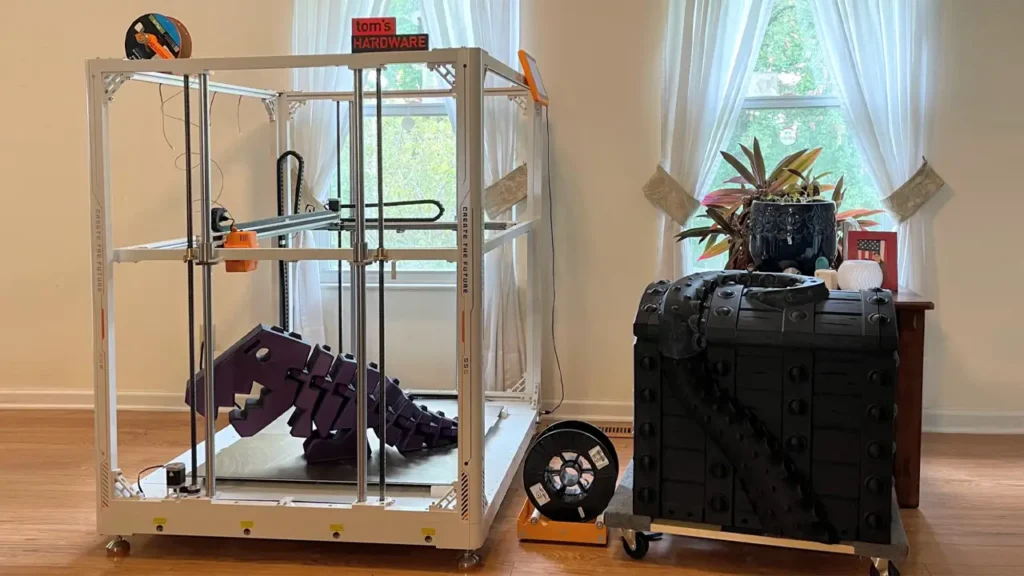
The Giga is so large it required special delivery by forklift and weighs approximately 230 pounds assembled, so it’s clearly not a machine for casual home use. You’ll need a dedicated workspace, appropriate flooring, and a suitable power circuit. But for the right user, those are entirely reasonable requirements for the capabilities on offer.
7. Comparison with Other Elegoo Models
Elegoo has built an impressive lineup over the years, covering everything from entry-level desktop FDM printers to professional resin machines. Understanding where the OrangeStorm Giga sits within that ecosystem helps you appreciate what makes it exceptional.
Below is a comparison of key Elegoo models to put the Giga in context:
| Model | Build Volume | Max Speed | Nozzle Temp | Target User |
|---|---|---|---|---|
| Neptune 4 Pro | 225×225×265 mm | 500 mm/s | 300 °C | Home / Hobby |
| Neptune 4 Max | 420×420×480 mm | 500 mm/s | 300 °C | Enthusiast |
| Jupiter SE | 277×156×300 mm | – | – | Resin / Studio |
| OrangeStorm Giga | 800×800×1000 mm | 300 mm/s | 300 °C | Pro / Industrial |
The gap between the Neptune 4 Max and the OrangeStorm Giga is enormous — not just in dimensions but in design philosophy. Where the Neptune series is optimized for speed and accessibility, the Giga is optimized for scale, reliability, and continuous professional use. It’s a completely different category of machine within the same brand family.
What the Giga borrows from its siblings is Elegoo’s commitment to value — delivering capabilities that compete with far more expensive machines at a price point that remains accessible to serious prosumers and small businesses.
8. Real Production Scenarios
The specifications are impressive, but the real test of any large format printer is how it performs in actual production contexts. Let’s look at some concrete scenarios where the OrangeStorm Giga genuinely excels.
Cosplay and Props Production
Full-scale Iron Man suits, medieval armor sets, superhero helmets — these are the kinds of projects that previously required either industrial equipment or extensive multi-part assembly. With 800 mm in both X and Y and a full meter in Z, the Giga can handle torso pieces, large helmets, and even full leg armor sections as single prints. This eliminates visible seam lines and dramatically reduces post-processing time.
Automotive Prototyping
The machine enables continuous operation for automotive prototyping such as full-scale bumper molds and aerospace tooling including wing jigs. For engineering teams validating designs before committing to expensive metal tooling, this kind of rapid large-scale prototyping is invaluable.
Architectural Models
Architecture firms routinely need physical models of buildings and urban spaces for client presentations. At 1:20 scale, a 16-meter building prints at 800 mm — exactly within the Giga’s height capacity. These models can be printed with fine structural detail and delivered far faster than traditional model-making methods.
Furniture and Interior Design
Custom furniture prototyping — chair frames, table bases, decorative panels — can be produced at 1:1 scale for client approval before production begins. The Giga’s four-zone heated bed means different components can be started and stopped in different zones depending on the job.
Education and Research
Universities and technical institutes running large-scale engineering programs benefit from access to a machine that can produce life-size functional prototypes. Mechanical engineering departments, industrial design programs, and medical research labs all stand to gain from this kind of large scale 3D printing capacity.
Here’s a practical overview of use cases and material recommendations:
| Use Case | Recommended Material | Key Advantage |
|---|---|---|
| Cosplay / Props | PLA / PETG | No seams, full-scale output |
| Automotive Prototyping | ASA / ABS | Heat resistance, structural integrity |
| Architecture Models | PLA | Fine detail at 1:20 scale |
| Flexible Components | TPU | Large flexible parts in one piece |
| Industrial Jigs | PETG / ABS | Dimensional accuracy, durability |
9. Advantages and Limitations
No review would be complete without an honest look at both sides of the equation. The OrangeStorm Giga is an exceptional machine, but it comes with real considerations that buyers should understand before committing.
Advantages
The sheer scale of the build volume is the obvious headline, but the surrounding engineering — the steel frame, the quad-core processor, the auto-leveling system, the modular heated bed — all combine to make this a genuinely capable professional 3D printing machine rather than just a big box.
The pricing is remarkable for what you get. The OrangeStorm Giga was available at a pre-order price of $2,499.99 USD , which positions it far below comparable-volume industrial alternatives that typically start at $10,000 or more.
The multi-nozzle expandability adds a layer of versatility that most large-format printers lack. Being able to simultaneously print with multiple materials or colors opens up workflows that simply aren’t possible on standard machines.
The reliability features — power-loss recovery, filament runout detection, caterpillar cable management, and an industrial-grade frame — all speak to a machine designed for sustained professional use rather than occasional hobby printing.
Limitations
Size is a real consideration. The machine arrived in two boxes approximately the size of dining room tables and requires forklift delivery. Installation requires planning, space, and potentially structural floor considerations given its weight.
Power consumption is significant. The machine has five power supplies and can noticeably raise the temperature of a room, with the potential to trip circuit breakers if connected to an inadequate outlet. Professional electrical assessment of your workspace is strongly recommended before installation.
Ergonomics at this scale require some adaptation. Because the machine sits at floor level when fully assembled, operations like leveling, Z-height calibration, and watching first layers require sitting or kneeling — something that users need to factor into their daily workflow planning.
Warm-up time for the full bed is approximately 17 minutes, which is reasonable given the surface area but something to factor into production scheduling.
Here is a summary comparison table of key technical specifications:
| Specification | Value |
|---|---|
| Build Volume | 800 × 800 × 1000 mm |
| Max Print Speed | 300 mm/s |
| Recommended Print Speed | 150 mm/s |
| Processor | RK3328 Quad-Core 1.5 GHz |
| Max Nozzle Temperature | 300 °C |
| Bed Configuration | 4 × Independent PEI 410×410 mm Zones |
| Max Bed Temperature | 100 °C |
| Bed Warm-up Time (full) | ~17 minutes |
| Auto-Leveling Points | 100 (10 × 10 grid) |
| Positional Accuracy (XY) | ≤0.05 mm |
| Machine Weight | ~104 kg (steel frame) |
| Display | 10.1″ Capacitive Touchscreen (1280×800) |
| Supported Filaments | PLA, PETG, TPU, ABS, ASA |
| Nozzle (included / optional) | 0.6 mm / 0.4, 0.8, 1.0 mm |
| Max Print Heads | 4 (1 standard + 3 optional) |
| Slicer Software | Elegoo Cura |
| Price (launch) | $2,499.99 USD |
10. Final Verdict
After exploring every dimension of the Elegoo OrangeStorm Giga — its architecture, its engineering, its real-world applications, and its honest limitations — we can arrive at a clear conclusion: this is one of the most significant large format 3D printers available in 2026, and it earns that status from the ground up.
What makes the Giga special isn’t any single feature — it’s the combination. A build volume that was previously the domain of $20,000+ industrial systems. A quad-core processor delivering six times the print speed of comparable-size machines. A modular four-zone heated bed that intelligently adapts to whatever you’re printing. An expandable multi-nozzle toolhead system. And all of this delivered at a price point that serious prosumers, studios, and small businesses can actually justify.
Elegoo’s CEO described the Giga as “one of our boldest innovations yet” — and looking at the machine objectively, it’s hard to disagree. The Technology Innovation Award it received in 2024, alongside global technology giants, confirms that the broader industry agrees.
Is it a perfect machine? No. The size demands serious workspace planning, the power requirements are substantial, and the ergonomics of operating a floor-level printer at this scale take some getting used to. These are real considerations, not minor quibbles.
But for the right user — the professional studio, the engineering team, the architectural firm, the ambitious creative operation — these are entirely manageable trade-offs for capabilities that genuinely have no affordable competitor at this scale. Large scale 3D printing at this level of quality, at this price, simply wasn’t available before the Giga arrived.
If you’re ready to think bigger and your work demands it, the Elegoo OrangeStorm Giga is the machine that makes it possible.
Discover more breakthrough tech, smart devices, and detailed product insights at https://bestchinagadget.com/. From innovative gadgets to in-depth reviews and expert comparisons, the platform highlights the most exciting releases from China’s tech industry. Stay ahead of trends, explore new possibilities, and find your next upgrade in one place.
Discover more from bestchina3dprinters.com
Subscribe to get the latest posts sent to your email.