If you’ve been searching for a 3D printer that gives you serious build volume, dual-color capability, and a CoreXY motion system — all without spending a fortune on industrial-grade hardware — the Tronxy X5SA 500 2E deserves your full attention. It’s a bold, ambitious machine sitting comfortably in the enthusiast segment: big enough to print things most printers simply can’t, and technically interesting enough to keep you tinkering for months.
This review covers everything you need to know — specs, real-world print performance, assembly experience, upgrade potential, and honest pros and cons. Whether you’re a seasoned maker or stepping up from a smaller desktop printer, this guide will help you decide if the X5SA 500 2E is the right machine for your workspace and goals.
Introduction to the Tronxy X5SA 500 2E
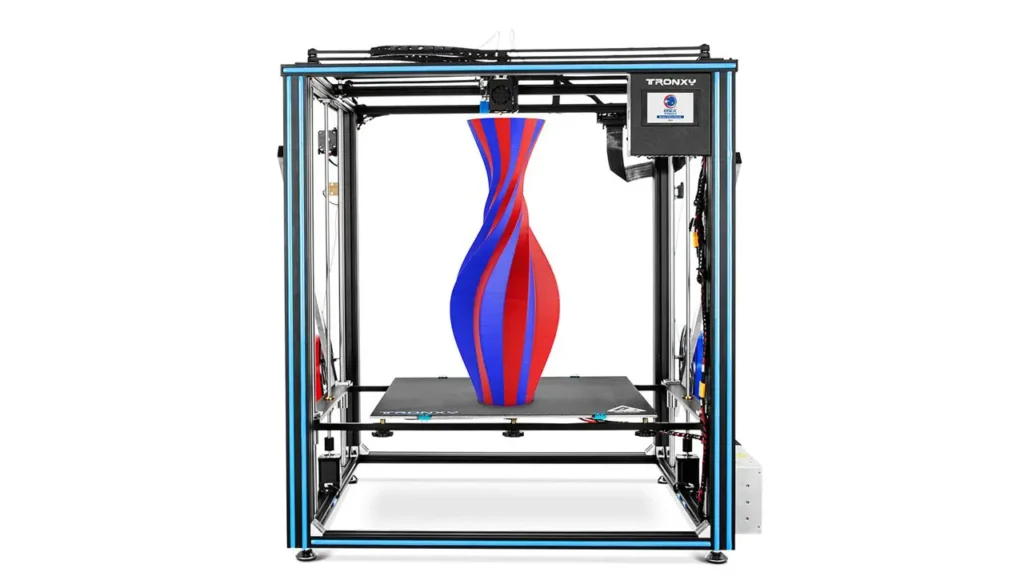
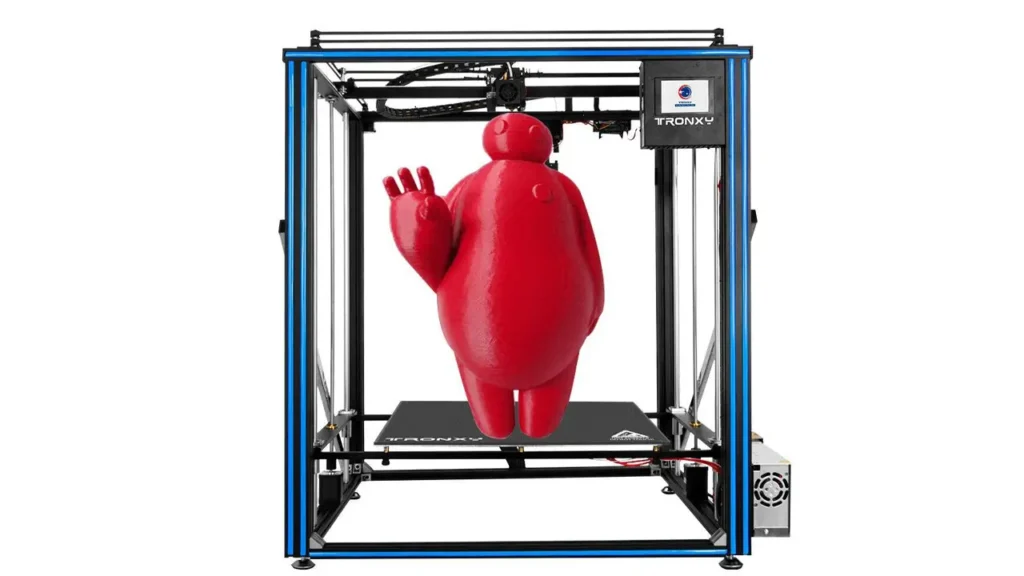
The Tronxy X5SA 500 2E is Tronxy’s flagship large-format FDM printer in the 2E dual-extrusion series. The “500” in the name refers to the massive 500 × 500 mm footprint of its heated bed, and “2E” signals its dual Titan extruder setup with a 2-in-1-out hotend — two filament inputs, one nozzle output, enabling mixed or dual-color printing in a single print session.
The X5SA-500-2E uses a double-injection and one-out nozzle design: two filaments, two extruders, one nozzle, with a build volume measuring 500 mm × 500 mm × 600 mm.
In the broader Tronxy 3D printer review ecosystem, this model occupies the top of the X5SA lineup. It’s not a beginner printer — Tronxy themselves are upfront that it’s a DIY kit better suited to users with some 3D printing experience. But for those who know what they’re doing, it’s a surprisingly capable machine at a price point well below comparable Western-branded alternatives.
Think of it this way: the X5SA 500 2E is not the printer you buy to get something out of the box and running in 20 minutes. It’s the printer you buy because you want to build something impressive, learn the mechanics intimately, and eventually tune it into a workhorse that prints objects most hobbyist printers can’t even dream of.
Tronxy X5SA 500 Specs Breakdown
Let’s start with the numbers. Before anything else, understanding what this machine is made of sets the foundation for everything that follows.
| Parameter | Specification |
|---|---|
| Print Volume | 500 × 500 × 600 mm |
| Machine Size | 940 × 780 × 915 mm |
| Machine Weight | ~25 kg |
| Package Weight | 28 kg |
| Motion System | CoreXY |
| Extruder Type | Dual Titan Extruder (Bowden Drive) |
| Nozzle System | 2-in-1-out (dual color, single nozzle) |
| Default Nozzle Diameter | 0.4 mm (supports 0.1–1.2 mm) |
| Max Nozzle Temperature | 260°C |
| Max Bed Temperature | 90–100°C |
| Layer Resolution | 0.1–0.4 mm (optional) |
| Positioning Accuracy (X/Y) | ±0.00625 mm |
| Positioning Accuracy (Z) | ±0.00125 mm |
| Print Speed | 20–100 mm/s (60 mm/s recommended) |
| Filament Diameter | 1.75 mm |
| Supported Materials | PLA, ABS, TPU, HIPS, PETG, WOOD, PC, PVC |
| Frame Material | Aluminum Profile + Sheet Metal |
| Mainboard | ARM 32-bit, TMC2225 ultra-quiet drivers |
| Firmware | Marlin (open-source compatible) |
| Screen | 3.5-inch full color touch screen |
| Power Supply | Input 110V/220V AC → Output 24V / 21A |
| Auto Leveling | TR Sensor (16-point detection) |
| Connectivity | USB, TF Card |
| File Formats | G-Code, STL, OBJ |
| Slicer Software | Tronxy Slicer / Cura compatible |
| Certification | CE, FCC |
The machine runs on a 24V power supply (input 110V/220V AC, output 24V 21A), uses a 3.5-inch full color touch screen, and supports an environmental operating temperature range of 8–40°C with humidity between 20–80%.
The frame is built from aluminum extrusion profile with sheet metal reinforcements — solid for the price range, though not as rigid as enclosed all-metal printer frames you’d find on industrial machines. The TMC2225 ultra-quiet stepper motor drive mainboard ensures smooth running movement under 50 dB, creating a comfortable printing environment whether at home, in a company workspace, or at school.
Massive Build Volume — Tronxy X5SA Print Size in the Real World
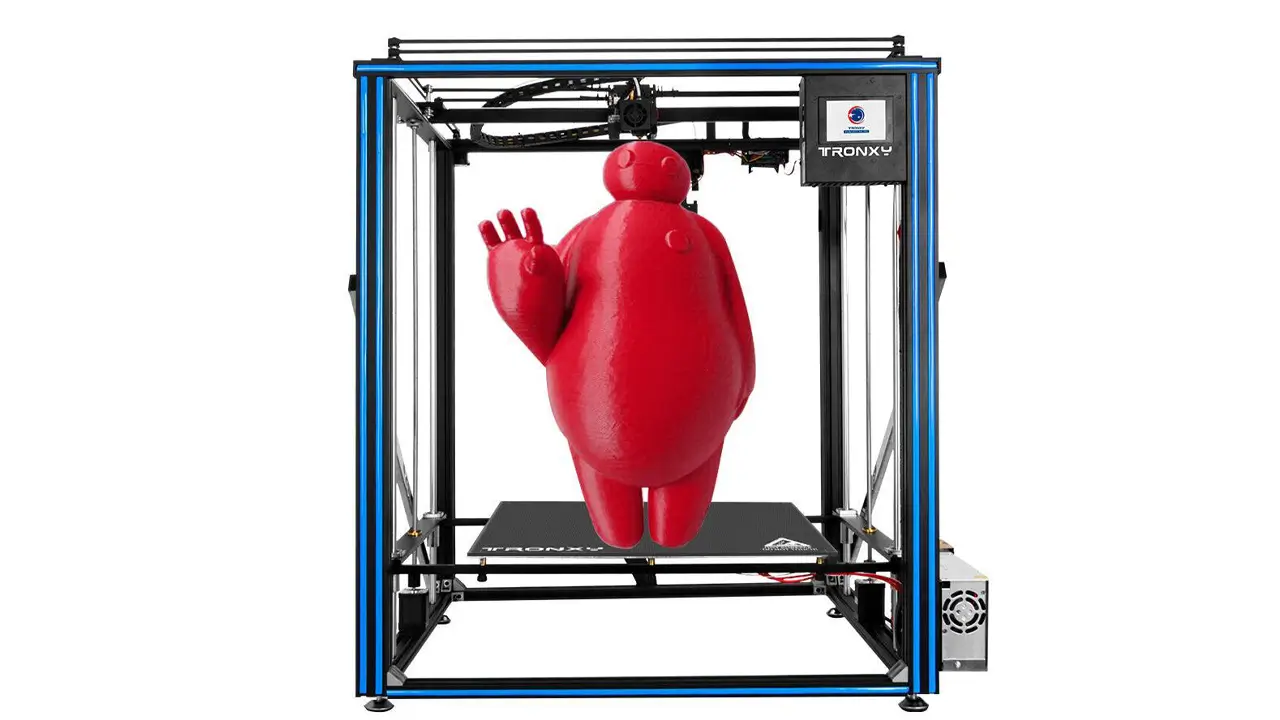
Let’s talk about the headline feature: that 500 × 500 × 600 mm build envelope. To put that in perspective, the total build volume is 150 liters of printable space. That’s roughly 7 to 8 times the build volume of a standard Ender 3-class printer.
A bigger build space means you can print models that 90% of other small 3D printers simply could not — large build volume for fulfilling your most ambitious ideas.
In practical terms, this opens the door to a completely different category of projects. Full-sized cosplay armor panels, large architectural models, oversized prop replicas, industrial-scale jigs and fixtures, large replacement parts — all of these become achievable without splitting models and gluing them together.
Within Tronxy’s own lineup, the X5SA series comes in multiple bed sizes (330 mm, 400 mm, and 500 mm variants). The 500 model is the largest consumer-accessible option in the family. The standard X5SA-2E, for comparison, offers a build volume of 330 × 330 × 400 mm or 400 × 400 × 400 mm, making the 500 version significantly more capable for large-format work.
One important real-world consideration: a 500 × 500 mm heated bed takes meaningful time and energy to heat up. The 24V power system helps here compared to older 12V variants, but patience during warmup is expected. Plan for 8–12 minutes to reach stable ABS printing temperatures across the full bed surface. For PLA, bed warmup is faster and less demanding.
Tronxy X5SA-500-2E
Large-format dual extrusion 3D printer from Tronxy. Spacious build volume, independent dual extruders, and reliable performance for multi-material printing and large-scale prototypes.
- • 500×500×400 mm Build
- • Dual Extrusion System
- • Auto Bed Leveling
- • Resume Print Function
CoreXY Mechanics Explained — Tronxy CoreXY 3D Printer Architecture
The CoreXY motion system is one of the primary reasons enthusiasts are drawn to the X5SA 500 2E over Cartesian-style printers in the same price range.
In a traditional Cartesian printer (like the Prusa i3 or Ender 3), the print bed moves along the Y-axis while the toolhead moves in X and Z. This is simple and reliable, but at large scales it creates a problem: a heavy, massive print bed is accelerating and decelerating hundreds of times per print layer. At 500 mm wide, that momentum becomes significant — it limits print speed and can introduce vibration artifacts into tall prints.
In CoreXY construction, the print head moves on both the X and Y axes, while the heated bed only moves on the Z-axis — vertically and in very small increments. The mass of the print bed has to be accelerated and decelerated much less frequently, which has a positive impact on printing speed and print quality.
For a 500 mm format printer specifically, this is not a luxury — it’s almost a necessity. A large, heavy bed oscillating back and forth at printing speeds would create unacceptable wobble and ghosting artifacts at this scale.
The X5SA 500 2E also uses a dual Z-axis screw motor design, running smooth, which is more durable, does not lose steps, and has higher accuracy than traditional single-coupling motors — better reducing the possibility of printing errors.
The Y-axis also benefits from a dual sideways design. The Y-axis integrated guide rail design with customized aluminum profile module considers both linear motion and platform stability, improving printing accuracy overall.
Speed vs. stability is always a trade-off on large CoreXY machines. While the theoretical maximum speed is listed at 100 mm/s, Tronxy’s recommended speed is 60 mm/s — a sensible sweet spot that keeps quality high without stressing the frame at large scales.
Dual Extrusion System — Tronxy Dual Extruder 3D Printer Capabilities
The “2E” suffix is what makes this model distinct from the standard X5SA 500. And dual extrusion at this scale is genuinely exciting — but also genuinely complex.
The 2E model features a 2-in-1-out hotend system with dual extruders, enabling true two-color printing without manual filament changes. It works well for multi-color models and for using soluble supports.
The dual Titan extruders use a Bowden drive configuration. The Titan extruder’s internal transmission ratio of 3:1 gear ratio makes more precise movements, combining the best of both speed and accuracy. The strengthened gear position structure is impact-resistant and more durable — lightweight, faster rate, and with strong compatibility.
What does 2-in-1-out actually mean in practice? Two separate filament spools feed into two independent extruder motors. Both filaments enter a single mixing hotend where they can be blended or switched. The slicer controls which extruder is active at any given layer or region of the print. This enables:
Dual-color prints with clean color changes between sections, gradient blending effects by mixing both extruders simultaneously, soluble support structures (using PVA as support material and PLA as the main material), and multi-material prints combining rigid and flexible filaments in a single object.
The calibration side of things is where users need to invest real time. Getting the offset between the two filament paths dialed in — so that color transitions appear exactly where intended — requires patience and methodical test printing. Dual hotend cooling fans assist here: an axial cooling fan continuously helps with hotend heat dissipation, while double blower fans promote quick cooling on the extruded filament, which helps maintain sharp transitions between materials.
Ooze control is the main challenge with any 2-in-1-out system. The inactive filament can seep slightly during printing, creating color contamination in transition zones. Proper retraction settings in your slicer — and dedicated purge towers — are essential workflow elements when printing dual-color models.
Tronxy 3D Printers
Shenzhen, China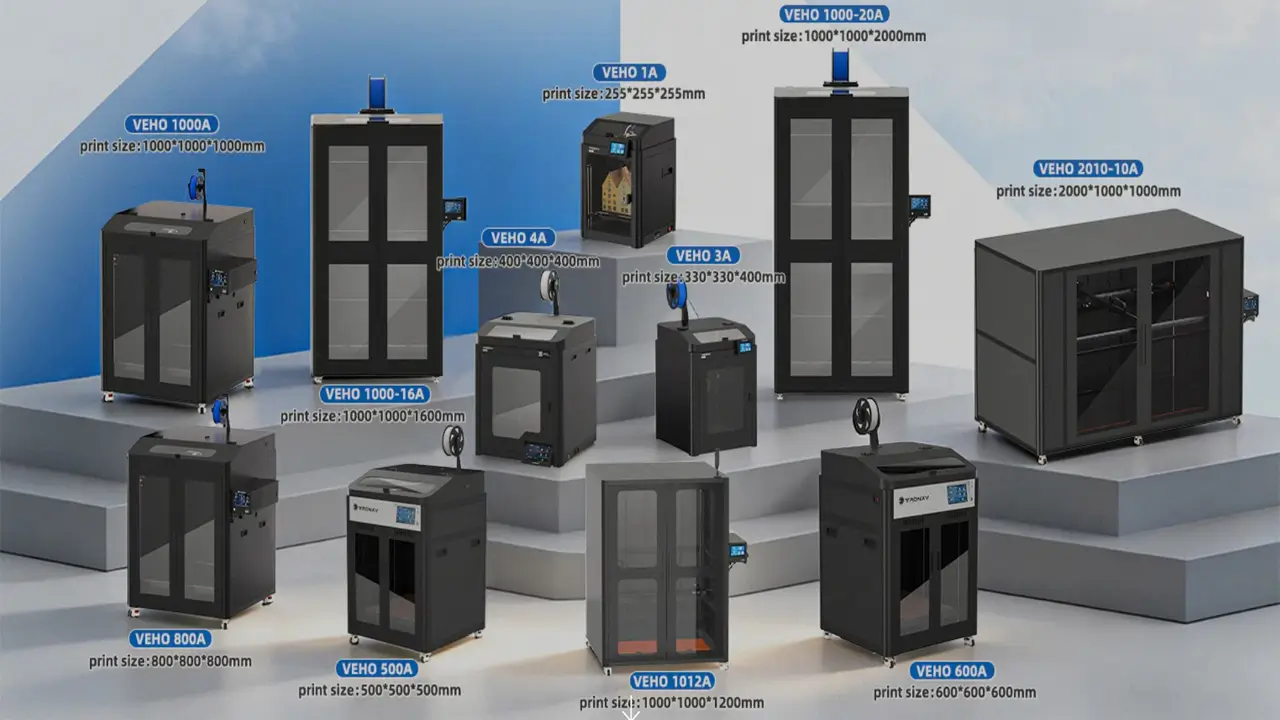
Reliable FDM Printers
Affordable and reliable 3D printers from Tronxy. Wide range of models for beginners and enthusiasts, with sturdy construction and consistent performance for everyday printing.
Assembly Experience — Tronxy X5SA 500 Assembly Guide
The Tronxy X5SA 500 2E arrives as a DIY kit. This is not a plug-and-play printer. It ships disassembled in a large box (package dimensions approximately 890 × 600 × 210 mm, weight ~28 kg), and assembly will take the average experienced user between 4 and 8 hours.
It is an assembly machine, more suitable for enthusiasts with 3D printing experience. It is a high difficulty challenge for newcomers — though the DIY assembly process is also part of the fun.
Here’s a realistic breakdown of the assembly process:
Frame construction comes first. The aluminum extrusion profiles bolt together in a logical order, and the manual provides clear enough guidance for those with prior experience. Squaring the frame is critical — an out-of-square frame will cause print problems later, so use a reliable square tool at this stage.
Motion system installation involves mounting the CoreXY belt routing, carriages, and stepper motors. The belt tension on a 500 mm format machine is more demanding than on smaller printers — both X and Y belts need to be taut and equal in tension. Unequal tension is a common source of skewed prints.
Bed installation is one of the heavier assembly steps. The 500 × 500 mm heated bed plate is substantial. The FPC cord design — lightweight, thin thickness, and easy plug-in — makes electrical connections for the bed easier, with each cable end reinforced with a stiffener for strain relief.
Electronics wiring closes out the build. The wiring harness is color-coded, and the 32-bit mainboard’s connections are labeled. Take time here — a misconnected stepper motor will cause the axis to move in the wrong direction, and checking wiring before first power-on is a worthwhile habit.
The kit includes a full metal frame, color touch screen, automatic leveling system, and resume power failure function.
First-time Tronxy assemblers should budget an extra hour for leveling and first-layer calibration. The 16-point auto-leveling TR sensor does most of the heavy lifting, but a manual first-layer Z-offset calibration print is recommended before diving into large models.
Print Quality and Performance — Tronxy X5SA 500 2E Review
Once dialed in, the X5SA 500 2E delivers print quality consistent with its positioning in the enthusiast segment. Let’s be specific about what “dialed in” means here.
For single-material PLA prints at 60 mm/s with 0.2 mm layer height, surface quality is clean and consistent. Layer lines are even, corners are sharp, and large flat surfaces come out without the bed adhesion problems that plague cheaper heated beds. The lattice glass print surface provides excellent first-layer adhesion for PLA and PETG, and prints release cleanly after the bed cools.
The positioning accuracy achieves X/Y: ±0.00625 mm and Z: ±0.00125 mm, which represents genuinely competitive precision for a printer at this price point.
For large-scale prints — think objects spanning 400+ mm — the dual Z-axis design proves its value. Tall prints maintain dimensional consistency from the base to the top without the Z-wobble artifacts that haunt single-screw designs.
ABS printing requires more attention. A 500 × 500 mm ABS print will warp aggressively without an enclosure. The X5SA 500 2E is an open-frame printer, which means ambient temperature control becomes the user’s responsibility. Dedicated enclosure builds (either purchased or DIY cardboard/acrylic) are strongly recommended for ABS and ASA.
PETG is a comfortable middle ground — printing at around 240°C nozzle and 70–80°C bed, it delivers strong, slightly flexible parts with excellent layer adhesion and minimal warping concerns on large prints.
The printer supports PLA, ABS, TPU, PETG, and other materials, which is a competitive material range for the price point. TPU (flexible filament) is manageable with the Bowden Titan extruder configuration, though it requires reduced print speeds and careful retraction tuning.
For dual-color prints specifically, results depend heavily on slicer configuration. Well-calibrated dual-color prints produce clean, vibrant color separations with minimal bleeding at transition zones. The key variables are purge tower volume, wipe settings, and retraction distance — all tunable in Cura and the Tronxy slicer.
Upgrade Potential — Tronxy X5SA Upgrade Guide
One of the most compelling aspects of the X5SA 500 2E is how upgrade-friendly the platform is. The open-frame design, Marlin firmware support, and active community mean there’s a well-trodden path of improvements available.
Klipper is an open-source firmware known for its advanced features and smooth motion control. Tronxy offers dedicated Klipper firmware upgrade kits for the X5SA series, potentially improving print quality and speed. While offering more control and performance gains, Klipper requires a steeper learning curve and may not be suitable for everyone.
A direct drive extruder upgrade replaces the stock Bowden extruder with a direct drive system, improving filament control and reducing retraction distance — leading to potentially sharper prints and better performance with flexible filaments.
A laser module add-on allows you to engrave designs or markings onto various materials, expanding the functionalities of your X5SA beyond 3D printing. Additional options include ball screw upgrades for smoother Z-axis movement, improved hotend and nozzle options for specific printing needs, and a larger bed surface for accommodating larger prints.
Here’s a practical upgrade priority list for the X5SA 500 2E:
The first priority is an all-metal hotend. The stock hotend is adequate for PLA and PETG, but switching to a full all-metal variant unlocks reliable printing above 240°C for PC, Nylon, and high-performance materials.
The second priority is PEI spring steel sheet. The stock glass lattice surface is decent, but a PEI-coated spring steel sheet offers better adhesion, easier print removal, and greater durability over time.
The third priority is a Raspberry Pi running OctoPrint or Klipper. Remote print monitoring, time-lapse capability, and Klipper’s advanced input shaping features transform the printing experience on long large-format jobs.
The fourth priority is an enclosure. For any serious ABS or ASA work, an enclosure is non-negotiable at this bed size. DIY enclosures using aluminum frame and polycarbonate panels are popular in the community.
The fifth priority is a firmware update to the latest Marlin release or a full Klipper migration. Upgrading firmware can potentially improve bug fixes, introduce new features, or optimize performance — but it’s crucial to follow the manufacturer’s instructions carefully to avoid any issues.
Polimerukr.com
Ukraine
3D Printing Materials & Supplies
Your trusted source for high-quality 3D printing materials in Ukraine. Wide selection of filaments, resins, and accessories for all printer types with fast local shipping.
Who Needs This Printer? CoreXY 3D Printer Large Build Volume Buyers
The Tronxy X5SA 500 2E occupies a very specific niche. Understanding whether you fit that niche is important before spending your budget.
This printer is ideal for experienced FDM users who want to scale up their projects. If you’ve been splitting large models into sections and gluing them, this machine eliminates that workflow entirely. Cosplayers, prop makers, scale modelers, architectural professionals, and prototype engineers with large-part requirements will find genuine value here.
It’s also compelling for those interested in dual-color and multi-material printing on a large scale. At its price point, it offers capabilities typically found in printers costing twice as much. The dual extruder system works well for multi-color models and for using soluble supports.
Makers who enjoy tuning, upgrading, and optimizing their machines will feel right at home. The platform rewards investment of time and knowledge — the more you put into understanding it, the better it performs.
However, there are clear cases where this printer is NOT the right choice. If you want a printer that works immediately out of the box with minimal setup, this is the wrong machine — look at pre-assembled options like the Bambu Lab A1 or similar ready-to-print printers. If you primarily print small, detailed objects (miniatures, jewelry, small mechanical parts), the large format adds zero value and considerable inconvenience. If your workspace is small, a 940 × 780 mm footprint machine is simply not physically practical. And if you have no experience with FDM 3D printing at all, the assembly complexity and calibration demands will likely lead to frustration.
| Buy It If You Are… | Skip It If You Are… |
|---|---|
| An experienced FDM user scaling up prints | A beginner wanting plug-and-play printing |
| A cosplayer, prop maker, or scale modeler | Primarily printing small or detailed items |
| Interested in dual-color / soluble support printing | Short on workspace (needs ~1m² footprint) |
| A tinkerer who enjoys tuning and upgrading | Someone who wants zero assembly |
| Looking for large-format value vs. cost | Needing maximum reliability out of box |
Final Verdict — Tronxy 3D Printer Review Summary
The Tronxy X5SA 500 2E is a genuinely impressive machine for what it offers at its price point — but it demands respect for what it is. It’s a large-format CoreXY DIY kit with dual extrusion, not a consumer appliance. The distinction matters.
When properly assembled, leveled, and calibrated, it produces large prints at competitive quality. The CoreXY system at this scale delivers real advantages over Cartesian alternatives. The dual Titan extruder setup opens doors to creative printing possibilities that most printers in this price range simply can’t offer. The open Marlin firmware platform means it grows with you as your skills develop.
The challenges are real too. Assembly takes time and patience. Dual-color calibration has a learning curve. The open frame limits high-temperature material printing without additional modifications. And customer support, as with most direct-from-manufacturer Chinese brands, can be inconsistent.
| Pros | Cons |
|---|---|
| Enormous 500×500×600 mm build volume | Long, complex assembly process |
| CoreXY system — stable at large scale | Open frame limits ABS/ASA without enclosure |
| Dual Titan extruder for 2-color prints | Dual-color calibration takes practice |
| 32-bit ARM mainboard + TMC2225 silent drivers | Large physical footprint (~1 m² desk space) |
| Marlin firmware — open source and upgradeable | Customer support can be slow or inconsistent |
| 16-point auto-leveling TR sensor | Bowden drive limits flexible filament performance |
| 24V power system — efficient bed heating | No WiFi connectivity out of the box |
| Wide material support (PLA, ABS, PETG, TPU, PC…) | DIY only — not suitable for complete beginners |
| Excellent upgrade path (Klipper, direct drive, etc.) | Bed warmup time is longer due to large surface |
| CE and FCC certified | No enclosure included |
Against the competition in the large-format CoreXY space — machines like the Creality CR-10 Max or the Artillery Genius Pro — the X5SA 500 2E’s dual extrusion capability is a meaningful differentiator. Few machines offer both 500 mm format and dual-color printing at a comparable price. At $750–850, it’s the most expensive variant in the X5SA lineup but offers capabilities typically found in printers costing twice as much.
The bottom line: if you’re an experienced maker with a large project ambition, a genuine interest in dual-color printing, and the patience to assemble and calibrate a complex kit — the Tronxy X5SA 500 2E is one of the best-value large-format options in its class. It’s a printer that rewards the curious, the patient, and the mechanically inclined. If that’s you, it’s hard to find a better deal for the build volume and feature set you get in return.
Tronxy X5SA-500-2E
Large-format dual extrusion 3D printer from Tronxy. Spacious build volume, independent dual extruders, and reliable performance for multi-material printing and large-scale prototypes.
- • 500×500×400 mm Build
- • Dual Extrusion System
- • Auto Bed Leveling
- • Resume Print Function
🇬🇧 John Miller — ⭐⭐⭐⭐⭐
Great review of the Tronxy X5SA 500 2E! The article is detailed, easy to follow, and реально helps understand the pros and cons of this large-format CoreXY printer. The site has a clean structure and useful insights. Highly recommend!
🔗 https://bestchina3dprinters.com/
🇪🇸 Carlos Ramírez — ⭐⭐⭐⭐⭐
Excelente análisis del Tronxy X5SA 500 2E. La información es clara y bien organizada, perfecta tanto para principiantes como para usuarios avanzados. El sitio es muy útil para elegir impresoras 3D.
🔗 https://bestchina3dprinters.com/
🇸🇦 أحمد العلي — ⭐⭐⭐⭐⭐
مراجعة رائعة لطابعة Tronxy X5SA 500 2E. الشرح مفصل وسهل الفهم، والموقع يحتوي على معلومات قيمة ومحدثة عن الطابعات ثلاثية الأبعاد. أنصح به بشدة.
🔗 https://bestchina3dprinters.com/
🇨🇳 李伟 — ⭐⭐⭐⭐⭐
这篇关于 Tronxy X5SA 500 2E 的评测非常专业,内容全面且易于理解。网站设计简洁,信息丰富,是寻找3D打印机评测的好地方。
🔗 https://bestchina3dprinters.com/
🇫🇷 Pierre Dubois — ⭐⭐⭐⭐⭐
Très bon article sur la Tronxy X5SA 500 2E. Les explications sont claires et détaillées, avec une vraie valeur ajoutée pour les passionnés d’impression 3D. Le site est fiable et bien structuré.
🔗 https://bestchina3dprinters.com/
🇩🇪 Markus Schneider — ⭐⭐⭐⭐⭐
Sehr informativer Testbericht zur Tronxy X5SA 500 2E. Die Analyse ist präzise und hilfreich, besonders für große CoreXY-Drucker. Die Website bietet hochwertige Inhalte und ist definitiv einen Besuch wert.
🔗 https://bestchina3dprinters.com/
Discover more from bestchina3dprinters.com
Subscribe to get the latest posts sent to your email.