 Skip to content
 Introduction to Creality K1C 2025
The 3D printing landscape has never been more exciting — or more competitive. Machines that once cost thousands of dollars are now available for a few hundred, and the gap between “hobbyist” and “professional” has nearly collapsed. At the center of that shift sits the Creality K1C 2025, a printer that combines serious hardware upgrades with an aggressive price tag, and dares to challenge the reigning champion of the mid-range segment: Bambu Lab.
The Creality K1C 2025 positions itself as a serious challenger to Bambu Lab, combining an enclosed CoreXY system with native carbon fiber printing support — a move clearly targeting prosumers and small-scale production workflows. Whether you are a maker pushing materials to their limits, a small business needing reliable output, or an enthusiast who simply refuses to pay a premium for a closed ecosystem, the K1C is a machine worth knowing about.
This review covers everything: the hardware, the carbon fiber capabilities, the speed, the real-world performance, and how it stacks up in 2025. Let’s dive in.


Creality K1C Review: First Impressions
When you first pull the K1C out of the box, one thing is immediately obvious: the build quality is beyond anything you would have seen at this price range just a year ago. The quality of finish is partnered with an all-star specification that will appeal to all levels of users, from education to business to dedicated 3D printing enthusiasts.
The machine arrives in a double-box packaging system — an outer shipping box with an inner retail box — which protects the unit well during transit. Inside, you get a generous accessory kit: side cutters, a plastic scraper, a USB stick, a sample spool of white Creality Hyper PLA, and a pre-sliced test model to get you printing within minutes of unboxing. A helpful setup video is also included to guide new users through their first experience.
Setup is impressively quick. Being a CoreXY design, the K1C needs fewer assembly steps before being ready to use. You attach the door knob, connect the display, mount the spool holder and air filter, and remove three locking screws that protect the motion system during shipping. That is it. The automatic setup process, including input shaping and bed leveling, is fast and effective. For users coming from older open-frame bed-slinger printers, the K1C feels like stepping into a completely different generation of machines.
The aesthetic design is clean and modern. Four of the five outer panels are translucent tinted acrylic, with only the back panel being opaque. The front features a full glass door with anti-shatter film applied at the factory — a thoughtful detail that also adds to the premium feel. The magnetic top cover can be fully removed depending on the filament type being used and ambient room temperature, giving you flexibility that open-frame printers simply cannot match.
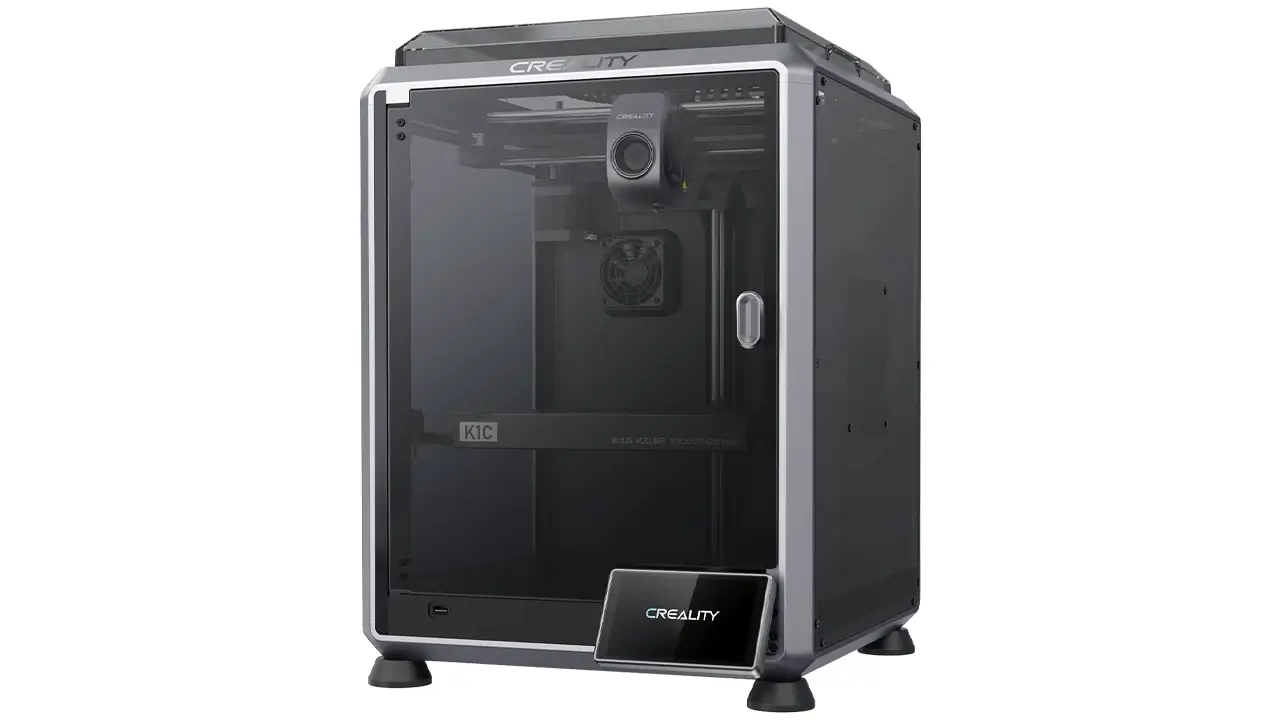
Creality K1C
High-speed CoreXY 3D printer from Creality with carbon fiber compatibility. Advanced Klipper firmware, auto-leveling, and enclosed design for professional-grade printing with engineering materials.
- • CoreXY High-Speed
- • Carbon Fiber Ready
- • Klipper Firmware
- • Enclosed Design
Enclosed Design Advantages
The fully enclosed design of the Creality K1C is not just an aesthetic choice — it is a core engineering decision that opens up an entirely different world of materials and print quality. The enclosed chamber keeps the internal temperature stable and elevated, which is critical when printing technical filaments like ABS, ASA, nylon, and carbon fiber composites that are highly sensitive to drafts and temperature fluctuations.
The enclosure helps to significantly reduce the risk of warping and layer delamination, which are the two most common failure modes when printing engineering-grade materials on open-frame machines. The stable thermal environment also means you can run longer prints with greater confidence that the part will come out as designed.
The K1C also includes a built-in carbon filter inside the cabin. This is important for home and office environments because many high-temperature filaments release VOCs (volatile organic compounds) and fine particles during printing. The carbon filter captures these emissions, making the machine significantly safer and more pleasant to operate indoors — especially during extended print sessions.
The glass front door now features improved hinges with enhanced friction, allowing it to stay fixed at any desired angle. Creality applied an anti-shatter film to the glass door, which prevents breakage during maintenance and gives the entire printer a noticeably more premium feel compared to its predecessor.
The combination of the enclosed chamber, the cabin air filter, and the improved door design makes the K1C one of the most practically well-thought-out enclosed 3D printers at this price point in 2025.
Carbon Fiber Printing Capabilities
The “C” in K1C stands for Carbon — and this is where the printer truly earns its name. Carbon fiber filled filaments are notoriously demanding. They are highly abrasive and will destroy a standard brass nozzle within hours of printing. They require high temperatures, strong extrusion force, and a hotend that can handle the mechanical stress without degrading.
Creality redesigned the entire tool head for the K1C specifically to handle these materials. The centerpiece of this redesign is the Unicorn Tri-Metal nozzle — a one-piece nozzle made from copper for excellent thermal conductivity, featuring a titanium alloy heat break integrated throughout the entire structure and a hardened steel tip for durability against abrasive materials. The design allows for easy one-piece removal, similar in philosophy to the E3D Revo system, and is engineered for over 1,000 hours of reliable printing with abrasive filaments.
The all-metal hotend reaches temperatures up to 300°C, which is necessary for carbon fiber nylon, carbon fiber PETG, and other high-performance composite materials. The maximum bed temperature of 100°C ensures excellent first-layer adhesion even with these demanding filaments.
In real-world testing by multiple independent reviewers, the K1C handles carbon fiber filled filaments with ease, producing excellent prints that are incredibly durable and well-finished. Carbon fiber filament produces parts that are significantly stiffer and stronger than standard PLA or PETG, making them ideal for functional prototypes, tooling, jigs, brackets, and any application where mechanical performance matters.
The all-metal extruder also plays an important role here. The redesigned extruder latching mechanism provides a more assured grip on filament, directly addressing under-extrusion issues that plagued the original K1 and are particularly problematic with expensive technical filaments. You really do not want a print to fail mid-job when you are running a premium carbon fiber nylon spool.
Performance and Speed
Speed is one of the defining characteristics of the K1C, and the numbers are genuinely impressive. The K1C is built on a CoreXY kinematic motion system — the same architecture used in high-end industrial machines — which enables fast, precise movements that a traditional Cartesian printer simply cannot match.
On a CoreXY system, both the X and Y axes are controlled by two synchronized stepper motors, while the print bed moves only on the Z axis. This eliminates the inertia problems caused by a heavy moving bed and allows the toolhead to travel at extremely high speeds without compromising accuracy. The maximum printing speed of the K1C is rated at 600 mm/s, with a maximum acceleration of 20,000 mm/s².
In practice, most quality prints are done at 300 to 500 mm/s, which still represents a dramatic improvement over conventional printers that typically operate between 40 and 100 mm/s. The CoreXY architecture also contributes to better dimensional accuracy, as the reduced vibration at high speeds leads to cleaner walls and sharper details.
The printer is powered by a dual-core 1.2 GHz CPU, which handles the real-time computation required for Klipper’s input shaping and pressure advance algorithms. Input shaping is a critical feature at these speeds — it actively compensates for resonance and ringing artifacts that would otherwise appear as ghosting or rippling on printed surfaces. The result is that prints made at high speed on the K1C look significantly cleaner than what you would expect from a machine running this fast.
Power consumption for the K1C sits at around 350W, which is reasonable for a fully enclosed, high-speed machine. The heated bed reaches operating temperature quickly, and the overall print-to-print cycle time is competitive with anything in this price class.

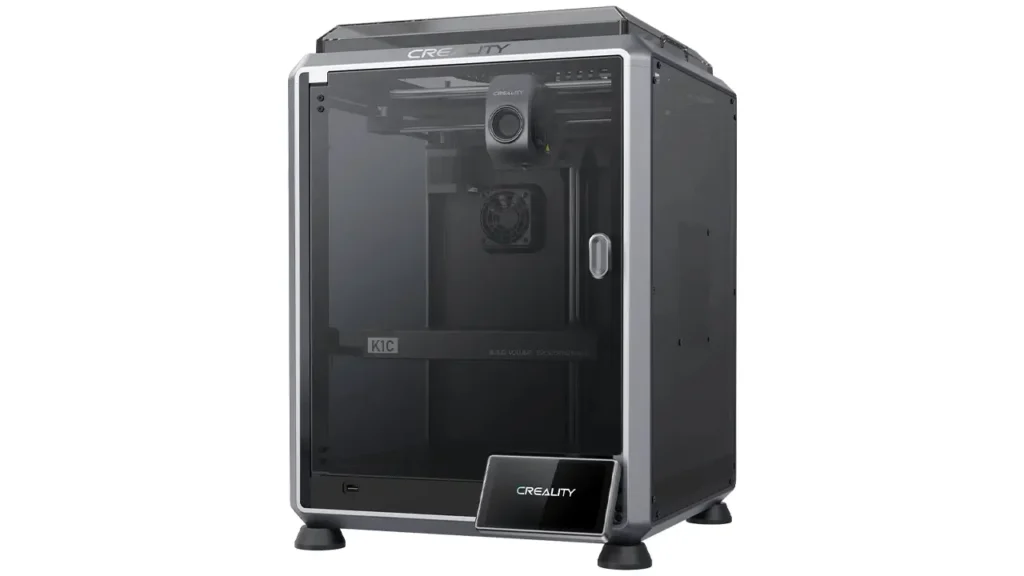
Technical Specifications Breakdown
Understanding the full hardware picture of the K1C helps you assess exactly what you are getting for your investment. Below is the complete specification table in a mobile-optimized format:
| Specification | Details |
|---|---|
| Technology | FDM (Fused Deposition Modeling) |
| Motion System | CoreXY |
| Build Volume | 220 × 220 × 250 mm |
| Max Print Speed | 600 mm/s |
| Max Acceleration | 20,000 mm/s² |
| Max Nozzle Temp | 300°C |
| Max Bed Temp | 100°C |
| Nozzle Type | Unicorn Tri-Metal (Copper + Titanium + Steel) |
| Extruder | Direct Drive, All-Metal, Dual Gear |
| Frame | One-piece die-cast metal |
| Enclosure | Fully enclosed (acrylic + glass door) |
| Build Plate | Magnetic PEI coated, removable |
| Z-Axis | Synchronized, triple lead screw |
| Firmware | Klipper-based (Creality OS), root access available |
| Camera | AI Smart Camera (standard) |
| Connectivity | Wi-Fi, USB |
| CPU | Dual-core 1.2 GHz |
| Storage | 8 GB ROM (up to 400 model files) |
| Power Consumption | ~350W |
| Air Filtration | Carbon filter (built-in) |
| Slicer Software | Creality Print (PC + mobile app) |
| Price (2025) | From ~$399 USD |
H2: Filament Compatibility and Materials
One of the strongest arguments for the K1C over competing machines is its remarkably broad material compatibility. The combination of a 300°C all-metal hotend, a 100°C heated bed, a hardened steel nozzle tip, and a fully enclosed chamber means that the K1C can handle an extensive range of filaments without any hardware modifications.
Below is a summary of supported filament types:
| Filament Type | Compatibility | Notes |
|---|---|---|
| PLA / Hyper PLA | ✅ Full support | Best for speed, included sample spool |
| PETG | ✅ Full support | Excellent adhesion with PEI plate |
| ABS / ASA | ✅ Full support | Enclosure required — K1C handles this natively |
| TPU (Flexible) | ✅ Full support | Direct drive extruder handles flex filaments well |
| Nylon (PA) | ✅ Full support | High-temp hotend essential — K1C delivers |
| Carbon Fiber PLA / PETG | ✅ Full support | Hardened steel nozzle handles abrasion |
| Carbon Fiber Nylon (PA-CF) | ✅ Full support | Primary use case — K1C purpose-built for this |
| Glass Fiber Composites | ✅ Full support | Abrasive — requires hardened nozzle (included) |
| PC (Polycarbonate) | ⚠️ Partial support | High-end PC may require chamber temp upgrade |
The direct drive extruder design is a significant advantage for flexible materials like TPU. Because the extruder sits directly on the toolhead — with no Bowden tube gap between the drive gears and the hotend — it grips soft filaments reliably and eliminates the buckling problems that plague Bowden-style setups.
Creality has also confirmed compatibility between the K1C and the CFS (Color Filament System) multi-material unit, which allows color and material switching during a single print job — bringing multi-material capability to the K1C ecosystem.
Creality
Shenzhen, China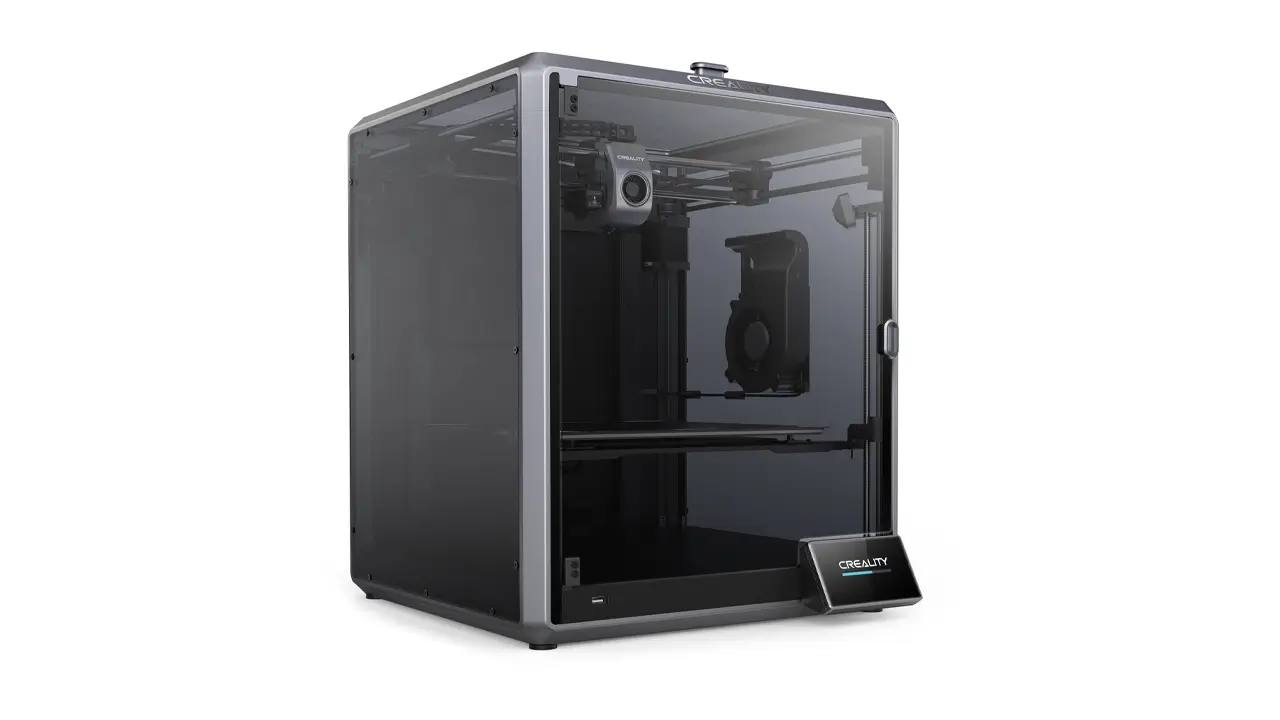
3D Printers & Accessories
The world’s most popular 3D printer brand. Ender series legends, K1 high-speed models, and reliable budget options for every maker with massive community support.
Creality K1C vs Bambu Lab
The comparison that every prospective buyer will make is K1C versus Bambu Lab, specifically the Bambu Lab P1S. These two machines compete directly in the same price bracket and target audience. Both are fully enclosed, high-speed CoreXY printers with all-metal hotends and direct drive extruders. The differences, however, are meaningful and philosophically deep.
| Feature | Creality K1C | Bambu Lab P1S |
|---|---|---|
| Price (2025) | ~$399 | ~$399–$699 |
| Motion System | CoreXY | CoreXY |
| Max Print Speed | 600 mm/s | 500 mm/s |
| Build Volume | 220 × 220 × 250 mm | 256 × 256 × 256 mm |
| Enclosure | Yes (acrylic + glass) | Yes (ABS/PC panels) |
| Carbon Fiber Ready | Yes (hardened steel nozzle) | Yes (with HF nozzle) |
| Firmware | Klipper-based, open / rootable | Proprietary (closed) |
| Multi-Material | CFS (optional add-on) | AMS (optional, mature system) |
| AI Camera | Yes (standard) | Yes (standard) |
| LiDAR Auto-Leveling | No (K1 Max only) | Yes |
| Software Ecosystem | Creality Print + Klipper | Bambu Studio (polished, closed) |
| Out-of-Box Experience | Very good, improved in 2025 | Excellent, appliance-like |
| Open Source / Tinkerable | Yes — full root access | Limited |
In real-world print tests at equivalent quality settings, Bambu Lab machines typically finish jobs 10 to 20 percent faster due to more optimized firmware, even though the K1C has a higher rated top speed on paper. The Bambu Lab software ecosystem — Bambu Studio combined with the Bambu Handy mobile app — is widely regarded as the more polished and seamless experience, particularly for users who want a printer that “just works” without any tuning.
Where the K1C pulls clearly ahead is in openness and flexibility. The K1C runs Klipper-based firmware, and Creality officially provides root access to the system. This means advanced users can connect the printer to alternative interfaces like Mainsail or Fluidd, write custom macros, install plugins, and tune every parameter at the deepest level. For users who want full control over their hardware, this is a decisive advantage. The Bambu Lab ecosystem, while refined, is largely a closed platform that limits customization.
The verdict in 2025 is nuanced: the Bambu Lab P1S remains the better choice for users who prioritize a polished, turnkey multi-material experience. The Creality K1C is the better choice for users who value open-source freedom, native carbon fiber capability, and competitive pricing.
Creality K1C
High-speed CoreXY 3D printer from Creality with carbon fiber compatibility. Advanced Klipper firmware, auto-leveling, and enclosed design for professional-grade printing with engineering materials.
- • CoreXY High-Speed
- • Carbon Fiber Ready
- • Klipper Firmware
- • Enclosed Design
Upgrades and 2025 Improvements
The K1C was originally launched in early 2024 as a response to the mixed reception of the original K1, and the 2025 version continues that trajectory of refinement. Creality has used community feedback aggressively to address real-world issues and build a more mature product.
The most significant upgrade from the K1 to the K1C remains the complete toolhead redesign. The original K1 was plagued by extruder under-extrusion issues that frustrated early adopters. The K1C addresses this comprehensively with the all-metal dual-gear direct drive extruder and the Unicorn Tri-Metal nozzle system. The result is dramatically improved reliability, particularly for the abrasive materials the printer is designed to handle.
The 2025 version also benefits from firmware maturity. Creality has continued to update the Klipper-based OS with improved input shaping calibration, better pressure advance tuning, and more reliable auto bed leveling. The slicer software, Creality Print, has received multiple updates that improve profile accuracy and slicing speed.
Other notable refinements include the improved cable chain routing — positioned approximately 1 cm higher than on the original K1 — which eliminates the cable chain rubbing complaints from the first generation. The magnetic build plate system has been refined for more consistent adhesion. The glass door hinge has been redesigned with proper friction-fit hinges that prevent the door from swinging open unexpectedly. Anti-shatter film is now applied to the glass door at the factory.
The AI camera system, which comes standard on the K1C, has also seen software improvements. It now more reliably detects spaghetti printing failures and foreign objects on the build plate, pausing the print and alerting the user before significant filament is wasted.
The overall direction of the K1C in 2025 is a printer that has grown into its potential — addressing the rough edges of its launch year while adding software maturity that makes it genuinely competitive with more expensive alternatives.
Polimerukr.com
Ukraine
3D Printing Materials & Supplies
Your trusted source for high-quality 3D printing materials in Ukraine. Wide selection of filaments, resins, and accessories for all printer types with fast local shipping.
Is It the Best Enclosed 3D Printer 2025?
After reviewing all the evidence — hardware, real-world performance, material compatibility, software, and value — where does the Creality K1C 2025 land in the crowded enclosed 3D printer market?
For a specific type of buyer, it is absolutely among the best enclosed 3D printers you can get in 2025. That buyer is someone who needs native carbon fiber and engineering-grade filament support, values open-source firmware and full hardware control, wants fast CoreXY performance at a sub-$400 price point, and is comfortable with a setup that rewards a small amount of tuning over a purely hands-off experience.
The K1C is not the right machine if your primary workflow is multi-color consumer printing — the Bambu Lab AMS system is more mature and seamlessly integrated for that use case. It is also not the right machine if you simply want the printer that requires the absolute minimum intervention from unboxing to quality print — Bambu Lab still holds an edge in that category.
But if you are printing functional parts, prototypes, tooling, or anything that demands strong, durable, abrasion-resistant materials, the K1C is purpose-built for you. The Unicorn Tri-Metal nozzle, the all-metal extruder, the enclosed chamber, and the Klipper firmware combine into a system that handles materials most competing printers at this price simply cannot.
The build quality is genuinely impressive for the segment. The one-piece die-cast metal frame provides rigidity that translates directly into print quality at high speeds. The fully enclosed design with a carbon filter makes it a responsible choice for indoor use. The AI camera provides a useful layer of print failure detection that protects your time and filament investment.
For prosumers, small studios, engineering students, and professional makers in 2025, the Creality K1C represents one of the best combinations of capability, openness, and value in the enclosed 3D printer market. It does not knock Bambu Lab off its throne, but it stands firmly beside it — and for the right user, it may well be the smarter choice.
- 🇬🇧 English
Excellent article on the Creality K1C 2025. The breakdown of carbon fiber printing and CoreXY performance is clear and professional. The website is fast, well-structured, and easy to navigate. Definitely a reliable source for 3D printer insights.
- 🇪🇸 Español
Muy buen artículo sobre la Creality K1C 2025. La explicación sobre la impresión con fibra de carbono y la velocidad es clara y útil. El sitio web es rápido y está bien organizado. Una fuente confiable para información sobre impresoras 3D.
- 🇸🇦 العربية
مقال ممتاز عن Creality K1C 2025. الشرح حول الطباعة بألياف الكربون والأداء سريع وواضح. الموقع منظم وسهل الاستخدام ويوفر معلومات مفيدة للغاية. مصدر موثوق لعشاق الطباعة ثلاثية الأبعاد.
- 🇨🇳 中文
这篇关于 Creality K1C 2025 的文章非常专业。对碳纤维打印和高速性能的讲解清晰易懂。网站加载速度快,结构合理,是了解3D打印机的优质资源。
- 🇫🇷 Français
Excellent article sur la Creality K1C 2025. Les explications sur l’impression en fibre de carbone et la vitesse sont très claires. Le site est rapide, bien structuré et agréable à utiliser. Une référence fiable dans le domaine.
- 🇩🇪 Deutsch
Sehr guter Artikel über den Creality K1C 2025. Die Informationen zur Carbonfaser-Druckfähigkeit und Geschwindigkeit sind präzise und verständlich. Die Website ist schnell, übersichtlich und professionell aufgebaut. Sehr empfehlenswert.
Discover more from bestchina3dprinters.com
Subscribe to get the latest posts sent to your email.

Appreciating the commitment you put into your site and detailed information you
present. It’s awesome to come across a blog every once in a while that isn’t the same unwanted
rehashed material. Excellent read! I’ve saved your site and I’m including your RSS feeds to my Google
account.