Introduction to QIDI Max4
If you have been paying attention to the world of desktop 3D printing lately, you know things are moving incredibly fast. Machines that used to cost tens of thousands of dollars are now landing on workbenches for a fraction of that price — and the QIDI Max4 is one of the most exciting examples of that shift in action.
Debuted at Formnext 2025, the global additive manufacturing event in Germany, the QIDI Max4 stands out as a flagship large-format 3D printer that QIDI positions as the largest print size among consumer-grade enclosed printers, while still maintaining excellent printing accuracy — successfully tackling the longstanding industry challenge of achieving both large print size and high precision at the same time.
This is not just an incremental upgrade. The Max4 is a ground-up rethink of what a professional desktop printer should be. It combines an enormous build volume, a fully heated enclosure, high-speed CoreXY motion, AI-driven print monitoring, and broad engineering material support — all wrapped up in a machine that targets engineers, makers, small studios, and anyone who has outgrown the limitations of standard desktop printers.
The QIDI Max series has always been known for large-format and versatile printing capabilities. The Max4 takes that mission further than ever before, with a build volume 55% larger than its predecessor the Max3, and a completely redesigned internal structure built to deliver industrial-grade stability at a consumer-accessible price. Whether you are prototyping functional mechanical parts, producing small batches of engineering components, or simply want to stop splitting large models into smaller pieces, the QIDI Max4 was built with you in mind.
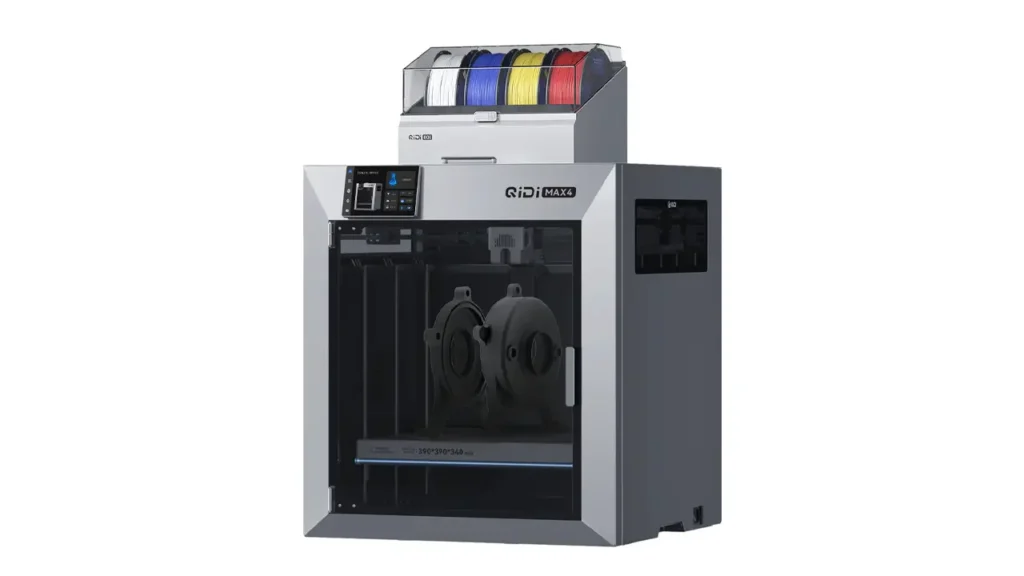
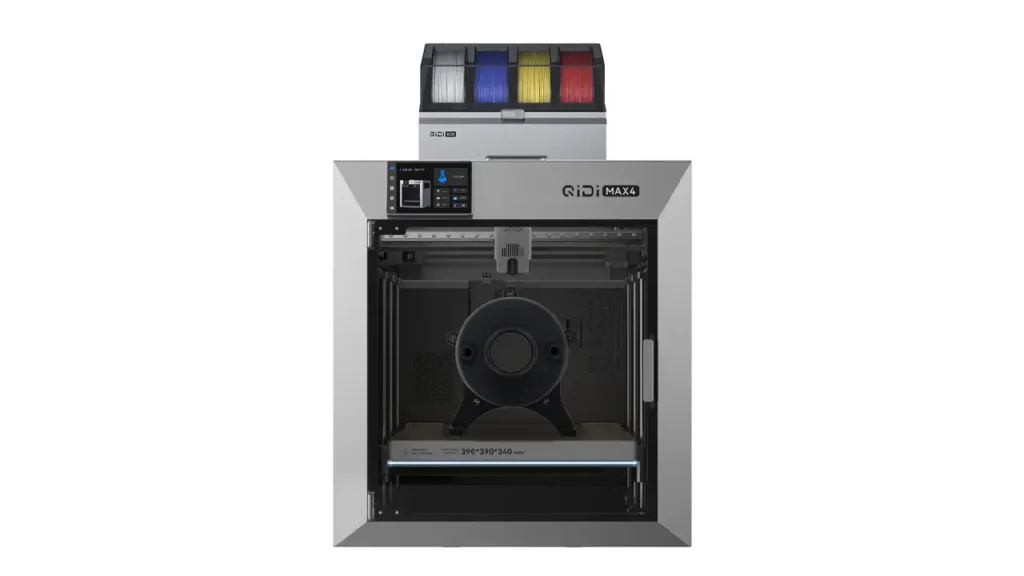
Design and Build Quality
First impressions of the QIDI Max4 are hard to ignore. The printer carries an external footprint of 558 × 578 × 612 mm, which makes it a substantial presence on any workbench — but every centimeter of that size is justified by what is inside.
The QIDI Max4 3D printer features a completely redesigned, industry-grade internal structure that prioritizes precision, stability, and speed. The enclosure is fully sealed, which is essential for high-temperature material printing, and QIDI has clearly put serious thought into thermal management, airflow, and structural rigidity throughout the entire design.
The CoreXY motion system is one of the defining characteristics of the Max4. Unlike bed-slinger designs where the print bed moves back and forth during printing, a CoreXY setup keeps the bed stationary on one axis and moves only the lightweight toolhead, allowing for significantly higher speeds and lower vibration at the same time. This is exactly the kind of motion architecture that enables the Max4 to reach its headline speeds without sacrificing print quality.
The frame itself is built for long-term durability. Industrial-grade linear rails guide the motion system, and QIDI uses custom 1.5GT belts specifically designed to reduce Vertical Fine Artifacts — the subtle banding patterns that can appear on fast CoreXY prints. This is a meaningful engineering decision, not just a marketing point. The result is a machine that feels solid and precise, with none of the flex or wobble that can plague cheaper large-format printers.
The Z-axis also deserves mention. QIDI engineered the Z-axis with 2 mm lead screws and an anti-backlash nut to maintain exceptional stability and eliminate vertical play entirely, ensuring perfect layer placement without wobble, ghosting, or ripple effects. The combination of a rigid CoreXY frame, precision rails, quality belts, and a stable Z-axis gives the Max4 a mechanical foundation that genuinely competes with machines costing far more.
The heated bed is a 390 × 390 mm industrial design featuring a full-surface silicone thermal layer with densely distributed heating wires, described by QIDI as one of the most uniform heating designs in its class. A high-efficiency insulation cotton layer beneath the bed further stabilizes temperature across the surface, improving first-layer adhesion and reducing warping risk even at the outer edges of large prints. The bed surface itself is a textured PEI plate, which provides reliable adhesion across a wide range of materials without needing glue for standard filaments.
On top of the enclosure, the Max4 includes a 3-in-1 air filtration system combining HEPA filtration and activated carbon to capture up to 99.5% of particles and fine dust from the build chamber — a genuinely important feature for anyone running engineering materials in an enclosed space.
Technical Specifications
Before diving deeper into performance, it helps to have all the key numbers in one place. The QIDI Max4 specs are impressive across the board, and the table below summarizes the most important figures.
| Specification | Value |
|---|---|
| Build Volume | 390 × 390 × 340 mm |
| Motion System | CoreXY with closed-loop motors |
| Max Print Speed | 800 mm/s |
| Max Acceleration | 30,000 mm/s² |
| Hotend Temperature | Up to 370°C |
| Heated Chamber | Up to 65°C (active) |
| Heated Bed | Up to 120°C |
| Hotend Flow Rate | 40 mm³/s |
| Nozzle Material | Hardened steel (bimetal) |
| Bed Surface | Textured PEI plate |
| Firmware | Klipper (open source) |
| Connectivity | Wi-Fi (2.4/5GHz), Ethernet, USB, QIDI Cloud |
| Air Filtration | 3-in-1 HEPA + Carbon (99.5% particle removal) |
| Touchscreen | 5-inch color touchscreen |
| External Dimensions | 558 × 578 × 612 mm |
| Supported File Formats | STL, OBJ, 3MF, STEP/STP |
| Compatible Slicers | QIDI Studio, OrcaSlicer, PrusaSlicer |
The 390 × 390 × 340 mm build volume is the headline number, and it earns that status. At 55% larger than the previous Max3, it genuinely opens up a new class of prints. The 370°C hotend is another standout — most budget and mid-range printers max out at 260–280°C, which excludes them from printing many high-performance engineering polymers entirely. The Max4 has no such limitation.
Printing Performance
In real-world use, the QIDI Max4 3D printer delivers the kind of consistent, repeatable results that professional users depend on. First layers come out nearly perfect thanks to the automatic bed leveling system, which uses the nozzle itself as the measurement point rather than relying on separate sensors — a design choice that improves accuracy and removes one potential point of failure.
For everyday materials, the Max4 is genuinely excellent. PLA prints cleanly and quickly, with sharp details and smooth surfaces. The large heated bed ensures even adhesion across the full 390 mm width, which matters enormously when you are printing large flat parts that would warp at the edges on a lesser machine. PETG also performs well, benefiting from the stable temperature environment that the enclosure provides.
Where the QIDI Max4 truly differentiates itself is with engineering filaments. ABS, ASA, Nylon, Polycarbonate, and carbon fiber composites all print with a reliability that is rare at this price point. The actively heated chamber prevents the rapid temperature swings at the part surface that cause delamination and warping in these materials. Users printing ABS or Nylon on open-frame machines often deal with frustrating failures — the Max4 largely eliminates those issues by maintaining a consistent thermal environment throughout the entire print.
Overhangs test cleanly up to 80 degrees, which puts the Max4 at the top tier for this class of printer. Carbon fiber reinforced materials, including PA-CF and ABS-CF, print with exceptional strength and dimensional accuracy, making the Max4 suitable for functional mechanical parts that need to hold up under real load.
The printer supports a wide range of materials officially: PLA, PETG, ABS, ASA, TPU (95A and above), PA (Nylon), PC, PPS-CF, and other carbon fiber composite materials. For TPU below 85A shore hardness, QIDI notes that print quality may be affected due to the flexible nature of those filaments, and provides a dedicated wiki guide for best results.
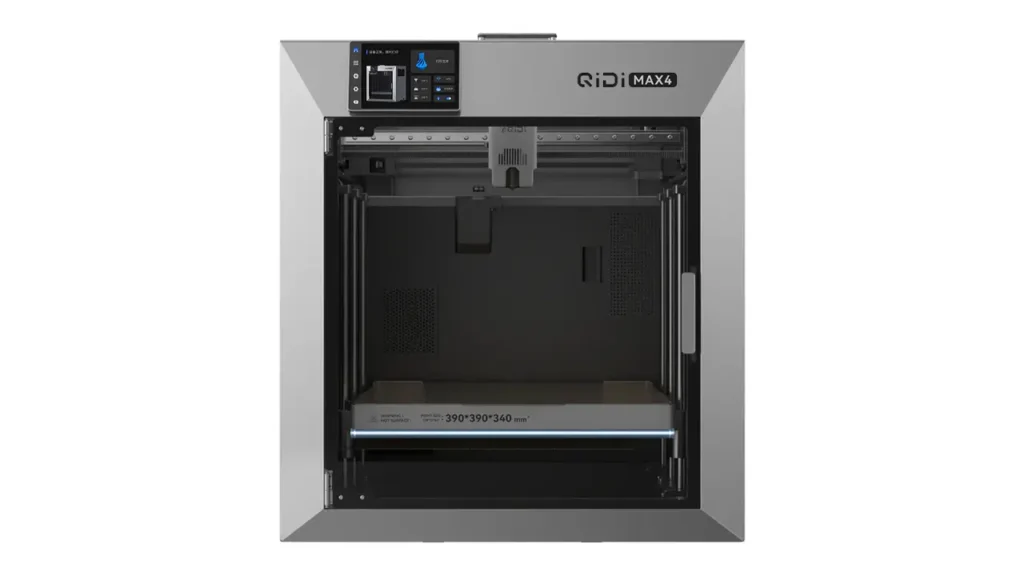
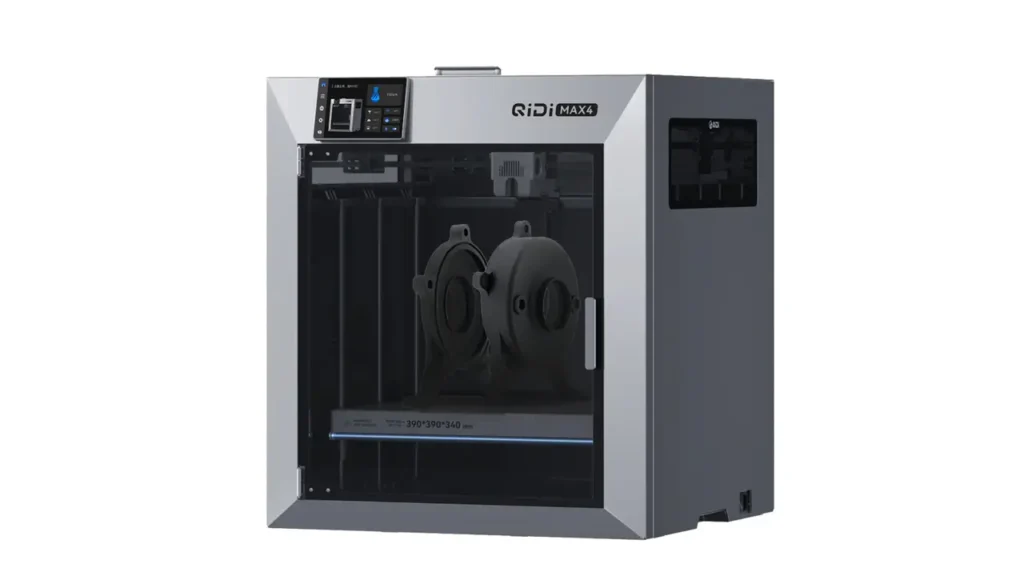
High Temperature Printing
The QIDI Max4 high temperature printer capabilities are built around two complementary systems that work together to create ideal conditions for demanding engineering filaments.
The first is the 370°C bimetal hardened steel hotend. A 370°C maximum temperature is a serious specification. It means the Max4 can handle materials like Polycarbonate, Nylon, PPS-CF, and glass-fiber composites that simply cannot be processed on standard hardware. The hardened steel nozzle adds another layer of capability — abrasive filaments like carbon fiber reinforced composites will wear through brass nozzles quickly, while hardened steel holds up over thousands of hours of use.
The second pillar is the second-generation Active Chamber Heating system. The Max4 maintains an internal chamber temperature of up to 65°C with optimized air circulation and uniform heat distribution throughout the enclosure. This is not a passive system — the chamber heating is actively managed, and the airflow is specifically designed to distribute heat evenly so that all parts of a large print experience the same thermal environment from first layer to last.
QIDI also introduced the optional “Polar Cooler” — their self-developed Active Toolhead Cooling System. This system directs cool air directly onto the extruder and filament pathway, significantly improving heat dissipation to prevent clogs. This addresses one of the key challenges in high-speed, high-temperature printing: keeping the cold zone of the hotend genuinely cold while the hot zone reaches extreme temperatures. The Polar Cooler is particularly valuable during high-speed printing sessions where heat creep can otherwise become a problem.
Together, the 370°C hotend, the 65°C actively heated chamber, and the optional Polar Cooler create a thermal management system that gives the Max4 a genuine advantage for engineering material printing compared to machines that lack active chamber heating.
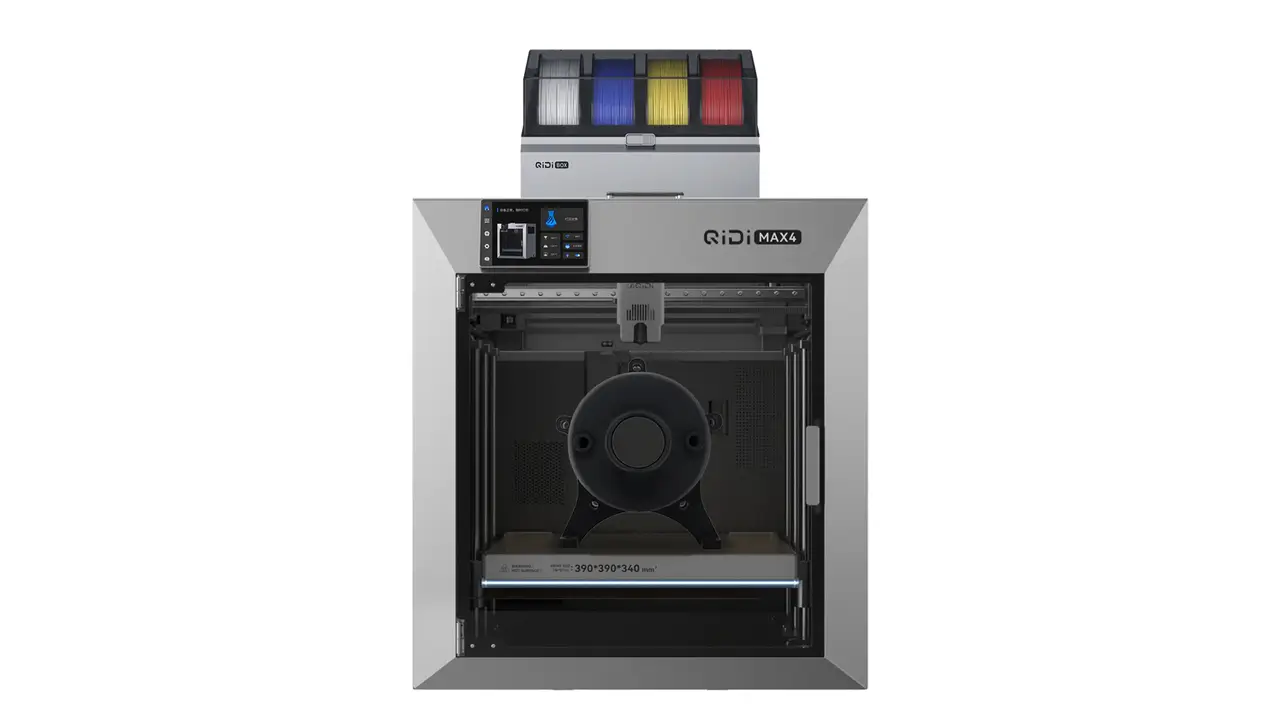
QIDI Max4
Professional large-format 3D printer from QIDI Tech. Advanced mechanics, high-temperature capability, and intelligent features for engineering materials and industrial prototyping applications.
- • Large Build Volume
- • 350°C High-Temp Hotend
- • Auto Bed Leveling
- • Engineering Materials
AI Camera and Smart Features
The QIDI Max4 AI camera system is one of the most practically useful smart features on any printer in this class. Powered by a high-performance processor, the system uses a high-definition camera to continuously monitor prints in real time, watching for issues such as spaghetti failures, where filament comes loose from the print bed and tangles into a mess, or structural collapse mid-print.
When the AI detects an anomaly, the printer automatically pauses the print and sends an alert to the user. This reduces the need for manual supervision significantly and minimizes wasted material — a meaningful benefit when you are running long prints with expensive engineering filaments that can cost several dollars per meter.
Beyond failure detection, the camera supports remote monitoring, allowing you to check on print progress from anywhere. The Max4 offers several flexible connection options for this: QIDI Cloud for remote monitoring and control over the internet, Wi-Fi on both 2.4GHz and 5GHz bands, Ethernet for stable wired local network control, and offline USB drive printing for environments where network connectivity is not available or not desired.
On the software side, the Max4 runs Klipper firmware, which is a widely respected open-source firmware platform. This means you can access the full Fluidd interface directly for complete control over printer settings, macros, and configuration without any restrictions. QIDI Studio is the recommended slicer for the best compatibility and pre-optimized print profiles, but the open Klipper base means OrcaSlicer and PrusaSlicer are also fully supported — a genuine advantage for users who have already invested time learning those tools.
The new 5-inch color touchscreen provides a fast, intuitive interface for local control, with a redesigned UI that responds quickly thanks to the high-performance processor handling both the AI monitoring and the display tasks simultaneously. The overall smart feature package makes the Max4 feel like a modern, connected machine rather than a basic printer with a camera bolted on.
Print Speed and Accuracy
The QIDI Max4 CoreXY motion system is engineered to deliver speed and precision simultaneously — two goals that are often in tension with each other at the hardware level.
The headline speed figure is 800 mm/s maximum toolhead movement, with a maximum acceleration of 30,000 mm/s². In practice, actual print speeds depend on the material and the nozzle flow rate. For high-speed PLA and ABS, volumetric flow rate is typically around 30 mm³/s, with the hotend rated for up to 40 mm³/s. QIDI has also indicated a higher-flow nozzle is planned for future release to push throughput even further.
The most significant technical upgrade enabling this performance is the new closed-loop motor system on the XY axes. Traditional open-loop stepper motors in 3D printers operate without feedback — they assume every commanded step was actually executed. Under high speed or high load conditions, steps can be missed, resulting in layer shifts and misalignment. The Max4’s closed-loop system monitors motor position through an encoder and instantly compensates for any deviation, bringing three key improvements: greater stability with dramatically reduced layer misalignment risk, improved surface accuracy through reduced torque ripple and fewer surface artifacts, and enhanced efficiency as the motors run cooler and quieter at high speeds.
The linear rails guiding the motion system are industrial-grade, providing smooth and consistent movement with minimal friction over thousands of hours of use. The custom 1.5GT belts are tuned specifically to reduce Vertical Fine Artifacts — the subtle banding patterns that appear on the walls of fast CoreXY prints. Combined with the rigid frame and the anti-backlash Z-axis, the result is a printer that can genuinely operate at high speed without the quality penalties that faster printing often brings on less sophisticated machines.
Auto bed leveling is fully automatic and handled by the nozzle itself, ensuring precise calibration across the entire 390 × 390 mm surface before every print. This removes one of the most time-consuming and error-prone manual tasks from the workflow and helps ensure consistent first-layer results regardless of how the machine is positioned or what temperature the bed is at.
QIDI Max4 vs Competitors
When evaluating the QIDI Max4 vs Bambu H2D and other large-format competitors, it helps to look at the numbers side by side before drawing conclusions.
| Feature | QIDI Max4 | Bambu H2D | Creality K2 Plus |
|---|---|---|---|
| Build Volume | 390×390×340 mm | 350×320×325 mm | 350×350×350 mm |
| Max Hotend Temp | 370°C | 350°C | 300°C |
| Heated Chamber | 65°C (active) | 65°C (active) | No |
| Max Speed | 800 mm/s | 600 mm/s | 600 mm/s |
| Max Acceleration | 30,000 mm/s² | 20,000 mm/s² | 30,000 mm/s² |
| Motion System | CoreXY + closed-loop | CoreXY + servo | CoreXY |
| AI Camera | Yes | Yes | Yes (dual cameras) |
| Firmware | Klipper (open) | Bambu OS (closed) | Klipper (open) |
| Multi-material | Yes (QIDI Box, up to 16 colors) | Yes (dual nozzle + AMS) | Yes (CFS system) |
| Starting Price | ~$1,149 | $1,899 | $1,299 |
Against the Bambu H2D, the QIDI Max4 holds some compelling advantages. The Max4 build volume of 390 × 390 × 340 mm is meaningfully larger than the H2D’s 350 × 320 × 325 mm. The Max4 also reaches a higher nozzle temperature at 370°C versus the H2D’s 350°C, which matters for the most extreme engineering polymers.
The Max4 runs open Klipper firmware, while the H2D uses Bambu’s proprietary closed operating system — a real consideration for users who want full control and customization. Price is perhaps the biggest differentiator: the Max4 starts at around $1,149 while the H2D starts at $1,899, a gap of $750 for the base units. The H2D counters with a dual-nozzle extrusion system and the mature Bambu software ecosystem, which remains best-in-class for ease of use.
Against the Creality K2 Plus, the comparison is interesting. Both printers share the same maximum acceleration of 30,000 mm/s² and similar CoreXY designs. However, the Creality K2 Plus notably lacks an active heated chamber — a fundamental disadvantage for anyone printing ABS, Nylon, or carbon fiber composites regularly. The Max4 wins clearly on thermal capability and hotend temperature. The K2 Plus costs $1,299 to the Max4’s $1,149, making the Max4 not only more capable on thermal specs but also less expensive.
The Elegoo Centauri Carbon and Anycubic Kobra S1 Combo are newer entrants in the large-format space, but neither matches the Max4’s combination of build volume, heated chamber temperature, nozzle temperature, and closed-loop motor precision at a comparable price point.
AndreevWebStudio.com
Professional web development and design services. Custom WordPress sites, landing pages, e-commerce solutions, and 3D printing content creation for businesses and creators.
- • WordPress Development
- • Custom Web Design
- • E-Commerce Solutions
- • 3D Printing Content
Price and Value
The QIDI Max4 price sits at approximately $1,149 for the base unit, with the QIDI Max4 Combo — which includes the QIDI Box multi-material unit — priced at around $1,499. Given the specifications on offer, this represents extraordinary value for professional users and serious makers.
To put that in perspective: a 370°C hotend, a 65°C actively heated chamber, a 390 × 390 × 340 mm build volume, closed-loop XY motors, industrial linear rails, AI camera monitoring, and full Klipper firmware — in years past, a printer with this feature set would have been priced at tens of thousands of dollars and sold exclusively into professional and industrial markets. The Max4 delivers all of that for a price that is within reach of individual engineers, designers, and workshop owners.
The QIDI Box multi-material unit, available separately for around $228, adds the ability to print with up to 4 spools per unit, and the Max4 can support up to 4 QIDI Box units simultaneously, enabling up to 16 different materials or colors in a single print job. This multi-material capability is genuinely useful for functional parts requiring soluble support material, or for creative projects requiring multiple colors, and adds significant versatility beyond what the base printer offers.
Operating costs are worth considering as well. The hardened steel nozzle reduces wear when printing abrasive materials, meaning fewer nozzle replacements over time. The HEPA and carbon filtration system is built in, removing the need for an external air purifier. The open Klipper firmware means no subscription fees and no vendor lock-in for software or accessories. The Max4 runs on standard filaments from any manufacturer, giving you full freedom to source materials at the best price.
For professional users who need large-format prints, reliable engineering material support, and a smart, connected workflow, the Max4 delivers a cost-per-capability ratio that is genuinely hard to beat in the current market.
Final Verdict
The QIDI Max4 is one of the most compelling large-format 3D printers available to professional users and serious makers in 2025 and 2026. It delivers a combination of features — massive build volume, high-temperature capability, closed-loop precision, AI monitoring, and open firmware — that would have been unthinkable at this price point just a few years ago.
Strengths are easy to list. The 390 × 390 × 340 mm build volume is among the largest available on any consumer-grade enclosed printer. The 370°C hotend and 65°C actively heated chamber create a genuinely capable engineering materials platform. Closed-loop XY motors deliver measurably better precision and surface quality compared to traditional open-loop stepper systems. The AI camera and QIDI Cloud integration make remote monitoring practical and useful. Open Klipper firmware means full customization freedom and compatibility with the broader 3D printing ecosystem. And the price — around $1,149 for the base unit — is remarkably aggressive for everything included.
Weaknesses are fewer but worth acknowledging. At approximately 40 kg (88 lbs), the Max4 is a heavy machine that genuinely requires two people to move and position safely. The external footprint of 558 × 578 × 612 mm demands a sturdy, dedicated surface and meaningful bench space. The Polar Cooler toolhead cooling system, which is highly recommended for high-speed engineering material printing, is sold as an optional accessory rather than included as standard. The QIDI software ecosystem, while functional and improving, is not yet at the same level of polish as Bambu Lab’s Bambu Studio environment. And the QIDI Box multi-material system, while capable, requires some setup patience to get dialed in.
The ideal audience for the QIDI Max4 is clear. This printer is built for engineers and product designers who need to prototype large functional parts in engineering-grade materials. It suits small manufacturing workshops producing batches of end-use components. It fits educators and research labs that need broad material capability and large build volume without an industrial budget. And it suits enthusiast makers who have genuinely outgrown the limitations of standard desktop printers and want a machine that can grow with their ambitions.
If your work involves large-format printing, engineering filaments like ABS, Nylon, PC, or carbon fiber composites, and you want a smart, connected, open-platform printer at a price that respects your budget — the QIDI Max4 deserves to be at the very top of your shortlist.
Discover more from bestchina3dprinters.com
Subscribe to get the latest posts sent to your email.