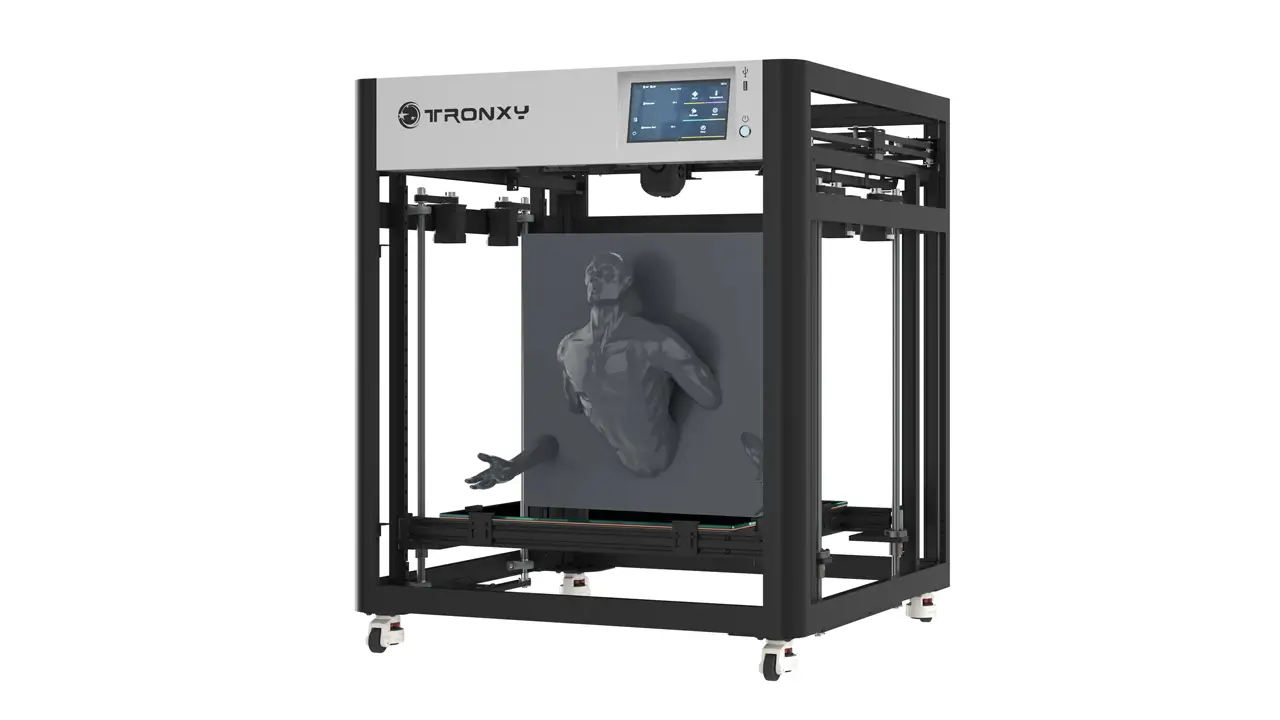
Tronxy VEHO-600 Pro V2
Advanced large-format 3D printer from Tronxy. High-speed CoreXY mechanics, auto-leveling, and robust construction for professional prototyping and production-scale projects.
- • Large Build Volume
- • High-Speed CoreXY
- • Auto Bed Leveling
- • Dual Z-Axis Stability
1. Introduction
Have you ever stared at an ambitious 3D design on your screen and thought: “If only I could print this whole thing in one go”? If that sounds familiar, the Tronxy VEHO-600 Pro V2 might be exactly the machine you have been waiting for. This is not your average desktop printer sitting quietly on a hobby desk. It is a bold, purpose-built large-format powerhouse aimed squarely at makers, engineers, educators, designers, and small-scale manufacturers who need significantly more — more build space, more speed, and more material freedom.
The Tronxy VEHO-600 Pro V2 sits at an exciting crossroads of professional capability and relative affordability within the large-format printer segment. Tronxy, a well-established Chinese 3D printer manufacturer with years of experience across consumer and semi-professional machines, developed this model as a meaningful upgrade over the original VEHO-600 Pro. The improvements touch nearly every core system: the motion architecture, the firmware, the extrusion system, and the build plate — all refined to push performance well beyond what the original offered.
In this review, we will walk through everything you need to know: what makes the VEHO-600 Pro V2 different from its predecessor, how it is constructed, its full technical specifications, real-world printing performance, supported materials, advantages and drawbacks, pricing compared to alternatives, and ultimately — who should actually buy one. Whether you are a hobbyist scaling up your ambitions or a professional seeking a capable production workhorse, there is a lot to cover here. Let’s get into it.
2. What’s New in the VEHO-600 Pro V2
The “V2” label is not just a marketing badge — this version introduces meaningful, practical upgrades across the board. The most significant change is the addition of native Klipper firmware support. Where older VEHO models relied on Marlin-based firmware, the V2 runs Klipper as standard, opening the door to a completely different level of print intelligence. Klipper enables the integration of modules such as accelerometers for resonance compensation, BLTouch for automatic bed leveling, cameras for remote monitoring, and vibration compensation algorithms — all features that meaningfully improve print quality and reliability at high speeds.
The second major upgrade is the direct drive extrusion system paired with a 320°C high-temperature hotend. This combination means the printer can handle engineering-grade materials that a Bowden-style setup would struggle with. Direct drive reduces the filament path between the motor and nozzle, which improves retraction precision and reduces stringing — a real advantage when printing complex geometries.
The build plate has also been improved. An optional 600×600 mm PEI removable spring steel plate is now available, making part removal after printing simple and damage-free. You flex the plate slightly and prints pop right off — no scraping, no tools, no frustration.
Finally, the Z-axis system has been reinforced. Four independent ball screw Z-axis assemblies now handle vertical movement, providing a level of stability that directly translates into consistent layer quality on tall prints — something that a large-format printer absolutely needs to get right.
3. Design and Build Quality
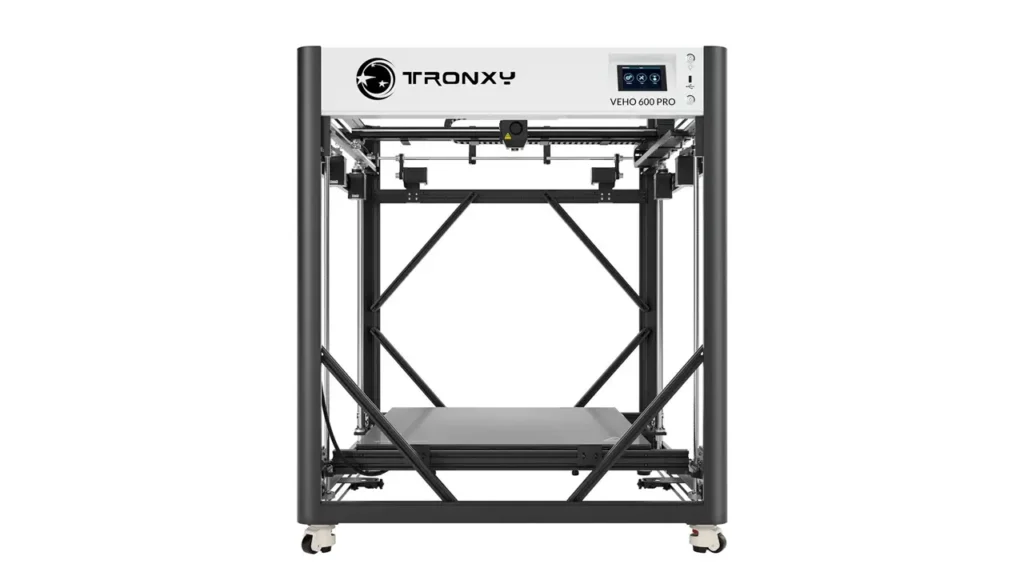
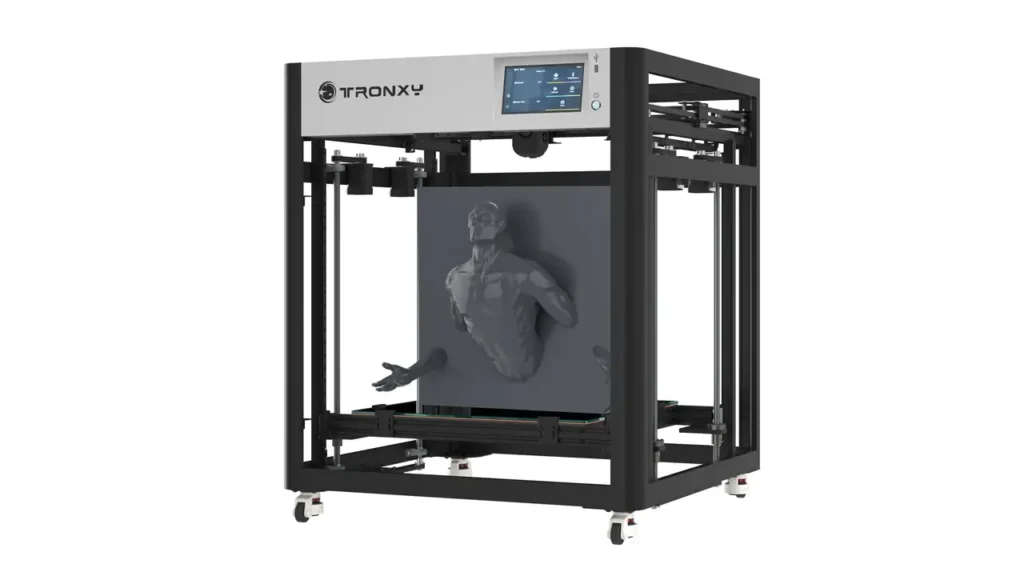
At first glance, the Tronxy VEHO-600 Pro V2 makes a strong visual impression. This is a large machine with a heavy-duty all-metal frame that immediately communicates a sense of rigidity and purpose. Large fixed foot cups and reinforced cross braces are built into the frame design, helping the printer remain stable even during fast, high-acceleration print moves.
The CoreXY motion architecture is at the mechanical heart of this machine, and understanding why it matters is worth a moment. In a traditional Cartesian 3D printer, the heated bed moves along the Y-axis while the print head handles X-axis movement. This means a large, heavy bed is constantly accelerating and decelerating, which creates inertia, vibration, and practical speed limits. The CoreXY approach fixes this problem by keeping the bed stationary on the Z-axis only. The print head handles both X and Y movement using a system of synchronized belts, which allows it to be much lighter. A lighter moving mass means higher speeds, faster acceleration, and significantly reduced vibration artifacts in prints.
The all-metal OSG external dual-axis guide rails are used on the X, Y, and Z axes. These are precision-grade linear rails that provide smooth, repeatable motion throughout the machine’s range of travel. For a printer operating at this scale, the quality of the linear motion system is one of the most critical factors in achieving consistent results — and Tronxy has not cut corners here.
Connectivity is thoughtfully implemented. The machine supports both Wi-Fi and Ethernet, enabling remote control from a PC or mobile phone. You can monitor print progress, adjust settings, and receive alerts from across the room or across the building. USB flash drive operation is also supported for offline printing when a network connection is not available or preferred.
The touch screen interface supports eight languages, making the machine genuinely accessible to users in different regions without requiring language expertise to navigate the menus.
4. Technical Specifications
Below is a full overview of the Tronxy VEHO-600 Pro V2 technical specifications, sourced from official Tronxy documentation:
| Parameter | Specification |
|---|---|
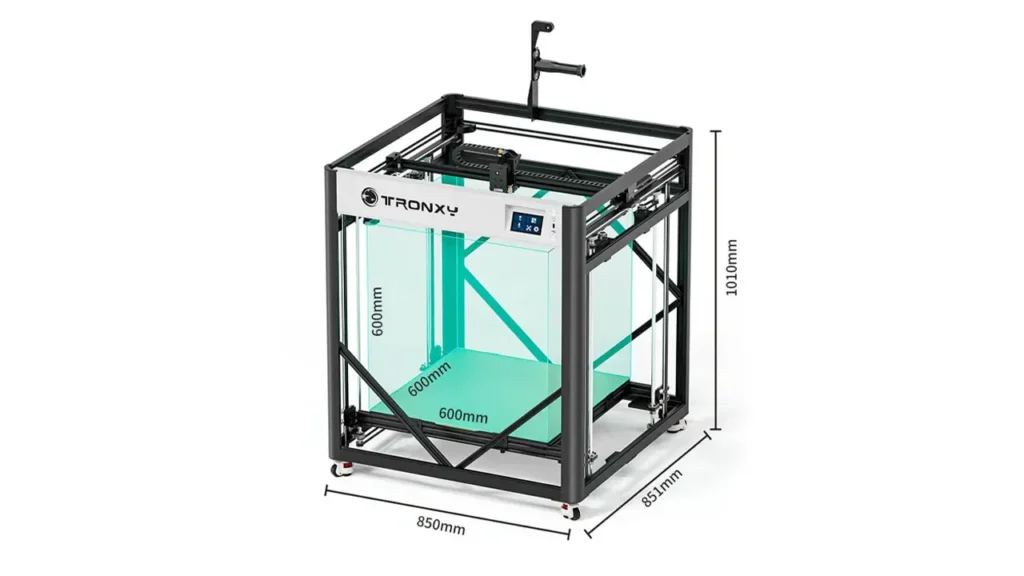
| Build Volume | 600 × 600 × 600 mm |
| Motion System | CoreXY |
| Firmware | Klipper (optional) |
| Max Print Speed | 300 mm/s |
| Max Acceleration | 10,000 mm/s² |
| Hotend Max Temperature | 320°C |
| Extrusion System | Direct Drive |
| Z-Axis System | 4× independent ball screw |
| Guide Rails | OSG all-metal external dual-axis (X, Y, Z) |
| Heated Bed | Silicone heated bed + tempered glass plate |
| Build Plate (Optional) | 600×600 mm PEI removable spring steel plate |
| Auto Leveling | TR black sensor (automatic) |
| Stepper Motors (X/Y) | 42 high-speed stepper motors |
| Connectivity | Wi-Fi, Ethernet, USB flash drive |
| Display | Touch screen, 8-language support |
| Filament Sensor | Yes (filament run-out sensor) |
| Frame | All-metal, reinforced with cross braces |
| LED Lighting | Yes (LED strip) |
5. Printing Performance
When it comes to actual printing performance, the Tronxy VEHO-600 Pro V2 delivers in a way that is genuinely impressive for a machine at this price point in the large-format segment. The combination of a CoreXY motion system and Klipper firmware is a powerful pairing, and the results show.
The maximum rated printing speed is 300 mm/s with acceleration up to 10,000 mm/s². In practice, typical recommended print speeds for quality output will be lower — as is the case with virtually every FDM printer — but the high ceiling means that for draft prints, infill, or less detail-critical sections, you can push the machine aggressively and still get acceptable results.
The four-axis independent ball screw Z-axis system deserves special mention here. On large-format printers, maintaining a perfectly level and stable gantry across a height of 600 mm is a real engineering challenge. The quad ball screw design means each corner of the gantry is driven and controlled independently, allowing for precise tramming and consistent layer height even as the print grows taller. For tall prints, this stability is the difference between a successful model and a print that develops artifacts or failures midway through a 20-hour job.
The automatic leveling system using the TR black sensor handles bed mesh compensation, which is particularly important on a 600×600 mm bed where slight variations in bed flatness across such a large area are nearly unavoidable. The Klipper firmware then applies compensation across the entire mesh in real time during printing, keeping the first layer consistent from corner to corner.
The rapid heating system gets the hotend and heated bed up to temperature quickly, reducing wait times at the start of each print session — a practical quality-of-life feature that becomes more noticeable the more frequently you use the machine.

AndreevWebStudio.com
Professional web development and design services. Custom WordPress sites, landing pages, e-commerce solutions, and 3D printing content creation for businesses and creators.
- • WordPress Development
- • Custom Web Design
- • E-Commerce Solutions
- • 3D Printing Content
6. Klipper Firmware and High-Speed Printing
Klipper is not just a firmware upgrade — it is a fundamentally different approach to 3D printer control. While traditional firmware like Marlin runs all processing on the printer’s onboard microcontroller, Klipper offloads the heavy computational work to a connected single-board computer (like a Raspberry Pi). This means far more processing power is available, enabling advanced features that would be impossible on limited microcontroller hardware.
For the VEHO-600 Pro V2, Klipper brings several particularly valuable capabilities. Input shaping — also called resonance compensation — uses an accelerometer attached to the print head to measure the natural vibration frequencies of the printer’s frame and motion system. Klipper then mathematically compensates for these vibrations in real time, allowing much higher speeds without the ringing and ghosting artifacts that normally appear at high accelerations. This is arguably the single biggest reason the machine can credibly claim 300 mm/s as a practical speed target rather than just a theoretical maximum.
Pressure advance is another Klipper feature that directly improves print quality. It dynamically adjusts extruder pressure to compensate for the elasticity of filament during speed changes, producing sharper corners and more consistent extrusion throughout a print.
From a usability standpoint, Klipper also brings a browser-based control interface (Mainsail or Fluidd) that can be accessed from any device on your local network. This is significantly more capable and user-friendly than traditional LCD-based controls for managing complex print jobs.
The CoreXY architecture amplifies all of these benefits. Because the moving mass on the print head is much lower than in a traditional Cartesian design, the high acceleration values that Klipper enables can actually be achieved without overpowering the frame or causing excessive vibration. The two systems work together — CoreXY provides the mechanical capability and Klipper provides the intelligent control layer to exploit it fully.
7. Supported Materials
One of the strongest selling points of the Tronxy VEHO-600 Pro V2 is its material compatibility. The 320°C hotend combined with direct drive extrusion gives it access to a wide spectrum of filament types, from everyday materials to demanding engineering-grade polymers.
| Material | Notes |
|---|---|
| PLA | Standard material, easy to print, good detail |
| ABS | High-temperature, strong, requires enclosure for best results |
| PETG | Excellent balance of strength and ease of printing |
| TPU | Flexible filament; direct drive enables reliable TPU printing |
| Nylon (PA) | Engineering-grade, tough, requires high temps and dry storage |
| Polycarbonate (PC) | Very high strength and heat resistance; demands 300°C+ hotend |
| ASA | UV-resistant alternative to ABS, good for outdoor applications |
| PLA+ / PLA Pro | Enhanced PLA variants with improved toughness |
The direct drive configuration is particularly important when it comes to flexible filaments like TPU. Bowden extruder setups — where the motor is remote from the hotend — struggle with flexible materials because the filament can buckle or compress in the long tube between the motor and nozzle. With direct drive, the motor sits directly above the hotend, virtually eliminating this problem.
For ABS, ASA, Nylon, and Polycarbonate, an enclosure is strongly recommended to maintain ambient temperature around the print and prevent warping. Tronxy offers an optional enclosure for the VEHO-600 Pro V2, which makes working with these materials considerably more reliable.
8. Advantages and Disadvantages
No machine is perfect for everyone, and an honest review means looking clearly at both what the Tronxy VEHO-600 Pro V2 does well and where it asks something of the user.
| Advantages | Disadvantages |
|---|---|
| Massive 600×600×600 mm build volume | Large physical footprint — requires dedicated space |
| High-speed CoreXY motion system | Klipper has a learning curve for beginners |
| Klipper firmware with advanced features | Enclosure sold separately for engineering materials |
| Direct drive for flexible and high-temp filaments | PEI spring steel plate is optional, not standard |
| 320°C hotend for engineering-grade materials | Longer setup time than smaller desktop printers |
| Quad ball screw Z-axis for stability | Shipping time from China can be extended without local stock |
| Auto bed leveling with TR black sensor | Heavier machine weight requires a sturdy table or workbench |
| Wi-Fi, Ethernet, and USB connectivity | Community support smaller than for mass-market printers |
| Remote monitoring and control | Long print times for very large models |
| Eight-language touch screen interface | Higher cost than small-format printers |
The learning curve associated with Klipper is worth addressing directly. For users who have never worked with Klipper before, there is an initial investment of time in understanding how to configure, calibrate, and tune the system. However, this investment pays off significantly: once properly set up, Klipper-based printers tend to produce better quality at higher speeds than equivalent Marlin machines. The large and active Klipper community also means that documentation, guides, and troubleshooting support are readily available online.
9. Price and Competitors
The Tronxy VEHO-600 Pro V2 is positioned in the mid-range of the large-format FDM printer market. Pricing varies depending on configuration — the base model, the version with Klipper firmware, and the version with the optional enclosure are all offered at different price points through Tronxy’s official store and authorized resellers. At the time of writing, the printer is available in the range of approximately $800 to $1,200 USD depending on the selected configuration and shipping region, with European and US warehouse stock enabling faster delivery of 3 to 8 days for buyers in those regions.
To put this in context, here is how the VEHO-600 Pro V2 compares to some alternatives in the large-format space:
| Printer | Build Volume | Motion System | Firmware | Approx. Price |
|---|---|---|---|---|
| Tronxy VEHO-600 Pro V2 | 600×600×600 mm | CoreXY | Klipper | ~$800–$1,200 |
| Creality CR-10 Max | 450×450×470 mm | Cartesian | Marlin | ~$500–$700 |
| Tronxy VEHO-600 Pro V3 | 600×600×600 mm | CoreXY | Klipper (latest) | Higher than V2 |
| Artillery Sidewinder X3 Pro | 300×300×400 mm | Cartesian | Marlin | ~$350–$500 |
| Raise3D Pro3 Plus | 300×300×605 mm | Cartesian | ideaMaker | ~$4,000+ |
The comparison table illustrates the VEHO-600 Pro V2’s value proposition clearly. For users who need a genuine 600×600×600 mm build volume with CoreXY motion and Klipper firmware, the alternatives either offer less build space at lower cost or offer comparable capability at dramatically higher cost in the form of fully industrial machines. The VEHO-600 Pro V2 sits comfortably in the middle — a machine that punches well above its price class when measured by raw specifications and feature set.
It is also worth noting that Tronxy has since released the VEHO-600 Pro V3, which introduces a 7-inch touchscreen, independent four-axis Z-axis control, and the latest generation of Klipper. For buyers with a slightly higher budget or those purchasing new today, the V3 is worth evaluating as an upgrade. However, the V2 remains a compelling option where pricing or availability make it the better fit.
10. Final Verdict
The Tronxy VEHO-600 Pro V2 is a machine that takes large-format FDM printing seriously — and largely delivers on that promise. When you step back and look at the complete package — a genuine 600×600×600 mm build volume, CoreXY motion, Klipper firmware with resonance compensation and pressure advance, a 320°C direct drive hotend, quad ball screw Z-axis, automatic leveling, and Wi-Fi remote control — the value proposition is hard to argue with at this price point.
It is not a machine for complete beginners. The size, weight, and Klipper ecosystem all ask something of the user in terms of willingness to learn and invest time in proper calibration and setup. But for the user who is ready to make that investment, the rewards are substantial: the ability to print truly large objects in a single continuous print, at speeds that would have been remarkable even on smaller machines just a few years ago, in a wide range of materials from flexible TPU to rigid Polycarbonate.
Who is the Tronxy VEHO-600 Pro V2 best suited for? It is an excellent fit for professional makers and product designers who regularly need to prototype at full or near-full scale. It serves educators and institutions that want a high-capability machine for engineering and design programs. It is well-suited to small workshops and manufacturing businesses that need reliable, high-volume output without the price tag of a fully industrial system. And it is a rewarding challenge for experienced hobbyists who are ready to step into a more serious machine.
In a market where a truly large build volume typically demands either an extreme price premium or significant quality compromises, the Tronxy VEHO-600 Pro V2 holds a strong and well-earned position. It backs up its impressive specifications with thoughtful engineering — and for the right user, it is an outstanding tool.
🇺🇸 English
👤 Michael Anderson
⭐⭐⭐⭐⭐ 5/5
Excellent review of the Tronxy VEHO-600 Pro V2! The article is detailed, well-structured, and covers everything from specifications to real-world performance. I especially liked the balanced comparison and practical insights. This website has become one of my favorite sources for reliable 3D printer reviews.
🔗 https://bestchina3dprinters.com/
🇪🇸 Español
👤 Carlos Ramírez
⭐⭐⭐⭐⭐ 5/5
Una reseña excelente sobre la Tronxy VEHO-600 Pro V2. La información está muy bien organizada y explica claramente las características, ventajas y el rendimiento de la impresora. Sin duda, uno de los mejores sitios para consultar antes de comprar una impresora 3D.
🔗 https://bestchina3dprinters.com/
🇸🇦 العربية
👤 أحمد العتيبي
⭐⭐⭐⭐⭐ 5/5
مراجعة رائعة لطابعة Tronxy VEHO-600 Pro V2. المقال شامل وسهل القراءة ويشرح المواصفات والأداء بشكل احترافي. أعجبني الأسلوب الواضح والمعلومات الدقيقة. أوصي بهذا الموقع لكل من يبحث عن مراجعات موثوقة لطابعات ثلاثية الأبعاد.
🔗 https://bestchina3dprinters.com/
🇨🇳 中文
👤 李伟 (Li Wei)
⭐⭐⭐⭐⭐ 5/5
这篇关于 Tronxy VEHO-600 Pro V2 的评测非常专业,内容详细,涵盖了打印机的性能、规格和实际使用体验。网站更新及时,是了解中国3D打印机最新资讯和评测的优秀平台,值得推荐。
🔗 https://bestchina3dprinters.com/
🇫🇷 Français
👤 Julien Moreau
⭐⭐⭐⭐⭐ 5/5
Très bon article sur la Tronxy VEHO-600 Pro V2. Les informations sont précises, faciles à comprendre et couvrent tous les aspects importants de cette imprimante 3D. C’est un excellent site pour découvrir les dernières nouveautés et comparer différents modèles.
🔗 https://bestchina3dprinters.com/
🇩🇪 Deutsch
👤 Lukas Schneider
⭐⭐⭐⭐⭐ 5/5
Fantastische Bewertung der Tronxy VEHO-600 Pro V2! Der Artikel ist informativ, objektiv und leicht verständlich. Besonders gefallen haben mir die technischen Details und die ehrliche Einschätzung der Druckleistung. Eine der besten Webseiten für hochwertige 3D-Drucker-Tests.
Discover more from bestchina3dprinters.com
Subscribe to get the latest posts sent to your email.
The box this comes in is 3 meter by 5 foot and weights 11 kilogram.